Are you concerned that your home may have a problem with asbestos? Asbestos is a mineral that is highly heat-resistant and makes a great electrical insulator, which is why it was used in homes for many years. Unfortunately, over time we learned that asbestos is also harmful, and if it is inhaled, it can lead to serious conditions, including cancer. If you have a home that was built before the 1980s and has not been renovated, then there is a chance that asbestos exists. If you do have existing asbestos, it should be a top priority to have it removed.
When it comes to asbestos removal, there are precautions that must be taken in order to do the job safely. It is important that you find a team of professionals who are licensed and trained for asbestos removal. Our team at Remtech Environmental has been providing professional asbestos removal for homes and commercial properties in Chapel Hill, North Carolina and surrounding areas for over 20 years. We fully equipped and prepared to do the job correctly and quickly, so that you can get back to your daily life with peace of mind.
When you call us for asbestos removal, we will come quickly to fully assess the situation. We will then create a plan for ridding your home of the harmful substance. We know you will be more than satisfied with our quick responsiveness, open and friendly communication, and high-quality work. We want to make sure you feel completely informed and assisted rather than worried during your asbestos removal process, so don’t hesitate to ask questions or discuss your concerns. To learn more about how we can help you, call us today.
At Remtech Environmental, we offer a range of services to help handle asbestos present in buildings throughout Raleigh, Durham, Cary, Asheville, Morrisville, Wake Forest, Wendell, Winston-Salem, Apex, Chapel Hill, and Greensboro, North Carolina.
Before we perform asbestos abatement, we begin by taking samples from the building for assessment. Read More →
An asbestos inspection can protect your health and offer peace of mind. Read More →
Every Chapel Hill project follows a documented five-step protocol designed around EPA NESHAP standards and North Carolina's asbestos hazard management rules.
Chapel Hill homes near the UNC campus, particularly the brick ranches in Westwood and Glen Lennox or the faculty cottages in Coker Hills, frequently contain asbestos in popcorn ceilings, vinyl floor mastic, and pipe lagging. Our NC-accredited asbestos building inspector performs a structured walkthrough, sampling suspect materials in friable and non-friable categories. Each bulk sample is logged, double-bagged, and shipped overnight to our NVLAP-accredited laboratory partner for Polarized Light Microscopy (PLM) analysis under EPA Method 600/R-93/116. Standard turnaround is 24 to 72 hours, with same-day rush available for time-pressured UNC rental turnovers. The written inspection report identifies friability, percentage by volume, and abatement priority so homeowners and Carrboro property managers receive defensible documentation before scheduling work.
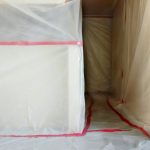
Containment in older Chapel Hill cottages, especially the tight floor plans in Pine Knolls and Northside, demands careful planning around narrow corridors and original plaster walls. We construct a fully sealed work area using two layers of 6-mil polyethylene sheeting on walls and floors, supplemented by critical barriers at every doorway and window. HEPA-filtered negative-air machines are sized for the room volume to maintain a minimum of -0.02 inches water column differential, drawing contaminated air through 99.97 percent filters. HVAC supply and return registers are sealed and the system is shut down for the duration of the project. Decontamination chambers with three stages, dirty room, shower, and clean room, are installed at each entry point.
Chapel Hill housing built between the 1940s and late 1970s, including the early Greenwood developments and Gimghoul Neighborhood revivals, commonly conceals asbestos in 9x9 floor tile, black mastic adhesive, transite siding, and chrysotile pipe wrap. Each abatement worker enters containment in disposable Tyvek coveralls, P100 full-face respirators, and nitrile gloves taped to suit cuffs. We apply amended water through airless sprayers to fully wet materials before disturbance, then remove components intact wherever possible to minimize fiber release. Popcorn ceilings are scraped wet, vinyl tile is heat-released and lifted in sections, and pipe insulation is glove-bagged. All waste is double-bagged in 6-mil printed asbestos bags, labeled with generator information, and staged inside the regulated zone.
Final clearance in Chapel Hill projects is performed by an independent third-party industrial hygienist with no financial relationship to our crew, ensuring an arms-length result that satisfies both UNC institutional buyers and private homeowners. We use Phase Contrast Microscopy (PCM) per NIOSH 7400 for routine residential clearance and upgrade to Transmission Electron Microscopy (TEM) per AHERA protocol when schools, daycare centers, or properties near Chapel Hill-Carrboro City Schools are involved. The standard residential clearance threshold is 0.01 fibers per cubic centimeter, with five aggressive air samples collected after the area is dried and visually clean. Containment may not be removed until written passing results are received, protecting reoccupants from any residual airborne fibers.
All friable and non-friable asbestos waste leaves Chapel Hill in a placarded, manifested transport vehicle bound for an NC-permitted Subtitle D landfill, typically the Orange County Landfill on Eubanks Road or a regional cell certified for Category I asbestos. We maintain a chain-of-custody manifest signed by the generator, transporter, and disposal facility, with the signed copy returned to the homeowner for their permanent file. NC DHHS Asbestos Hazard Management Program receives the required 10-working-day notification under 15A NCAC 19C, and Orange County Environmental Health is copied where local jurisdictional rules apply. The completed project file includes the inspection report, lab analyses, daily logs, air clearance results, manifests, and final closure letter.
Chapel Hill's housing stock reflects the post-war expansion of the University of North Carolina, with a dense band of single-family homes constructed between 1945 and 1978 that fall squarely inside the asbestos-use window. Faculty subdivisions like Westwood, Glen Lennox, and Coker Hills were built when chrysotile asbestos was standard in vinyl flooring, ceiling textures, joint compound, and HVAC duct insulation. The historic Franklin Street commercial corridor and adjacent Northside and Pine Knolls neighborhoods include even older structures, many with original transite siding, 9x9 floor tile, and pipe lagging. Greenwood, Gimghoul, and the early ranches above Estes Drive also commonly retain popcorn ceilings applied through the late 1970s. Carrboro's Lloyd-Broad and Old East Chapel Hill homes share the same vintage and often the same materials. North Carolina regulates asbestos abatement under 15A NCAC 19C, administered by the NC DHHS Asbestos Hazard Management Program, with federal overlay from EPA NESHAP (40 CFR 61 Subpart M) and OSHA 29 CFR 1926.1101. In Orange County, demolition and renovation notifications route through both NC DHHS and Orange County Environmental Health, and any disturbance of regulated asbestos-containing material above the threshold quantity triggers mandatory licensed abatement before work proceeds.
Most Chapel Hill residential abatement projects fall between 1,800 dollars for a small popcorn ceiling in a Glen Lennox condo and 9,500 dollars for a full basement pipe-insulation removal in a Coker Hills mid-century. A 1,200-square-foot popcorn ceiling scrape with full containment typically runs 2,800 to 4,200 dollars. Vinyl floor and mastic removal in a Westwood kitchen averages 6 to 10 dollars per square foot. Larger projects, such as transite siding removal on a Northside bungalow, can reach 12,000 to 18,000 dollars depending on linear footage. Every estimate includes lab analysis, NC DHHS notification fees, NVLAP-accredited testing, third-party clearance, and Subtitle D disposal at an Orange County permitted facility.
Yes, occupants must vacate the regulated work area for the duration of containment, clearance air sampling, and final teardown. For a single-room popcorn ceiling abatement in a Greenwood ranch, you can usually remain in unaffected portions of the home if a hard barrier and negative-air separation can be maintained. For whole-house projects in Westwood or basement work in Coker Hills where HVAC must be shut down, plan on relocating for two to four days. UNC graduate-student rentals and Carrboro duplexes are typically vacated entirely between leases, which is the cleanest scheduling window. We coordinate with property managers along Franklin Street and provide written reoccupancy clearance before residents return.
Asbestos abatement in North Carolina is regulated under 15A NCAC 19C and administered by the NC DHHS Asbestos Hazard Management Program, which licenses inspectors, supervisors, workers, and management planners. Federal regulations from EPA NESHAP (40 CFR 61 Subpart M) govern notification, work practices, and disposal, while OSHA 29 CFR 1926.1101 sets worker exposure limits and engineering controls. In Chapel Hill, projects also intersect with Orange County Environmental Health for solid waste handling and with the Town of Chapel Hill Inspections Department for related building permits. Demolition and renovation projects above the regulatory threshold require a 10-working-day advance notification, and only NC-licensed abatement contractors may perform the work. Penalties for non-compliance can exceed 25,000 dollars per day per violation.
Project duration in Chapel Hill depends on material type, square footage, and clearance scheduling. A single-room popcorn ceiling in a Glen Lennox condo is typically a one-day scrape with clearance results back the following morning, two days total. A full-house popcorn removal in a 2,200-square-foot Westwood ranch runs three to five days including setup, removal, encapsulation, clearance air sampling, and teardown. Pipe insulation in a Coker Hills crawlspace usually takes two to three days. Transite siding removal on a Northside bungalow can stretch to a full week if weather delays containment. Add 24 to 72 hours upfront for the pre-abatement inspection and bulk sample analysis, and the mandatory 10-day NC DHHS notification window before work can legally begin.
Removal is one type of abatement, the physical extraction and disposal of asbestos-containing material. Abatement is the broader regulatory term covering any action that controls the asbestos hazard, including encapsulation (sealing fibers in place with a bonded coating), enclosure (constructing an airtight barrier around the material), and operations and maintenance programs. In a 1955 Coker Hills home with intact pipe lagging in a dry, low-traffic basement, encapsulation can be the right call, costing 40 to 60 percent less than full removal while still meeting NC DHHS work-practice standards. By contrast, friable popcorn ceiling in a Pine Knolls rental being renovated for new tenants almost always warrants removal so future trades can work freely without re-disturbing fibers.
Remtech serves Chapel Hill and surrounding Orange County communities, including Westwood, Glen Lennox, Coker Hills, Greenwood, Gimghoul, Northside, Pine Knolls, Lake Forest, Oaks, Briarcliff, and the Franklin Street historic district. We extend coverage into Carrboro for Lloyd-Broad, Old East, Carrboro Plaza, and the Highway 54 corridor, plus Hillsborough, Efland, Calvander, and the unincorporated stretches along Old NC 86. UNC student rentals, faculty homes, and historic downtown commercial buildings each carry their own abatement considerations, and our crews are familiar with local parking constraints, leaf-collection schedules, and the narrow alleys typical of older Chapel Hill blocks.
Contact us today to schedule an inspection or receive a free quote for our services.
Get a Free QuoteReady to get started? Fill out the form below and we'll get back to you right away.
We believe that a job done right is the only way to sleep well at night.
Contact Us Today