
Almost everyone has heard of asbestos and knows that it can cause health issues, but you may not really understand what it is, when it was primarily used or what materials may contain it. Asbestos is a naturally occurring mineral that has been used in thousands of different materials, including many building materials. The use of asbestos was drastically reduced in the 1980s, so most modern building materials and buildings rarely contain asbestos. If your home or business was built before 1985, it is more likely that it may contain materials with asbestos.
Here are some of the building materials that were produced with asbestos fiber content:
Asbestos is generally not harmful unless it is disturbed, but these materials can degrade and deteriorate over time, making it more likely that they can release airborne fibers that can cause cancerous diseases when inhaled. Exposure to these fibers can lead to symptoms decades later. You can’t see or smell asbestos, so if you aren’t sure if your home or business contains asbestos (especially if it was built before 1980), it is a good idea to get it evaluated.
Here at Remtech Environment, we can take samples of various materials in your building and have them evaluated for asbestos. If asbestos is present, we can help with the safe removal and disposal of the problem material. Once the removal is complete, we will complete secondary testing to make sure all asbestos is gone. We have been helping property owners with asbestos in the Asheville, North Carolina area for over 20 years. Give us a call today.
At Remtech Environmental, we offer a range of services to help handle asbestos present in buildings throughout Raleigh, Durham, Cary, Asheville, Morrisville, Wake Forest, Wendell, Winston-Salem, Apex, Chapel Hill, and Greensboro, North Carolina.
Before we perform asbestos abatement, we begin by taking samples from the building for assessment. Read More →
Professional Asbestos Removal Remtech has been licensed asbestos removal specialists for over 20 years, helping homeowners and commercial property owners in Asheville and all across North Carolina Read More →
Our technicians take all necessary safety precautions when performing asbestos popcorn ceiling removal to protect your home. Read More →
Every Asheville project follows a documented five-step protocol designed around EPA NESHAP standards and North Carolina's asbestos hazard management rules.
Asheville's housing stock skews older than most of North Carolina, with Biltmore-era construction in Montford, Grove Park, and Albemarle Park dating to the 1890s through the 1920s, when asbestos saturated nearly every building product. Our NC-accredited asbestos building inspector pays particular attention to attics where Zonolite vermiculite from the Libby, Montana mine is widely present, plaster keys, transite siding, and boiler rooms. Bulk samples are double-bagged, logged, and sent under chain-of-custody to an NVLAP-accredited laboratory for Polarized Light Microscopy under EPA 600/R-93/116. Standard turnaround is 24 to 72 hours, with rush turnaround prioritized for Hurricane Helene-related insurance claims. Reports identify friability, percentage by volume, and abatement priority for Buncombe County Environmental Health permitting.
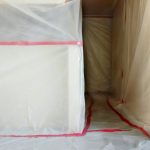
Containment in Asheville's mountain microclimate must account for elevation-driven air pressure swings and the steeply sloped lots common in Kenilworth and Chestnut Hill. Crews install two layers of 6-mil polyethylene on floors and one on walls, sealing every penetration with spray adhesive and abatement-grade tape. HEPA negative-air machines are sized to deliver four to six air changes per hour and maintain negative pressure verified by a continuously logged manometer. HVAC systems are shut down and registers are sealed before work begins. A three-chamber decontamination unit, dirty room, shower, clean room, is constructed at the entry point. For vermiculite attic abatement, supplemental rigid sheeting is added to prevent fiber migration along ceiling joists.
Asheville materials reflect the city's age and its post-Helene reconstruction wave. Montford and Grove Park homes routinely contain plaster with chrysotile, transite siding, original 9x9 floor tile, and boiler-room pipe lagging. Vermiculite attic insulation contaminated with tremolite and actinolite from the Libby mine is found in roughly one in three pre-1990 attics across Buncombe County. Workers wear full-face P100 respirators, Tyvek coveralls, and nitrile gloves taped to suit cuffs. Amended water is applied through airless sprayers before any disturbance. Vermiculite is removed with HEPA-filtered industrial vacuums and never mechanically agitated. Pipe lagging is glove-bagged, popcorn ceilings are scraped wet, and floor tile is lifted in sections. All waste is double-bagged, labeled, and staged inside the regulated work zone.
Asheville clearance is performed by an independent third-party industrial hygienist with no financial relationship to our abatement crew, a separation routinely required by Buncombe County, Asheville City Schools, and Helene-related insurance adjusters. Phase Contrast Microscopy per NIOSH 7400 covers most residential clearance, while Transmission Electron Microscopy under AHERA is required for schools, daycare centers, vermiculite projects with potential Libby amphibole content, and any property where TEM is specified by the insurer. The clearance threshold is 0.01 fibers per cubic centimeter, established through aggressive air sampling with leaf blowers and floor fans agitating settled particulates before five samples are pulled. Containment cannot be torn down until written passing clearance is issued by the third-party hygienist.
Asheville-area asbestos waste travels in a placarded transport vehicle to an NC-permitted Subtitle D landfill, typically the Buncombe County Landfill on Panther Branch Road or a regional Republic Services facility certified for Category I asbestos. Each load is accompanied by a chain-of-custody waste manifest signed by generator, transporter, and disposal facility, with the signed return copy filed in the project record. NC DHHS Asbestos Hazard Management Program receives the 10-working-day pre-job notification under 15A NCAC 19C, and Buncombe County Environmental Health is copied for local review, especially for Helene-flagged demolition permits. The final project file delivered to the homeowner includes the inspection report, lab analyses, daily logs, air clearance results, manifests, and a written closure letter.
Asheville's asbestos profile is unusually heavy because of its construction era and a single dominant insulation product. Montford Historic District, Grove Park, Albemarle Park, Norwood Park, and Chestnut Hill were largely built between 1890 and 1925, during the Biltmore Estate boom that drew master craftsmen and wealthy industrialists to the mountains. These homes were built when asbestos was standard in plaster keys, pipe lagging, boiler jackets, transite siding, and decorative ceiling textures. Kenilworth's 1920s development and the West Asheville bungalow belt extend the asbestos-use window through the 1970s, with vinyl asbestos tile, mastic, and popcorn ceilings layered on during mid-century remodels. Compounding the problem, vermiculite attic insulation from the Libby, Montana mine, sold under the Zonolite brand, was heavily distributed across western North Carolina and is contaminated with tremolite and actinolite asbestos. After Hurricane Helene's catastrophic September 2024 flooding and wind damage, thousands of Asheville and Buncombe County homes are now in active demolition, gut-rehab, or partial-rebuild status, dramatically increasing the volume of disturbed asbestos-containing material in attics, basements, and crawlspaces. North Carolina regulates abatement under 15A NCAC 19C, administered by NC DHHS Asbestos Hazard Management Program, with EPA NESHAP and OSHA federal overlay. Buncombe County Environmental Health coordinates local notifications, and Helene-related demolition permits are reviewed individually for asbestos compliance before issuance.
Asheville residential abatement typically runs 1,800 dollars for a single Kenilworth bedroom popcorn ceiling and climbs to 25,000 dollars or more for full vermiculite attic removal in a Montford Victorian. A 1,500-square-foot popcorn scrape in a West Asheville bungalow averages 3,200 to 4,800 dollars. Vermiculite removal with confirmed Libby amphibole content runs 8 to 14 dollars per square foot of attic floor, often totaling 12,000 to 20,000 dollars for a typical Grove Park home. Helene-related demolition projects requiring asbestos abatement before salvage commonly fall between 6,000 and 18,000 dollars. Every estimate includes the inspection, NVLAP-accredited PLM and TEM analysis, NC DHHS notification, third-party clearance, and Subtitle D disposal at a Buncombe County permitted facility.
Yes, occupants must vacate the regulated work area until written third-party clearance is issued. A single-room popcorn abatement in a Chestnut Hill cottage may allow the family to remain in unaffected rooms if a hard critical barrier and independent HVAC zone are maintained. Vermiculite attic projects, by contrast, almost always require full-home vacation for three to five days because of the risk of fiber migration through ceiling penetrations. Helene-displaced homeowners often coordinate abatement with their existing temporary housing, allowing the project to run while permanent rebuild work is staged. Montford and Grove Park whole-house projects routinely require a full week off-site. We provide the written reoccupancy clearance letter before any return is permitted.
North Carolina regulates asbestos abatement under 15A NCAC 19C, administered by the NC DHHS Asbestos Hazard Management Program, which licenses inspectors, supervisors, workers, and project designers. EPA NESHAP (40 CFR 61 Subpart M) governs federal notification, work practices, and disposal, while OSHA 29 CFR 1926.1101 sets worker exposure limits and required engineering controls. In Asheville, Buncombe County Environmental Health coordinates local enforcement and reviews demolition permits, a process that has intensified since Hurricane Helene in September 2024 because of the spike in damaged-property demolition. The Asheville Historic Resources Commission also reviews exterior abatement in designated districts. Notification is required 10 working days before regulated work begins, and civil penalties for non-compliance can exceed 25,000 dollars per day per violation.
Asheville project duration depends heavily on material type. A single-room popcorn ceiling in a Kenilworth ranch is a one-day scrape with overnight clearance, two days total. A whole-house popcorn project in a 2,000-square-foot West Asheville bungalow averages four to six days. Vermiculite attic abatement in a 1910 Montford Victorian typically runs four to seven days because of careful HEPA vacuum work and the slow pace of TEM clearance. Helene-related demolition prep abatement in a flood-damaged Swannanoa or River Arts District home can run a full week or longer when crews must navigate structural instability. Add 24 to 72 hours for inspection and lab analysis, plus the 10 working-day NC DHHS notification window before regulated work can begin.
Abatement is the broader regulatory category, and removal is one type of abatement alongside encapsulation, enclosure, and operations and maintenance programs. In a 1908 Montford home where pipe lagging in a dry, low-traffic basement is intact and undamaged, encapsulation with a bonded coating can satisfy NC DHHS work-practice standards while costing 40 to 60 percent less than removal. By contrast, vermiculite attic insulation contaminated with Libby amphibole asbestos almost always warrants full removal because the loose-fill product cannot be reliably encapsulated and remains a long-term hazard whenever the attic is entered for HVAC, electrical, or roofing work. Helene-damaged homes undergoing gut renovation similarly require removal because every wall, ceiling, and floor will be disturbed during reconstruction.
Remtech serves Asheville and surrounding Buncombe County communities, including Montford, Grove Park, Albemarle Park, Norwood Park, Chestnut Hill, Kenilworth, Biltmore Forest, Biltmore Village, West Asheville, Haw Creek, Oakley, Beverly Hills, and the River Arts District. Coverage extends through Black Mountain, Swannanoa, Weaverville, Woodfin, Candler, Arden, Fletcher, Mills River, and Fairview, all communities heavily affected by Hurricane Helene flooding and wind damage. We work with Asheville-area insurance restoration contractors, Helene rebuild project managers, Buncombe County Schools facility teams, and historic-district homeowners requiring careful coordination with the Historic Resources Commission for any exterior abatement work.
Contact us today to schedule an inspection or receive a free quote for our services.
Get a Free QuoteReady to get started? Fill out the form below and we'll get back to you right away.
We believe that a job done right is the only way to sleep well at night.
Contact Us Today