
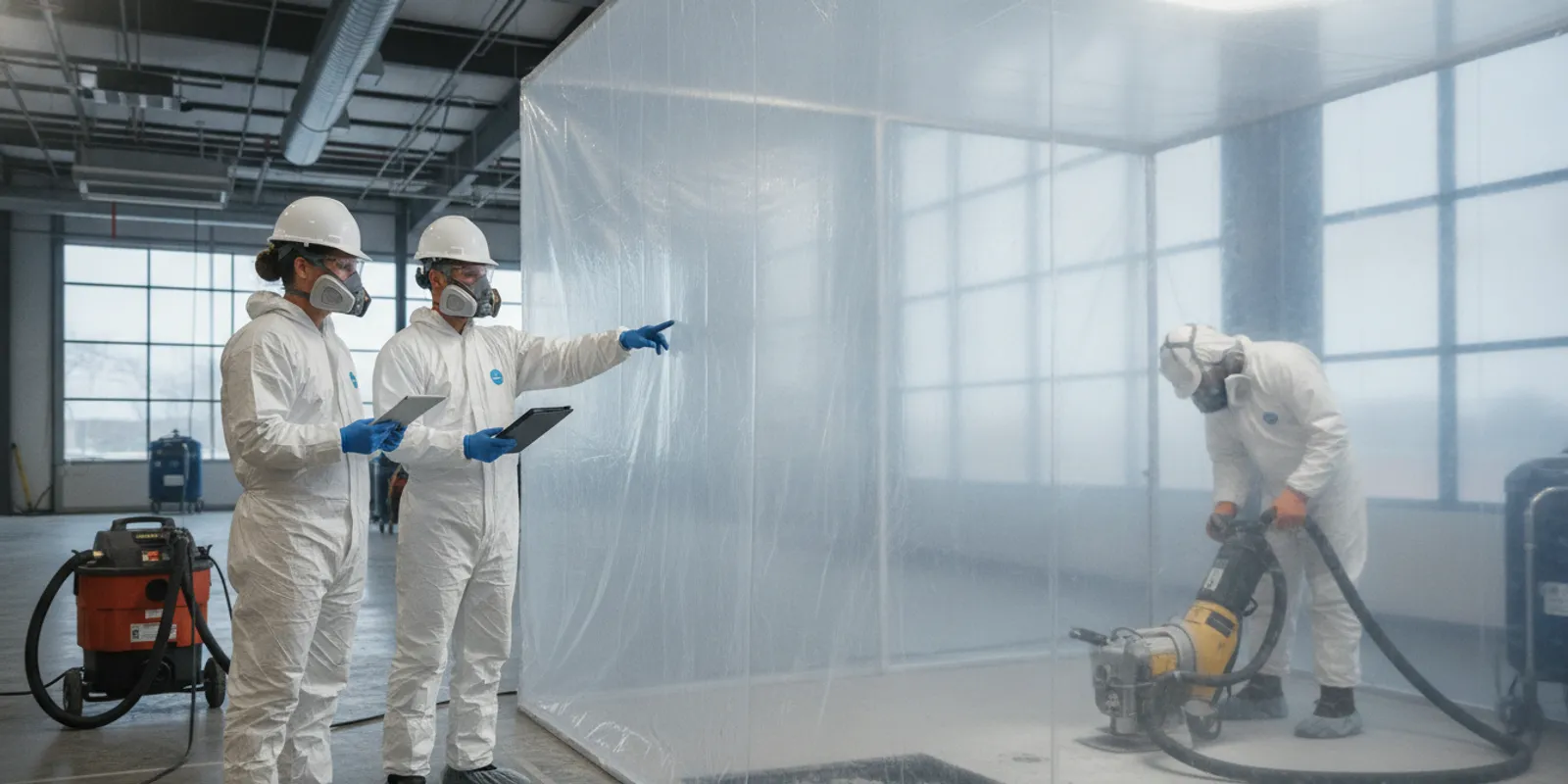
If you own or manage an older North Carolina property and renovation, repair, or demolition may disturb suspect material, an asbestos abatement checklist can keep the project from starting with missing information. The checklist is not a substitute for an asbestos inspection, testing, or project-specific regulatory advice. It is a way to organize the decisions and documents you should review before work begins.
First: pause before disturbing a suspect material
Do not cut, scrape, sand, drill, remove, sweep, or otherwise disturb a material simply because it looks old or because a renovation schedule is tight. Asbestos cannot be confirmed by appearance alone. If a material may contain asbestos, limit access to the area, keep occupants away from visible debris, and ask a qualified professional what should happen next. Avoid sweeping or using a household vacuum on suspected debris.
Common locations can include resilient floor tile and mastic, pipe or duct insulation, textured ceilings, siding, roofing products, cement board, and other building materials. A material’s age or location can help a professional plan an assessment, but neither proves that asbestos is present. A sample should be collected and evaluated through an appropriate professional process before a property owner makes a disturbance decision.
Remtech’s Raleigh asbestos inspection guidance explains why inspection and testing are useful starting points. If you are outside Raleigh, the same first principle applies: document the concern and arrange an assessment that matches the property and planned work.
North Carolina asbestos abatement checklist at a glance
Use this table as a planning aid. The person responsible for a property should confirm the details with the qualified professionals and agencies that apply to the specific project, building type, location, and scope of work.
| Checklist area | What to confirm | Evidence to keep |
|---|---|---|
| Project scope | Which rooms, materials, surfaces, and planned activities could be affected? | Marked plans, photographs, repair or renovation scope |
| Inspection and testing | Has the suspect material been assessed, sampled where appropriate, and documented? | Inspection report, laboratory results, sampling locations |
| North Carolina requirements | Does the work require notification, a permit, an accredited professional, or coordination with another authority? | Current agency guidance, submitted forms, approvals or correspondence |
| Contractor qualifications | Can the people performing the work show the credentials and training applicable to the project? | Accreditation information, insurance documents, written proposal |
| Work plan and controls | Does the written plan explain containment, worker protection, occupied-space controls, and cleanup? | Work plan, schedule, site-control plan |
| Waste and closeout | How will asbestos waste be packaged, transported, disposed of, and documented? What confirms the area is ready for reoccupancy? | Waste records, clearance documentation, final project file |
1. Define what work is actually planned
Start by writing down the work that may affect the material. “Update the bathroom” or “remove the old flooring” is not enough for a useful abatement review. Note whether the project includes demolition, selective removal, flooring replacement, plumbing or electrical access, HVAC work, ceiling work, window replacement, roof work, or repairs after a leak or impact. Include adjacent rooms, shared walls, crawlspaces, attics, mechanical areas, and exterior surfaces when they could be affected.
For a commercial building, add tenant-improvement drawings, maintenance activities, planned shutdowns, and the location of occupied areas. For a rental or multifamily property, identify each unit, common area, and building system in the scope. This prevents a report for one visible material from being treated as a blanket clearance for every part of a building.
A clear scope also helps a professional determine whether the appropriate starting point is an inspection, a renovation survey, a demolition survey, or another form of project assessment. Remtech’s guide to asbestos building surveys versus inspections can help owners understand why those terms should not be treated as interchangeable.
2. Locate and document suspect materials without disturbing them
Make a room-by-room record using photographs taken from a safe distance, a simple floor plan, and notes about the material’s condition. Record where the material is intact, damaged, water-stained, crumbling, concealed, or already covered by another finish. Note whether anyone may have disturbed it and whether debris is present. Do not remove a piece to photograph the cross-section.
Keep the record factual. “Old white ceiling texture” is more useful than “definitely asbestos.” Describing a material as asbestos-containing before it has been evaluated can mislead workers and future owners. Conversely, calling it safe because it looks intact can create an unsafe assumption. The purpose of this step is to preserve information for the professional who will assess the work.
If the concern is in an occupied home, keep children, pets, tenants, and visitors out of the area while you arrange the next step. If visible debris has spread, describe what happened when you request help. Do not attempt to clean suspected asbestos debris with ordinary household equipment.
3. Arrange the right inspection and testing
Ask the professional to explain what the assessment covers, where samples will be taken, how many materials are in scope, and what the results will and will not establish. Sampling should represent the materials that the planned work could disturb, rather than simply testing the easiest or most visible spot. The report should connect sample locations to the building and project scope.
When reviewing results, look for the material description, location, sample identification, laboratory information, and the conclusion relevant to the proposed work. If the report covers only one room or one homogeneous material, do not assume it answers questions about a different floor, wall, pipe, ceiling, or outbuilding. Ask what additional evaluation is needed if the renovation scope changes.
Remtech’s pages on asbestos testing and when to call for professional asbestos testing provide related context. The practical checklist question is: does the documented assessment address the material and activity that will actually occur?
4. Confirm the North Carolina notification and permit pathway
North Carolina requirements can depend on the project type, the amount and condition of regulated material, the building, the planned activity, and the location. Before scheduling work, ask which current state or local requirements apply, who is responsible for each submission, and how much lead time is needed. A local building or demolition permit is not automatically the same thing as an asbestos notification or asbestos removal permit.
The state’s North Carolina demolition and renovation requirements document is a useful starting reference, but it identifies itself as an overview. Use the current Health Hazards Control Unit instructions and applicable local agency guidance for the project rather than relying on a blog summary or an old form. Ask the contractor to identify the agency, form, submission date, and project fact that supports the proposed pathway.
For federal context, the EPA overview of the Asbestos NESHAP explains federal demolition and renovation requirements. The EPA asbestos laws and regulations page is another authoritative reference. These sources do not eliminate the need to confirm North Carolina and local requirements for the property.
Keep copies of submitted notifications, approvals, revisions, and correspondence. If the project changes after a form is submitted, stop and ask whether the change requires an amendment or a new submission. Do not assume the original paperwork follows a different scope, address, contractor, start date, or material quantity.
5. Choose professionals for the actual scope
Compare qualifications against the work you need, not just against a company name or a low quote. Ask who will inspect or sample, who will supervise the abatement, who will perform the work, and who will handle waste. Confirm that the credentials and training are appropriate for the role and current for the project. For a commercial or public-facing property, ask how the team will coordinate with the building representative and occupants.
Request documentation that helps you evaluate the proposal, such as applicable North Carolina accreditation information, insurance documentation, references for similar work, and a written scope. A property owner should also ask whether the proposal includes mobilization, containment, air monitoring when appropriate, cleanup, disposal, and closeout or whether those items are excluded.
Remtech’s guide to reviewing a residential asbestos abatement quote covers questions that can make proposals easier to compare. Its North Carolina asbestos contractor insurance guide offers additional questions for reviewing coverage. A checklist cannot turn an incomplete proposal into a safe plan, so ask for a revised scope before authorizing work.
Get a Free Consultation About Your Property
6. Review the written abatement work plan
A work plan should translate the assessment into site-specific actions. Look for the work area, materials and quantities in scope, sequence, containment approach, worker-protection measures, access restrictions, equipment, cleaning method, waste handling, and the person responsible for each major step. The plan should explain how the team will respond if an unexpected material or hidden condition is found.
For an occupied property, the plan should address who can enter the work area and how occupants will be notified. It should also explain how shared systems and pathways will be managed. Ask how the team will prevent contamination from moving beyond the controlled area. A schedule alone is not a containment plan. Ask where workers will change or clean equipment, how tools and waste will leave the area, and what happens if the work takes longer than expected.
Read Remtech’s asbestos abatement work plan guide alongside the proposal, but keep the project-specific plan as the controlling document for the job. If the documents conflict, resolve the conflict in writing before work begins.
7. Plan communication and site controls
Choose one property representative to coordinate questions, access, schedule changes, and records. Give occupants and workers a clear description of the restricted area without making unsupported promises about safety or timing. For a rental or commercial property, document notices and the planned alternative routes, work hours, utility interruptions, and return-to-space process.
Ask how the contractor will separate the work zone from occupied areas and how they will control doors, windows, ventilation, negative-air equipment, debris movement, and housekeeping. The correct controls vary with the material, location, and work method, so a generic promise that “the area will be sealed” is not enough. The work plan should explain the controls in terms a property representative can monitor.
Keep the project boundary clear. If workers discover a material outside the assessed area, pause that portion of the work and have the scope reassessed. Do not let a change order silently expand the work without updating the assessment, controls, documentation, and regulatory review where needed.
8. Confirm waste handling and disposal records
Ask how asbestos-containing waste will be packaged, labeled, transported, and accepted at the intended disposal facility. The property owner should know who is responsible for the waste paperwork and what records will be returned after disposal. Do not treat a contractor’s statement that waste was “taken away” as a complete closeout record.
Waste documentation may include a description of the waste, the date, the transporter, the receiving facility, and related project information. The exact record set depends on the project and applicable requirements. Ask the contractor to identify what will be provided and how long the property owner should retain it. Remtech’s North Carolina asbestos disposal guide provides related planning questions.
Never place suspected asbestos material in ordinary household trash or move it in an improvised vehicle. If material has already been removed or debris is present, disclose that fact before anyone proposes cleanup or disposal.
9. Plan clearance and closeout before the crew arrives
Closeout should be part of the proposal, not an afterthought. Ask what visual inspection, cleaning, air monitoring, or other verification is appropriate for the work and who will perform it. The answer can depend on the material, work method, building use, and governing requirements. A property owner should understand what evidence supports the conclusion that the controlled area can be released.
Request a final file containing the completed scope, change documentation, inspection or testing records, applicable notifications or permits, worker or contractor documentation, waste records, and clearance or closeout records. Compare the final file with the original checklist. If a room, material, or planned activity was added or removed, make sure the final documents say so.
Remtech’s asbestos air clearance testing guide explains what air clearance can show and why it should be understood in context. Clearance documentation does not make unrelated areas of a building safe by assumption. It supports the specific work and area evaluated.
Printable 10-step owner checklist
- Pause work and prevent disturbance of suspect materials until the next step is defined.
- Write down the full renovation, repair, maintenance, or demolition scope.
- Photograph and map suspect materials without cutting, scraping, or collecting your own sample.
- Arrange an inspection and testing approach that covers the materials and activities in scope.
- Read the report and ask what areas or materials are outside its conclusions.
- Confirm current North Carolina and local notification, permit, accreditation, and lead-time requirements.
- Compare qualified professionals using a written scope, applicable credentials, insurance, and references.
- Review the project-specific work plan, containment, occupant controls, schedule, and unexpected-material procedure.
- Confirm waste handling, disposal documentation, cleanup, and the closeout or clearance process.
- Retain the complete project file and update it if the property is sold, leased, renovated, or managed by someone new.
Common checklist mistakes to avoid
- Relying on appearance: color, texture, and age do not confirm or exclude asbestos.
- Testing only the easiest spot: one sample may not answer a broader renovation question.
- Using a generic scope: “remove asbestos” does not identify the material, location, quantity, method, or closeout.
- Confusing permits: local construction paperwork and asbestos notifications can be separate responsibilities.
- Choosing the lowest price without comparing exclusions: a lower number may leave out containment, waste, monitoring, or closeout.
- Starting before paperwork is ready: schedule pressure does not replace the required review or lead time.
- Assuming a change is minor: a newly discovered material or changed work method can change the assessment and controls.
- Discarding records: retain the final reports and disposal documentation with the property’s maintenance file.
Talk With Remtech About Your Asbestos Project
Frequently Asked Questions
Can I make my own asbestos abatement checklist?
Yes. An owner-created checklist is useful for organizing scope, documents, questions, and responsibilities. It should supplement, not replace, an inspection, appropriate testing, a project-specific work plan, and current North Carolina or local requirements.
Does an old building automatically need abatement?
No. Age can be a reason to investigate, but it does not by itself prove that asbestos is present or that abatement is required. The relevant question is whether suspect material is present and whether planned work could disturb it. Ask a qualified professional to evaluate the project.
Is a building permit the same as an asbestos notification?
Not necessarily. Different agencies and requirements can apply to construction, demolition, renovation, and asbestos work. Confirm the current pathway with the responsible North Carolina and local authorities for the project. Keep the approvals and correspondence with the project file.
What should a property owner compare in two abatement quotes?
Compare the same scope: materials and areas, preparation, containment, worker protection, supervision, monitoring or testing where appropriate, cleanup, waste handling, disposal records, closeout, exclusions, schedule, insurance, and change-order rules. Ask the contractor to explain differences rather than comparing only the total price.
How do I know when the work area can be used again?
Ask before work starts what closeout evidence will be provided and who is responsible for the verification. The appropriate process depends on the project. A final visual review, cleaning documentation, air testing, or other evidence may be relevant, but the project file should state what was done and what area it covers.
Need help organizing the next step?
Remtech Environmental helps North Carolina property owners understand asbestos inspection, testing, abatement, removal, disposal, and project closeout. Bring your renovation scope, photographs, prior reports, and schedule to a consultation so the next decision is based on the property and the work that is actually planned.