
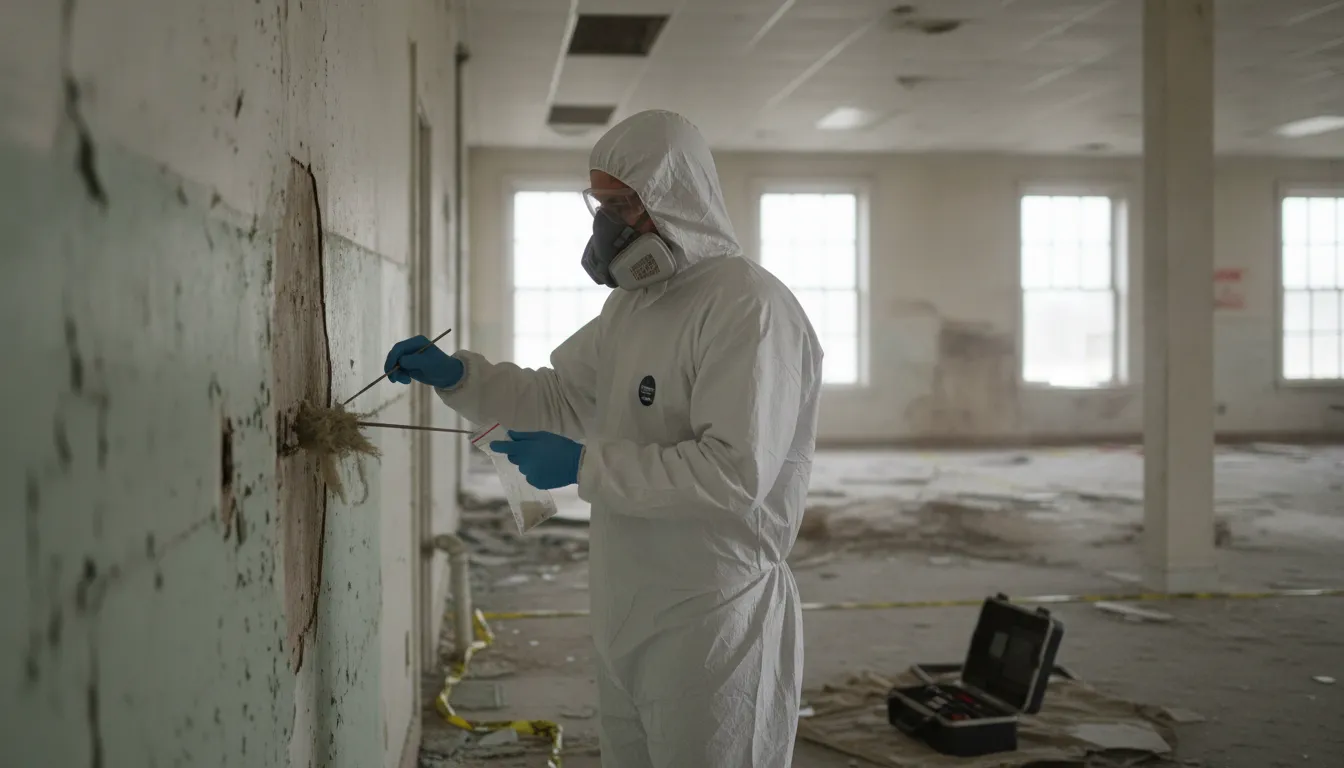
Before a North Carolina property changes hands or a wall comes down, the most useful asbestos question is not simply whether someone can look for suspect materials. It is what decision the assessment must support. A renovation project may need a detailed understanding of materials that could be disturbed, while a building owner managing known asbestos may need condition-focused follow-up and records.
Remtech Environmental can help you choose a practical next step.
An asbestos building survey vs inspection is mainly a question of scope and purpose. A comprehensive survey is designed to locate, identify, quantify, and assess asbestos-containing materials. An inspection may evaluate condition, document changes, or support sampling and testing for a defined area. A visual review alone cannot conclusively identify asbestos. See the OSHA construction guidance and EPA monitoring guidance for related federal context.
The labels can vary by provider and project, so the right comparison starts with the information each assessment produces. Understanding those differences helps owners, buyers, facility managers, and contractors choose an approach that matches renovation planning, due diligence, occupancy, or remediation.
What Is the Difference Between an Asbestos Building Survey and an Inspection?
The terms survey and inspection are sometimes used interchangeably, but they can describe different levels of review. In this article, an asbestos building survey means a broader assessment intended to locate, identify, quantify, and evaluate suspected asbestos-containing materials (ACM). That scope aligns with the purpose described for comprehensive surveys in ASTM E2356 guidance referenced by OSHA. A survey may support renovation planning, demolition decisions, property due diligence, or an asbestos management program.
An inspection is usually narrower and more focused on a particular question. It may review the condition of known or suspected ACM, document visible damage, evaluate an area before or after work, or check whether an abatement project appears complete. ASTM E1368, for example, addresses visual inspection of asbestos abatement projects. A condition inspection can help determine whether material is deteriorating or may be disturbed. But it does not automatically provide a complete inventory of every suspect material in a building.
Scope, purpose, and output
A survey generally asks, "Where might ACM be, what materials are involved, and how much is present?" Depending on the project. The work may include a review of accessible areas, building records, material descriptions, sampling, laboratory analysis, and a written report or survey record. The final scope should be tailored to the planned work. A renovation survey, for example, may need to cover areas that construction will disturb rather than every part of the property.
An inspection more often asks, "What is the condition of this material or work area right now?" It can produce observations. Photographs, condition notes, recommendations, or documentation related to abatement and clearance activities. Remtech's asbestos inspection and testing services can include material sampling and air monitoring when those tools are appropriate to the project. These are distinct from simply looking at a surface.
Neither label should be treated as proof that a visual review alone has identified asbestos. Many building materials can look similar, and a visual assessment cannot conclusively establish asbestos content. Sampling and laboratory testing may be needed when the answer affects renovation, removal, occupancy, or other decisions. The right scope depends on the building, the materials, their condition, and the work being considered.
Discuss your asbestos assessment needs with Remtech Environmental
Which Assessment Fits a Renovation or Demolition Project?
Renovation and demolition require a different level of planning than a routine visual check. The useful assessment is the one that helps identify materials that could be disturbed by the planned work. Determines whether sampling or laboratory analysis is needed, and supports the required work practices and notifications. The correct scope depends on the building, the materials involved, the work area, the project design, and the applicable jurisdiction.
Start with the planned disturbance
Map the work before choosing an assessment. Removing flooring, opening walls, replacing mechanical insulation, disturbing ceilings, or demolishing an entire structure can expose different suspect asbestos-containing materials. A comprehensive survey is intended to locate, identify, quantify, and assess asbestos-containing materials across a building or facility. That broader scope may be appropriate when the project affects multiple areas or when the construction plans are still developing. A limited assessment may be more suitable for a clearly defined work area, but its limits should be documented so contractors do not assume unexamined areas are clear.
Building age alone does not answer the question. OSHA notes that asbestos may still be present in some buildings constructed after 1980, including in thermal system insulation, flooring, ceiling tile, joint compound, and other materials. Existing drawings, product records, and prior reports can help, but they may be incomplete or inaccurate. When records are unreliable and there is good reason to suspect asbestos. OSHA guidance says the material should be treated as asbestos-containing or laboratory analysis should establish that asbestos is absent. See the OSHA guidance on identifying asbestos in buildings for the relevant context.
Account for North Carolina requirements
EPA's asbestos NESHAP calls for a thorough inspection of the area where demolition or renovation will occur. Advance notice can depend on the project scope and whether the building contains a threshold amount of regulated asbestos-containing material. So a property owner should not assume that every project follows the same process. North Carolina's Asbestos Hazard Management Program addresses contamination and exposure from renovation and demolition. Issues permits and demolition notifications, accredits people who perform asbestos management activities, and inspects projects. The state rules also adopt the federal NESHAP demolition and renovation requirements by reference.
Before work begins, ask the assessor: Which areas and materials are included? Will planned cuts, removals, or demolition be covered? Which materials need samples, and how will results be documented? Who will confirm whether permits or notifications apply? What information should be given to the designer, contractor, and property manager? These questions keep the assessment tied to the actual scope rather than treating an inspection label as a universal legal answer.
For a North Carolina renovation or demolition project, the goal is a defensible plan: identify what may be disturbed. Resolve uncertainty through appropriate analysis, and coordinate qualified professionals before work starts. That is more useful than relying on a visual impression alone.
When Is an Inspection More Useful for Buying or Occupying a Building?
The right assessment depends on the decision you need to make. During a purchase, a buyer may need enough information to evaluate known or suspected asbestos-containing materials (ACM). Understand management responsibilities, and decide whether additional investigation belongs in the due-diligence process. A building survey that does not include sampling may support disclosure or operations and maintenance (O&M) planning only when suspect materials are treated as ACM. OSHA states that owners must either determine whether known suspect materials are ACM and manage them accordingly, or treat them as ACM.
That distinction matters when reviewing records. Existing building documents can help, but they may be incomplete or unreliable. If there is good reason to suspect a material and the records do not establish its status. Laboratory analysis may be needed, or the material should be managed as though it contains asbestos. This is one reason an asbestos inspection during due diligence can add practical information beyond a general property inspection.
For buyers: focus on decisions and documentation
A purchase-related assessment should be tied to the property's planned use, renovation ideas, age, accessible materials, and available records. The useful output is not simply a label such as "survey" or "inspection." It is a clear record of what was reviewed. What remains uncertain, how suspect materials should be managed, and whether targeted sampling or other follow-up is appropriate. A visual review alone cannot conclusively identify asbestos.
For occupants and building managers: focus on condition over time
Once a building is occupied, the priority often shifts from initial discovery to preventing damage and maintaining reliable records. EPA recommends periodic visual and physical reinspection of ACM through an O&M program. Reinspection can document current condition, physical characteristics, damage, and the likelihood of future fiber release. Photographs or video taken over time can make changes easier to identify.
Carefully designed air monitoring may supplement, but not replace, a comprehensive visual and physical program. For schools, AHERA includes specific reinspection and surveillance requirements. For other buildings with ACM, EPA identifies six-month surveillance as good practice, while the appropriate interval should reflect the building and its management plan. A reinspection is especially useful after maintenance, damage, water intrusion, or other work that could disturb suspect materials.
Survey vs. Inspection: How the Choice Changes by Project Goal
The right assessment depends less on the label and more on the decision you need to make. A comprehensive survey is generally used to locate, identify, quantify, and assess asbestos-containing materials (ACM). While an inspection may focus on current condition, project work, or the results of abatement. ASTM E2356 describes comprehensive building asbestos survey practices, and ASTM E1368 addresses visual inspection of asbestos abatement projects. These are different questions, even though a project may require both.
| Project goal | Useful assessment focus | Typical decision supported |
|---|---|---|
| Renovation or demolition | Survey of areas and materials that could be disturbed, with sampling or testing as appropriate | Define work limits, plan controls, and determine what project-specific requirements may apply |
| Purchase or due diligence | Review available records and suspect materials, with a scope matched to the property decision | Understand potential management obligations and how findings may affect planning |
| Ongoing occupancy or management | Visual and physical condition inspection, records review, and periodic reinspection when appropriate | Track damage or deterioration and guide operations and maintenance decisions |
| Abatement or clearance | Inspection of the work area and completed abatement, with air monitoring or other verification when specified | Document whether the completed work meets the defined project criteria before the next phase |
For renovation or demolition, the priority is usually completeness within the planned disturbance area. The assessment should identify materials that workers may encounter and clarify where sampling, laboratory analysis, containment, or other controls may be needed. For purchase, the scope may be narrower or broader depending on the building, records, planned improvements, and the level of due diligence required. Terms are not used identically on every project, so the written scope matters more than the title.
Discuss your project and request a free quote
During occupancy, an inspection is often about condition rather than discovering every material in the building. A visual review cannot conclusively identify asbestos. Periodic inspections can document changes, damage, and maintenance concerns, while sampling, testing, or air monitoring may provide additional information when the project calls for it. For abatement and clearance, the inspection should be tied to the work plan and the required completion criteria, not treated as a generic walkthrough.
Questions to ask before choosing an assessment
- What decision will the report support: construction planning, a property transaction, routine management, or completion of abatement?
- Which rooms, materials, concealed areas, and planned disturbance zones are included?
- Will the scope include material sampling, laboratory testing, air monitoring, or only visual and physical observations?
- What records, photographs, maps, laboratory results, and project-specific recommendations will be provided?
Remtech's approach is to assess the situation, explain the findings, and plan around the actual project. Its asbestos services include inspection and testing, material sampling, air monitoring, and residential and commercial abatement. That education-first process helps owners choose an assessment that answers the question in front of them, rather than paying for a generic label.
What Happens After Suspect Asbestos Is Identified?
Finding a material that may contain asbestos does not by itself determine the final response. The appropriate next step depends on the material, its condition, the planned work, available records, and the level of certainty needed for the decision. A practical sequence helps property owners avoid unnecessary disturbance while building a clear path forward.
-
Pause work that could disturb the material
Stop cutting, sanding, drilling, scraping, removing, or otherwise disturbing the suspect material until its status and the project scope are understood. Keep occupants and workers away from the immediate area as appropriate. And do not collect an informal sample unless the work is being performed under a suitable professional process. Existing records can help, but they may be incomplete or unreliable. OSHA guidance states that when records are not reliable and there is good reason to suspect asbestos. The material should be treated as containing asbestos or shown to be asbestos-free through laboratory analysis. Read the OSHA guidance.
-
Decide whether sampling or testing is needed
An inspection or survey can define where suspect materials are located and how they may affect the project, but visual review alone does not conclusively identify asbestos. If the decision requires confirmation, a qualified professional can determine whether sampling is appropriate and coordinate analysis through a laboratory. Remtech provides laboratory asbestos testing and reports, along with material sampling and air monitoring where the project calls for those services. Testing should answer a specific project question rather than be treated as a substitute for planning the work.
-
Review the report and define the project scope
Use the findings to identify affected materials, locations, condition, quantity, and the activities that could disturb them. The same result may lead to different decisions in an occupied building, a planned renovation, or a demolition project. Ask what areas were assessed, which materials were sampled, what limitations applied, and what work assumptions were used. This is also the point to identify any required notifications, permits, work practices, occupant protections, or coordination with contractors.
-
Choose management, abatement, or another documented response
If the material is in good condition and will remain undisturbed, a project may call for documented management, communication, and future monitoring. If renovation, demolition, damage, or planned work could disturb it, project-specific abatement or other controlled work may be appropriate. Remtech describes its process as assessing conditions, explaining findings, and planning the work for the specific project. Its residential and commercial services include abatement associated with renovation and demolition. For a plain-language overview, see what happens after asbestos is identified.
-
Document the outcome and any follow-up
Keep the assessment, laboratory results, work plan, photographs, notifications, completion records, and any applicable clearance or air-monitoring documentation with the property records. If asbestos remains in place, note its location and the controls needed to prevent future disturbance. If work is completed, confirm what was addressed and what documentation the owner, occupants, contractors, or future buyers may need. The goal is not to force every situation into the same response. It is to make the next decision traceable and appropriate to the building and the work.
How Should North Carolina Property Owners Plan the Next Step?
Once you understand whether you need a survey, inspection, sampling, or a combination of assessments, turn the decision into a project plan. Start by writing down the building's intended use and the work being considered. A purchase, occupied-building management, renovation, demolition, and abatement project can each require different information.
A practical planning checklist
- Define the work area. Identify rooms, systems, finishes, or exterior materials that may be disturbed. Include planned demolition, repairs, and access needs.
- Gather existing records. Collect prior surveys, inspection reports, renovation plans, and material records, but do not assume incomplete records answer every question.
- Ask what the assessment will deliver. Confirm whether the scope includes visual review, material sampling, laboratory analysis, quantity estimates, condition notes, air monitoring, or project clearance. A visual review alone does not conclusively identify asbestos.
- Check the applicable requirements. North Carolina's Health Hazards Control Unit issues permits and demolition notifications, accredits asbestos management professionals, and inspects certain removal and renovation projects. North Carolina rules also adopt federal NESHAP asbestos demolition and renovation requirements. Whether a particular requirement applies depends on the building and project, so verify current obligations before work begins. North Carolina program guidance and the project team can help clarify the path.
- Choose qualified help. Ask about relevant accreditation, North Carolina licensing, experience with similar properties, written findings, and how the results will guide the next decision.
For a commercial property, this planning conversation may need to coordinate owners, tenants, contractors, facility managers, and regulators. Our guide to commercial building asbestos planning can help organize those questions. Remtech's model is to assess the situation, explain the findings, and build a project-specific plan, supported by EPA-accredited specialists and North Carolina asbestos licensing. Learn more about Remtech's education-first approach.
Discuss your North Carolina asbestos project and request a free quote
Frequently Asked Questions
Are an asbestos building survey and an inspection the same thing?
No. A survey is generally a broader investigation used to locate, identify, quantify, and assess asbestos-containing materials. An inspection may be narrower, such as evaluating the condition of known material, checking a building before work, or reviewing an abatement project. The labels can vary, so confirm the scope, sampling plan, and final report before scheduling the work.
Is an asbestos survey mandatory in North Carolina?
Requirements depend on the building, the planned work, and the applicable federal and state rules. EPA asbestos NESHAP calls for a thorough inspection where demolition or renovation will occur. Advance notification can depend on the amount of regulated asbestos-containing material and the project scope. North Carolina also manages permits, notifications, accreditation, and project oversight. A qualified professional can help determine which requirements apply.
How much does a full asbestos survey cost?
There is no reliable standard price. The project-specific cost depends on the building size and age, accessible areas, materials that require sampling. Laboratory analysis, report requirements, and whether the work supports renovation, purchase due diligence, or ongoing management. Request a defined scope so proposals can be compared accurately.
What is the 3-5-7 rule for asbestos testing?
The 3-5-7 rule is not a universal testing standard that should be used to determine the right sampling plan. Sampling should reflect the building, materials, project scope, and applicable requirements. If records are unreliable and there is good reason to suspect asbestos. OSHA says the material should be treated as asbestos-containing or shown to be asbestos-free through laboratory analysis: OSHA guidance.
Talk With an Asbestos Professional About Your Project
The right assessment depends on what you need to decide, what work is planned, and what the property records can support. Remtech Environmental can help explain the options, identify the information your project may require, and plan a practical next step for a North Carolina property.