
A commercial building in Raleigh can carry asbestos-containing materials for decades without disrupting daily operations. The challenge begins when planned renovation, maintenance, a property transaction. Or tenant concerns require owners and facility managers to understand what is present and how it must be managed.
Commercial asbestos abatement Raleigh NC involves more than removing suspect materials. It requires qualified professionals, controlled work practices, OSHA and EPA compliance, tenant-safety planning, and documentation that supports regulatory review and real estate decisions.
Commercial work also differs from residential removal because larger, occupied, and multi-use properties demand coordination among owners, contractors, employees, tenants, and regulators. Asbestos was widely used for its fire-resistant and insulating properties, so identifying where it may exist is an important first step before work begins. The building's age, occupants, planned scope, and compliance responsibilities all shape the right approach.
Why Commercial Asbestos Abatement in Raleigh NC Matters for Your Building
Raleigh has thousands of commercial properties built before the 1980s, including offices, industrial facilities, and other buildings where asbestos-containing materials may still be present. Asbestos was once widely used in commercial construction because it offered fire resistance and effective insulation. Those qualities made it practical for many building products, but they do not make every older material an immediate hazard.
The important question is whether asbestos-containing material is present, where it is located, and whether planned maintenance, renovation, or demolition could disturb it. A thoughtful assessment gives owners the information needed to make decisions based on the building's condition and project plans, rather than assumptions.
Older materials can become a planning issue
Asbestos may be incorporated into materials such as insulation, floor tiles, roofing products, or other construction components. When these materials remain intact and undisturbed, the management approach may differ from the approach required when walls, ceilings, mechanical systems, or flooring will be altered. Before work begins, testing and professional planning can help identify materials that need controls or abatement.
This is especially relevant when a building changes hands, receives a new tenant, or enters a renovation schedule. Identifying potential asbestos early can help owners coordinate qualified professionals, communicate with contractors, and reduce the risk of an avoidable pause after construction is underway. It also creates a clearer record for future maintenance and property decisions.
Owners have a duty to communicate
Commercial property owners are responsible for identifying and managing asbestos-containing materials in a way that supports tenant and worker safety. The EPA explains that building owners have a duty to inform tenants and employees when asbestos-containing materials are present. That responsibility is not limited to removal. It includes maintaining useful information about the building, sharing relevant findings, and making sure people who may encounter the material understand the appropriate precautions.
Professional commercial asbestos abatement in Raleigh NC can support that process through inspection, testing, abatement planning, controlled work, and documentation. The goal is not to create alarm. It is to replace uncertainty with a practical plan that protects people, supports regulatory responsibilities, and fits the building's operational needs. For owners preparing for a sale or transfer, review our guide to asbestos disclosure for North Carolina real estate as part of the planning process.
With the right information and qualified guidance, owners can address asbestos responsibly while continuing to make informed decisions about their property.
How Commercial Asbestos Abatement Differs from Residential Removal
Commercial asbestos work is shaped by the building's size, use, occupants, and regulatory obligations. An office, industrial plant, hospital, or medical center may contain asbestos materials across multiple rooms, floors, mechanical systems, or building phases. The project also has to fit around tenants, employees, patients, visitors, equipment, and planned construction. Residential removal is often smaller in physical scope, but it still requires careful planning and qualified professionals.
The distinction is not simply commercial projects are larger and residential projects are smaller. Commercial property owners and facility managers carry a broader coordination and documentation burden. OSHA and EPA requirements, work-area controls, tenant communication, disposal records, and renovation schedules all need to be addressed before work begins. For demolition or renovation projects subject to the federal asbestos regulations. NESHAP generally requires advance notification to the appropriate agency at least 10 working days before the activity begins. Requirements can vary by project, so the applicable rules should be confirmed during planning.
| Consideration | Commercial project | Residential project |
|---|---|---|
| Typical setting | Offices, industrial plants, hospitals, medical centers, retail properties, and other occupied or partially occupied facilities. | Single-family homes, townhomes, apartments, or other residential spaces, usually with fewer occupants and a more limited footprint. |
| Project scale | May involve multiple work areas, interconnected building systems, large quantities of material, and phased construction. | Often centers on a defined area such as flooring, pipe insulation, ceilings, siding, or another identified material. |
| Containment and access | Containment may need to separate tenants, departments, patients, production areas, and building systems while maintaining approved access routes. | Containment is planned around residents, pets, furnishings, and the home's ventilation and access points. |
| Scheduling | Must coordinate with renovation, demolition, maintenance, business operations, shift changes, and tenant requirements. | Can often be scheduled around the residents' temporary relocation and a smaller number of trades or activities. |
| Records and coordination | Typically includes more extensive planning, notifications, work records, disposal documentation, air monitoring, and communication among owners, contractors, and occupants. | Still requires project documentation and appropriate clearance, but there are generally fewer parties and operational schedules to coordinate. |
| Liability considerations | Potential exposure may involve employees, tenants, visitors, contractors, business interruption, and property transactions. | Primary concerns generally center on residents, workers, the home's occupants, and future disclosure of the work. |
In both settings, asbestos should be handled by trained and accredited professionals to minimize airborne fiber exposure. A commercial plan should begin with the building's history, an assessment of potentially affected materials, the intended renovation or demolition scope, and the people who may be affected. A residential plan follows the same safety principles, but usually involves fewer stakeholders and a narrower operating environment. This high-level comparison is educational, not a substitute for a project-specific assessment or regulatory review.
OSHA and EPA Compliance for Commercial Property Owners
Compliance is part of responsible building management, not an obstacle to a renovation or maintenance plan. Commercial property owners and facility managers need a clear understanding of where asbestos-containing material (ACM) or presumed ACM may be present. Who needs to be informed, and which employees require awareness training.
OSHA requires employers to provide asbestos awareness training to employees who perform housekeeping operations in facilities where ACM or presumed ACM is present. That requirement matters because routine work, such as dusting, maintenance, or accessing building systems, can bring employees into areas where asbestos-containing materials are located. Training helps workers recognize the limits of their role and understand when work must stop and be referred to qualified professionals. OSHA's asbestos compliance guidance provides the applicable regulatory context.
Property owners have an information duty
Building owners also have a duty to inform tenants and employees about the presence of asbestos-containing materials. That responsibility is broader than arranging a one-time inspection. It involves maintaining reliable information about known or presumed ACM, communicating relevant hazards to the people who use the property. And coordinating future maintenance or construction work with the building's asbestos management plan. The EPA explains these building-management responsibilities in its guidance on managing asbestos in buildings.
For a multi-tenant office, industrial facility, hospital, or medical center, practical compliance depends on coordination. Property managers may need to align contractors, tenants, maintenance personnel, and project schedules before work begins. If planned renovation or demolition could disturb ACM, the project may also require advance regulatory notice and carefully documented procedures. Treating compliance as a planning function reduces confusion and helps protect business continuity.
Qualified support makes compliance easier to manage
Remtech Environmental approaches commercial asbestos work with an education-first process. Its EPA-accredited specialists and IICRC-certified technicians help property owners understand inspection findings, plan the appropriate scope, and make informed decisions without pressure. Remtech exceeds North Carolina state requirements through its professional certifications and standards, while comprehensive insurance. Including environmental pollution liability coverage, adds an important layer of risk management for commercial clients.
The goal is not to create unnecessary alarm. It is to give owners and managers dependable information, documented procedures, and peace of mind that asbestos-related decisions are being handled the right way. When the building's history, occupants, maintenance needs, and renovation plans are reviewed together, compliance becomes a practical part of protecting people and managing liability.
Protecting Tenants and Workers During Commercial Asbestos Abatement
A well-managed abatement project protects people by controlling the work area, limiting access, and keeping building occupants informed. Asbestos should only be handled by trained and accredited professionals who understand how to minimize the risk of airborne fiber exposure, as the U.S. Environmental Protection Agency explains.
Establishing a controlled work area
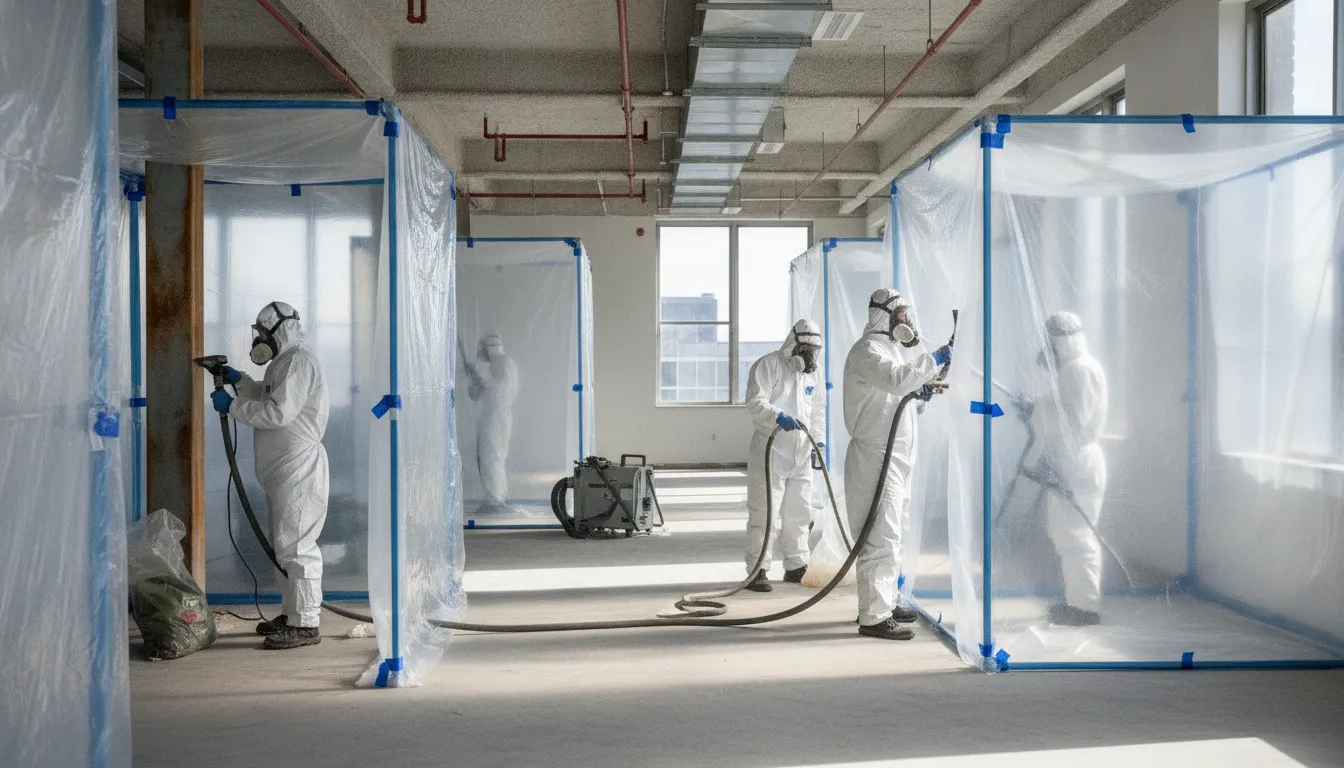
Before work begins, the abatement team should evaluate the building layout, planned work, occupancy schedule, and condition of the asbestos-containing material. This information supports a written plan for separating the work zone from occupied areas. Proper containment barriers help prevent dust and debris from moving into hallways, offices, mechanical spaces, or tenant suites. Access should be limited to authorized personnel, with routes and scheduling planned around the building's normal operations whenever practical.
Commercial containment commonly includes sealed barriers, controlled entry points, and negative air pressure within the work area. Negative pressure helps direct airflow into the contained space rather than allowing potentially contaminated air to move toward occupied areas. The exact setup depends on the material, location, scope, and building conditions. A qualified contractor should explain these controls before mobilization, not after occupants have questions.
Using wet methods and monitoring conditions
Wet methods are an important part of responsible asbestos work because keeping material damp helps prevent emissions during handling and removal. Work practices should be selected to reduce disturbance, contain debris, and support orderly cleanup. Air monitoring can provide objective information about conditions during the project and help document that the work area is ready for the next phase or for reoccupancy. Monitoring and visual inspection are also important components of North Carolina asbestos project documentation.
Communicating with occupants
Tenant and worker protection includes clear communication. Property owners and facility managers should receive practical information about the work schedule, restricted areas, expected noise or access changes, and the person responsible for questions. The EPA states that building owners have a duty to inform tenants and employees about the presence of asbestos-containing materials. A calm, direct explanation helps occupants follow site controls without creating unnecessary concern.
Professional certifications and documented procedures provide another layer of confidence. Remtech's EPA-accredited specialists and IICRC-certified technicians approach commercial projects with the goal of doing the right work the right way. For property owners comparing providers, this guide to the difference between asbestos abatement and removal can help clarify what to ask before work starts.
Documentation Requirements for Property Transactions
For commercial buyers, sellers, landlords, and real estate investors, asbestos records are part of responsible due diligence. A completed project should leave behind more than a cleared work area. It should provide a documented record showing what was assessed, what work was performed, how the regulated area was controlled, and how completion was verified.
Records that support due diligence
North Carolina's Department of Health and Human Services requires specific documentation for asbestos removal projects. The state's guidance makes clear that project records are a regulatory requirement, not an optional administrative detail. Documentation may include the scope of work, notifications, material information, waste shipment records, daily activity records, and the reports associated with air monitoring and visual inspections. Requirements can vary with the project, so the abatement professional should identify the applicable records before work begins.
Air monitoring helps document conditions during and after the work. Visual inspections help confirm that the regulated area has been properly cleaned and that no visible residue remains. Together, these checks create a clearer basis for determining whether the project met its stated completion criteria. NCDHHS provides the governing information for North Carolina asbestos project documentation at its asbestos management forms.
Why the file matters at closing
A complete project file gives a buyer and lender something concrete to review instead of relying on an informal statement that asbestos was removed. It can help the parties evaluate remaining obligations, coordinate future renovation work, and understand how the property was managed. For sellers and landlords, organized records demonstrate that the work was addressed through a defined professional process. They can also help reduce uncertainty when an insurer, consultant, lender, or future buyer asks about the property's environmental history.
Documentation does not replace legal advice or guarantee a property's value. It does, however, make the condition and history of the building easier to understand. It is also important to distinguish project records from disclosure duties. Review North Carolina asbestos disclosure requirements with the appropriate real estate or legal professional when a transaction involves known or suspected asbestos-containing materials.
Plan records before work starts
Record-keeping works best when it is built into the abatement plan and transaction schedule from the beginning. Ask what documentation will be produced, who will receive it, and when final reports will be available for due diligence. Working with asbestos abatement versus removal can help property stakeholders align inspection, abatement, verification, and closeout records with the needs of the project.
Will Insurance Pay for Commercial Asbestos Abatement?
Commercial property insurance may help pay for asbestos abatement in some situations, but coverage is not automatic. The answer depends on the specific policy, its exclusions, the cause of the asbestos-related work, and the carrier's interpretation of the claim. A facility manager should avoid assuming that a policy will cover the full project. Or that an exclusion applies, before reviewing the details with the insurer and an experienced environmental professional.
Coverage questions often become more complicated when asbestos is discovered during a renovation, demolition, repair, or property transaction. Some policies may address certain sudden or covered events, while excluding known conditions, gradual deterioration, maintenance, or improvements. The wording can also distinguish between repairing covered property damage and paying to remove or manage pre-existing asbestos-containing materials. These distinctions are policy-specific, so general online estimates cannot determine whether a particular commercial building is covered.
What to review before contacting the carrier
Gather the policy, endorsements, declarations, claim instructions, inspection reports, renovation plans, and any records showing when the material was discovered. Note whether the asbestos was known before the work began, whether a covered incident triggered the project, and whether the planned work involves disturbance or removal. Clear documentation helps the carrier evaluate the claim and gives the property owner a more complete basis for planning.
Ask the insurer what information it needs before work starts. That may include an asbestos inspection, laboratory results, a written scope of work, project schedule, contractor qualifications, disposal records, and air-monitoring documentation. Commercial abatement also has regulatory and tenant-safety responsibilities that exist separately from insurance coverage. A policy decision does not replace the need for proper planning, trained professionals, containment, or required records.
Plan the work without waiting on assumptions
If coverage is uncertain, obtain a project-specific assessment and written proposal while the claim is being reviewed. A qualified abatement professional can explain what the building needs, separate eligible work from related construction activities when appropriate, and identify the documentation needed for a responsible decision. Costs vary with the material, location, access, containment requirements, testing, disposal, and building operations, so standardized per-square-foot rates are not a reliable answer.
For commercial asbestos abatement in Raleigh NC, Remtech Environmental can review the situation, explain the available options, and provide a consultation-based scope without pressure. The goal is a clear path forward for owners and facility managers, whether insurance contributes or the project must be funded directly.
What Commercial Asbestos Abatement in Raleigh NC Involves
For a commercial property owner or facility manager, abatement is a coordinated project rather than a single removal visit. The work begins with an inspection of areas affected by planned renovation, maintenance, or demolition. Qualified professionals identify suspected asbestos-containing materials, arrange appropriate testing, and use the results to define the scope of work. This early assessment helps the project team make informed decisions about tenant access, scheduling, and construction sequencing.
Inspection, planning, and preparation
Once the scope is understood, the abatement plan should address work methods, containment, worker and occupant protection, air monitoring, disposal, and required notifications. Commercial work may involve offices, industrial facilities, hospitals, or medical centers, so the plan must fit the building's operations instead of treating every site alike. Renovation and demolition projects may also require advance regulatory notice under applicable NESHAP requirements. Remtech's team helps coordinate these details so property managers have a clear path from initial inspection through final documentation.
Project pricing is determined by the site conditions, materials, access, containment requirements, schedule, and other project-specific factors. There is no responsible one-size-fits-all rate for commercial asbestos work. For background, review what asbestos removal costs and use a site consultation to develop a scope-based quote.
Containment, removal, and air clearance
During abatement, the crew establishes controlled work areas and uses specialized containment and wet methods to help prevent asbestos fibers from becoming airborne. Work practices are selected for the material and setting, with attention to nearby tenants, employees, visitors, and other trades. The goal is to keep the project orderly and controlled while allowing the property owner's broader schedule to move forward safely.
Air monitoring and visual inspections are important parts of the closeout process. Monitoring helps verify conditions inside and around the work area, while a final visual inspection confirms that the intended scope has been completed. North Carolina's Department of Health and Human Services requires specific documentation for asbestos removal projects, so records should be retained as part of the property's environmental file. See our asbestos abatement process for a closer look at Remtech's systematic approach.
Disposal and project documentation
Removed asbestos-containing materials must be packaged, handled, transported, and disposed of through approved procedures. The final project file may include inspection and testing information, work plans, notifications, monitoring results, clearance records, disposal documentation, and related correspondence. Keeping this information organized supports future maintenance decisions, renovation planning, and property transactions.
Remtech approaches commercial work with comprehensive coordination, EPA-accredited specialists, IICRC-certified technicians, and comprehensive insurance coverage that includes environmental pollution liability. The emphasis is practical and transparent: doing the right work the right way, with documentation and communication that help commercial stakeholders make confident decisions.
Frequently Asked Questions
Will insurance pay for asbestos abatement?
Coverage depends on your commercial property policy, the cause of the work, exclusions, and your insurer's requirements. Review the policy before scheduling work, then ask the carrier what inspection, documentation, and approval steps it requires. A qualified contractor can help organize project information, but only your insurer can confirm coverage.
What's the difference between asbestos abatement and asbestos removal?
Asbestos removal takes asbestos-containing material out of a building. Abatement is the broader process of controlling, enclosing, repairing, encapsulating, or removing the material so it no longer creates an unacceptable exposure risk. The appropriate method depends on the material's condition, location, planned renovation, and the property's management plan.
How much does asbestos abatement cost per square foot?
There is no reliable standard price per square foot for a commercial project. Costs vary with the material, quantity, accessibility, containment requirements, testing, air monitoring, disposal, building occupancy, and schedule. A site evaluation and project-specific scope are needed for a useful estimate.
Do you need a permit for asbestos abatement?
Requirements depend on the project, material, building, and authorities involved. Demolition or renovation projects may require advance regulatory notice, and NESHAP generally requires notice at least 10 working days before covered work begins. North Carolina also requires specific documentation for asbestos removal projects, including records related to air monitoring and visual inspections. Confirm the applicable requirements before work starts with the contractor and relevant agency.
Take the Next Step Toward a Safer, Compliant Commercial Property
Managing asbestos in a commercial building does not have to be daunting. With the right qualified team, clear planning, and documented, code-compliant abatement, you protect your tenants, employees, and the long-term value of your property.
Remtech Environmental brings more than 25 years of experience to commercial projects across Raleigh and the surrounding Triangle area. Our EPA-accredited specialists and IICRC-certified technicians handle inspection, containment, removal, air monitoring, and the documentation you need for tenants, insurers, and property transactions. We also carry comprehensive insurance, including environmental pollution liability, so you can move forward with confidence.
Request a free, consultation-based estimate for your commercial asbestos abatement project. We will help you understand what is present, what compliance requires, and the safest path forward for your building.