
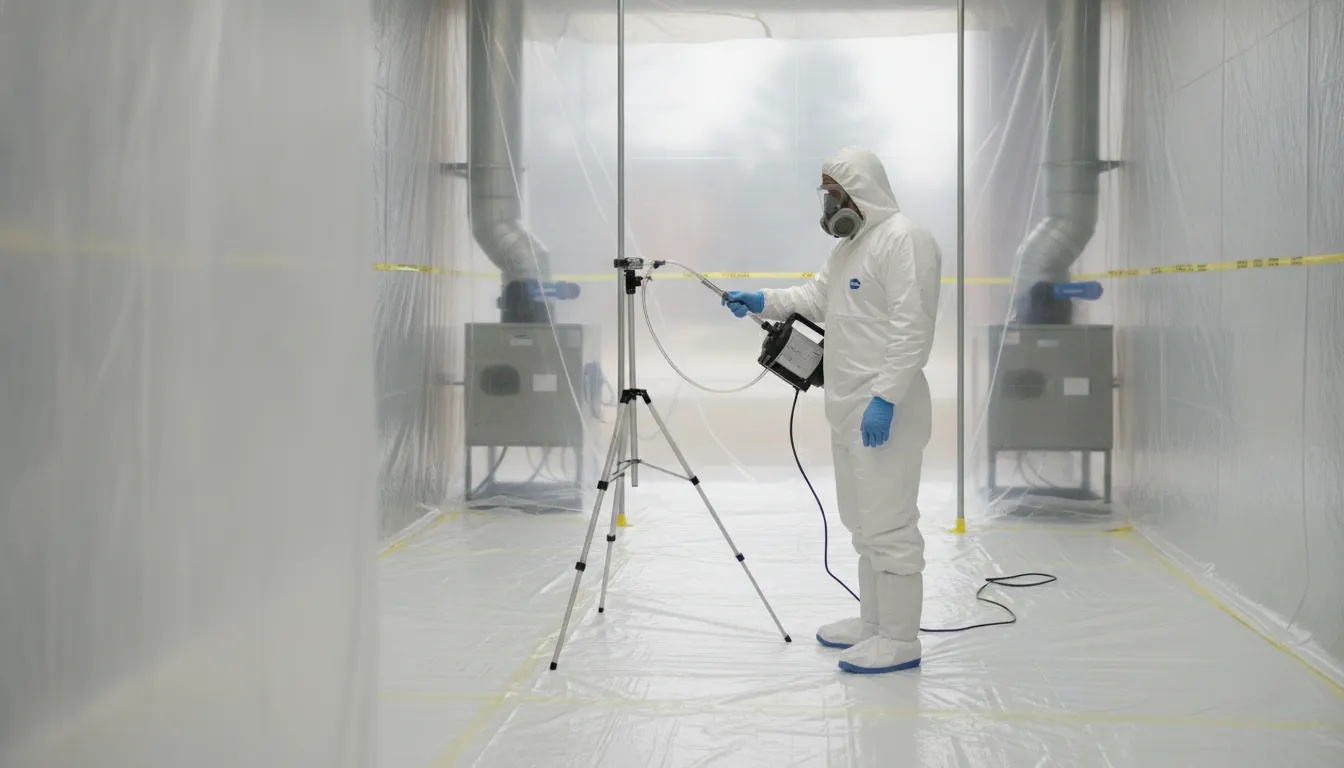
Finishing the physical removal of asbestos-containing material is an important milestone. It is not the same as documenting that the work area is ready for its next use. A careful post-abatement process connects final cleaning, visual review, air sampling, and written project records so the result can be understood in context.
Asbestos air clearance testing evaluates airborne fiber conditions after abatement and cleanup. A passing result supports a project-specific release decision. It does not prove that an area contains zero asbestos or guarantee future air quality.
For homeowners, facility managers, and real estate professionals in North Carolina, the clearance report is more than a pass-or-fail phrase. It should identify what was tested, which criteria applied, who performed the work, and what decision the documentation supports. Understanding those pieces makes it easier to address questions before reoccupancy.
Request a project-specific assessment
What Is Asbestos Air Clearance Testing?
Asbestos air clearance testing is a post-abatement evaluation. It assesses whether airborne fiber conditions in a work area meet the criteria established for that project. It takes place after asbestos-containing material has been removed or otherwise addressed. The work area has also been cleaned and prepared for final review.
The process generally combines a careful visual review with air sampling. Visual review looks for remaining debris, dust, or other conditions that indicate cleaning is incomplete. Air sampling evaluates airborne conditions through samples collected using the method and locations appropriate to the project. The written report should explain what was reviewed and how the results compare with the applicable criteria.
How clearance differs from an initial inspection
Clearance testing is not the same as the inspection performed before work begins. An initial inspection helps identify suspect materials and document their condition. It may also determine whether material samples should be collected. A laboratory can analyze bulk samples to determine whether asbestos is present. For an overview of that earlier stage, see this professional asbestos inspection and sampling guide.
Bulk material sampling answers a material-identification question: does a collected piece contain asbestos? Clearance sampling answers a different question: after abatement and cleanup, do airborne conditions meet the criteria for this project? One does not substitute for the other. A negative bulk sample is not a post-abatement clearance report. A clearance result does not identify every material elsewhere in a building.
Why project details matter
There is no responsible one-size-fits-all answer for sample number, sample placement, pass criteria, or test sequence. Scope, building type, work practices, affected areas, and applicable rules can influence the clearance plan. Air monitoring during active work may also serve a different purpose from final clearance testing. Monitoring can evaluate conditions while abatement is underway. It does not necessarily document readiness for release.
A passing result supports the release decision described in the written documentation. It does not prove that a building contains zero asbestos or guarantee future air conditions. If the visual review or sampling does not meet the applicable criteria, additional cleaning, corrective work, and retesting may be needed.
How Does Clearance Testing Show an Asbestos Project Is Complete?
Clearance is a documented decision-making process, not simply a final air sample. The work area must be completed and cleaned. It is then reviewed visually, sampled according to project requirements, and evaluated through laboratory results and written records. Requirements can vary by scope, building type, affected materials, and applicable North Carolina, federal, or local rules.
-
Complete the planned abatement work
The contractor finishes the work described in the project plan. This may include removal, repair, or another approved method of handling asbestos-containing material. Remtech's typical sequence includes area preparation, worker protection and decontamination, wet removal methods, regulated waste handling, and air-clearance testing as final verification. Clearance is not a substitute for completing the contracted scope.
-
Contain, clean, and prepare the area
After active work ends, the work area is cleaned using procedures appropriate to the project. Debris, residue, and visible dust must be addressed before sampling can provide useful information. EPA guidance for covered renovation and demolition work emphasizes thorough inspection of affected areas and emission-control practices. The project plan and applicable rules control the details.
-
Perform a careful visual review
A qualified reviewer examines the area for remaining debris, residue, damage, or other conditions that could affect release. This matters because an air sample is only one part of the evaluation. If the area is not visibly ready for sampling, additional cleaning may be needed. Visual review does not prove every asbestos fiber has been removed.
-
Collect air samples under the project protocol
Once the area is ready, air sampling evaluates airborne conditions after work and cleanup. This differs from a pre-work bulk sample, which characterizes material. Sampling method, locations, duration, sample number, and criteria are not universal. They should follow the project requirements. Clearance monitoring helps determine whether an area is suitable for reoccupancy when applicable requirements call for it.
-
Review results and issue the report
Laboratory findings are interpreted with the visual review, project scope, and applicable criteria. The report should identify what was evaluated and record the result, conditions, and limitations. If the review or sampling does not meet the criteria, further cleaning, corrective work, or retesting may be required.
-
Make the release decision
A passing report supports a project-specific release decision. Keep it with the project records. It confirms the conditions evaluated at that time. It does not establish that a property contains zero asbestos or eliminate the need to manage future disturbances safely.
Who Performs the Clearance Inspection and Air Sampling in North Carolina?
Several parties may contribute to a post-abatement clearance decision. Their responsibilities should not be confused. The abatement contractor performs planned removal and cleaning. A qualified clearance professional or inspector evaluates the completed area. A laboratory analyzes samples when required. The property owner preserves records. Regulators establish or enforce rules that may apply.
The abatement contractor
The contractor follows the approved scope and work practices. The contractor controls the work area, removes or treats materials as specified, and completes final cleaning. The contractor may arrange clearance activities. Arranging a test is not the same as deciding that an area is ready for release. Understanding the asbestos abatement process shows where final inspection and air sampling fit.
The clearance professional and laboratory
The clearance professional reviews the area after cleanup. That person determines whether visual conditions and the sampling plan meet the criteria for the project. Depending on the scope, contract, and applicable rules, the professional may be an independent inspector, an industrial hygiene professional, or another qualified party. North Carolina projects do not all follow one arrangement. An independent inspector is not automatically a legal requirement for every job. Separation can still provide useful objectivity and may be required by project documents or a specific rule.
When air samples are collected, a laboratory may analyze them using the method specified for the project. The written report should identify what was reviewed and sampled. It should also explain how results relate to the release criteria. Air clearance differs from the earlier professional asbestos inspection and sampling.
The owner and regulators
Owners should confirm who is responsible for each step before work starts. They should provide access, review project documents, and retain clearance reports, laboratory results, notifications, and other required records. Regulators may set requirements, receive notifications, review records, or oversee compliance when their jurisdiction and the project scope call for it.
Requirements can depend on the building, quantities, work classification, and applicable state or federal rules. Ask the contractor and clearance professional to identify the governing criteria in writing. A documented assignment is more reliable than assuming every North Carolina project uses the same inspector, sample plan, or release procedure.
What Does a Passing or Failed Clearance Result Mean?
A passing clearance report records that the project met the applicable criteria for releasing the affected area. It generally reflects more than a single air result. The work area should receive a visual review, cleaning, sampling, laboratory analysis, and documentation required for that project. When those pieces align, the report can support a decision to reoccupy or begin the next phase of work.
Read the result within its scope. It does not prove a building contains zero asbestos, certify every room, or guarantee future indoor air conditions. It is not a substitute for the inspection performed before work. Bulk sampling identifies material contents. Clearance sampling evaluates airborne conditions after abatement and cleanup. Ask the testing professional to explain limitations, excluded areas, or release conditions.
| Result or document | What it tells you | Practical next step |
|---|---|---|
| Passing visual inspection | The inspected area met the visual criteria being applied. | Confirm whether air sampling and written documentation are also required. |
| Passing air-clearance result | Collected samples met the applicable criteria for the conditions tested. | Review the report, scope, and release instructions before reoccupying. |
| Failed visual review | Visible debris, dust, residue, or incomplete work needs attention. | Complete corrective work and arrange the required follow-up review. |
| Failed or inconclusive air result | The data does not support release as documented. | Keep the area controlled and complete corrective work or retesting as required. |
| Final clearance report | It records what was evaluated, the results, and attached limitations. | Retain it with contracts, inspection records, and related project files. |
A failed result is not a reason to guess or rush. The response depends on whether the issue was visual cleanliness, sampling, laboratory findings, documentation, or project scope. Additional cleaning, corrective abatement, or retesting may be appropriate. The written report should guide that decision.
Request a project-specific assessment
When Can People Reoccupy an Area After Asbestos Work?
Reoccupancy is tied to the completed clearance process and written release documentation, not a generic number of hours. The area should remain controlled until required cleaning, visual review, air sampling, laboratory evaluation, and documentation are complete. Criteria may depend on the building, work area, materials, and rules governing the project.
Ask the project team what the report covers. It may apply to a contained room, a portion of a building, or a defined work area rather than the entire property. It should identify conditions or limitations attached to release. If additional cleaning, corrective work, or retesting is needed, the area is not ready to be treated as cleared because active removal has ended.
Use the report, not a verbal assumption
For a homeowner, the practical question is whether the responsible professional has provided written confirmation that the affected area meets the release criteria. For a commercial property manager, the report becomes part of the environmental project file. Share it with people responsible for access, maintenance, renovation, or leasing. A future contractor should be able to see which area was addressed and what supported release.
Clearance also has a defined scope in time. A passing result supports the decision for conditions evaluated at that point. It does not prove every part of a building is free of asbestos. It does not eliminate the need to manage suspect materials during future work. Renovation or maintenance outside the cleared area may require a separate review.
Remtech's broader asbestos abatement process explains how preparation, controlled work, cleanup, and final verification fit together.
What Should Property Owners Keep After Clearance Testing?
Once asbestos work is complete, the clearance process creates a record of what was addressed and what conditions applied when the area was released. Keep these documents with the project contract and building maintenance records.
- Keep the written clearance report. Save it in a secure digital location and a physical project file. It should identify the project, area evaluated, date, and result. A passing result does not mean the property contains zero asbestos or guarantee future air quality.
- Confirm the scope and areas addressed. Compare the report with the work plan, inspection findings, and contract. Note the rooms, surfaces, materials, or contained areas included. Do not let a partial clearance be mistaken for clearance of the whole property.
- Retain laboratory and inspection records. Keep air-sampling data, laboratory results, visual notes, chain-of-custody documents when provided, and related photographs. These records clarify which activities supported the release decision.
- Document failed results and corrective work. Keep the report explaining the result, along with records of cleaning, corrective work, and retesting. Ask what remains unresolved before treating the area as cleared.
- Record re-entry or next steps. Keep written direction explaining when and under what conditions the area may be reoccupied. Re-entry follows the documented decision and project requirements, not a universal timer.
Organized records make future planning easier. If documentation is incomplete, request clarification from the qualified professionals involved before closing the project file.
Request a project-specific assessment
What Should You Do If Clearance Testing Does Not Pass?
A failed post-abatement result is a project signal, not a reason to panic. It means the area should not yet be released for reoccupancy under the applicable criteria. Keep people, furnishings, and ongoing work out until the project team explains the result and confirms the next step in writing.
Ask for the written explanation
Request the clearance report or other documentation. Ask the contractor, inspector, or analyst to explain what did not meet the project requirements. The issue may relate to visible dust, work-area conditions, air-sampling results, documentation, or work outside the original scope. The correction depends on what the report identified.
Complete corrective work
Corrective work may involve additional cleaning, removal of debris, addressing an overlooked scope item, or resolving a documentation problem. Perform the work using controls appropriate to the project. Do not use informal sweeping or unplanned disturbance. If the concern involves sampling or the report, ask how it will be addressed before assuming more cleaning is the answer.
A failed result does not prove the entire project was improperly performed. It is a finding that requires review and a documented response. The team should identify the source, complete the correction, and keep the area controlled while work continues.
Arrange applicable retesting
After correction, the project may require another visual review, another round of air-clearance testing, or both. The choice depends on scope and applicable requirements. Reoccupancy should wait until the responsible professional provides written clearance. There is no universal retesting timeline for every building.
For context, independent asbestos clearance testing is one part of a broader abatement sequence. If you need help understanding the next step, request a project-specific assessment.
Frequently Asked Questions
What does asbestos air clearance testing check after abatement?
It checks whether airborne fiber conditions in the work area meet the applicable criteria after abatement and cleanup. It differs from a bulk material sample taken before work. Bulk sampling identifies material contents, while clearance sampling evaluates air conditions after work. The process may also include a documented visual review.
Does a passing clearance result prove there is zero asbestos?
No. A passing result supports the project-specific decision to release the area under the written report and applicable requirements. It does not prove every asbestos fiber has been eliminated, certify future air quality, or replace management of remaining asbestos-containing materials. Keep the clearance documentation with the project records.
What happens if the clearance inspection or air sample does not pass?
The area should not be released based on that result. The project team reviews whether additional cleaning, corrective work, or another response is needed. Retesting follows when required by the project criteria. Owners should follow the written instructions rather than assume a universal remedy.
When may people reoccupy an area after asbestos work?
Reoccupancy may occur after required cleanup and clearance are complete, results meet applicable criteria, and responsible parties have written release documentation. There is no single timer for every North Carolina project. Confirm the decision from the project report.
Plan the Next Step With Clear Asbestos Project Information
Asbestos air clearance testing connects final cleaning, visual review, sampling, results, and the decision to release an affected area. The right approach depends on the property, work scope, and requirements that apply.
Remtech Environmental provides education-first asbestos inspection, testing, and abatement support for residential and commercial properties in North Carolina. The team can help explain questions to ask, records to request, and the next practical step.