
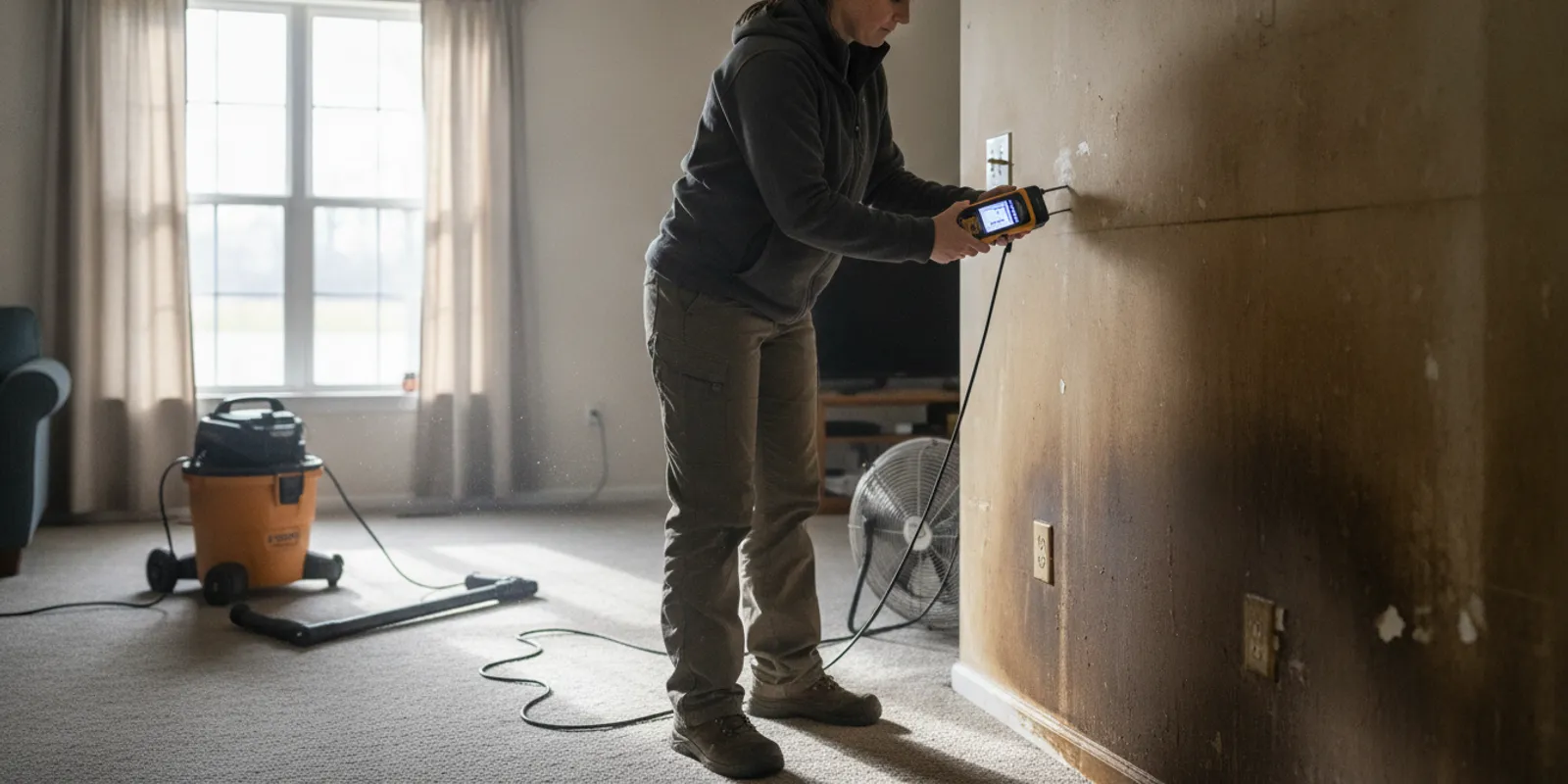
Structural drying after flood conditions is a measured process, not simply a matter of running fans until surfaces look dry. Water can remain inside wall cavities, flooring, insulation, and framing after visible water is gone. Knowing what a mitigation provider should evaluate can help property owners make informed decisions and avoid closing up materials too soon.
Ask Remtech about an environmental concern
What does structural drying involve?
Structural drying aims to remove moisture from building materials and surrounding air in a controlled way. Work generally begins with an assessment of affected rooms and materials, the path moisture may have traveled, and whether the building can be entered safely. A mitigation provider may use moisture meters and other instruments to establish baseline conditions and track change over time.
Visible dryness is not the same as confirmed dryness. North Dakota State University Extension explains that building materials may remain wet below the surface and recommends checking moisture content before rebuilding. Read its guidance on checking structural materials before rebuilding.
The approach depends on the material, how extensively and how long it was wet, indoor conditions, and whether items can be dried in place or need removal. A provider should explain the assessment and the reason for each proposed step. Different assemblies call for different decisions; a single recipe applied to every room is not a substitute for examining the property.
What should happen before drying begins?
Safety comes first. Do not enter a building that appears unstable or has hazards such as sagging ceilings, shifted foundations, exposed wiring, or contaminated water. Contact the appropriate emergency, utility, or building-safety professional when needed. For an active incident, arrange mitigation through a provider equipped for that work. This article is general information, not emergency response.
Once access is considered safe, document affected rooms and belongings with photographs, and note when the event occurred and what has already been done. If you have insurance, ask your insurer what documentation it needs. Avoid disturbing suspect building materials, especially in older properties, until you have appropriate advice. Keep copies of estimates, readings, and communications together so that later decisions can be tied to the condition observed at the time.
- Identify the source and arrange for the appropriate provider to stop ongoing entry.
- Record visibly affected materials without delaying safety measures.
- Ask how hidden moisture will be assessed and how progress will be checked.
- Clarify what materials may be removed, why, and how disposal will be handled.
- Ask who will authorize changes if opening a wall or floor reveals additional affected areas.
It can help to make a simple room-by-room list: location, visible condition, material type, photographs taken, and questions to resolve. Mark the date of each observation. This is not a substitute for technical measurements, but it gives you a practical way to compare what was first observed with later findings and communicate clearly with an insurer or contractor.
How long can structural drying take?
There is no reliable single timetable for every building. Drying may take several days or longer, depending on how much water entered, material type and thickness, ventilation, temperature, humidity, and access to concealed spaces. Dense or layered assemblies can take longer than exposed surfaces. Some materials may be suitable for drying in place after evaluation; others may require removal because of their condition or because moisture cannot be reached and verified.
North Dakota State University advises that flood-affected walls, ceilings, and floors may need several weeks to dry and cautions against restoration before adequate drying. The practical lesson is to rely on documented measurements and professional judgment rather than a calendar estimate alone. A stated number of days is a planning estimate, not proof that every affected component is ready to cover.
| Material or condition | Useful question | Why it matters |
|---|---|---|
| Exposed framing | How will moisture be measured at multiple points? | Surface appearance may not show moisture inside the wood. |
| Wallboard or insulation | Can it be dried in place, or does it need removal? | Layered materials may retain moisture and need separate evaluation. |
| Flooring and subfloor | How will readings be taken beneath the finish? | A dry-looking floor can conceal moisture in lower layers. |
| Confined or poorly ventilated areas | How will airflow and progress be monitored? | Limited access can slow drying and make assessment harder. |
| Materials with visible damage | What condition would make repair or removal appropriate? | Appearance, material type, and the extent of wetting inform next steps. |
How do materials and building assemblies affect the plan?
Materials do not respond to moisture in the same way. Solid wood, engineered wood, gypsum board, insulation, tile, and carpet have different structures and different ways of holding or concealing moisture. Even within one room, a finished floor may sit over underlayment and a subfloor, while a wall contains framing, insulation, and interior sheathing. A surface check alone cannot describe every layer.
Ask the provider to identify which materials were checked and which were not accessible. Where finishes remain in place, ask what observations or readings support the decision to leave them. Where removal is proposed, ask what information the opening is expected to reveal and how the scope will be documented. If a material is removed, ask how adjacent areas will be assessed rather than assuming the visible boundary is the full extent.
Construction details matter too. A cavity behind cabinets, a low area beneath a floor, or a tight corner may have less air movement than an open room. These are reasons to ask how the plan accounts for the layout, not reasons to assume a particular hidden condition. A clear explanation should distinguish measured findings from areas that remain uncertain.
How is drying progress verified?
A sound plan uses repeat measurements, not just equipment run time. Ask what baseline readings were recorded, where readings will be repeated, and what conditions indicate that drying is complete. Moisture meters are useful, but readings must be interpreted for the material and measurement location. A professional should explain results in plain language and identify areas that remain inaccessible.
Ask for a clear record of affected areas, methods used, readings over time, and the basis for deciding that materials are ready for repair. If readings plateau or hidden spaces remain wet, ask what additional evaluation or action is appropriate. Avoid covering or rebuilding over damp materials based only on appearance.
When reviewing readings, consistency is useful: the same material and comparable locations should be checked where practical, and the provider should note any changes in method. Ask whether the reading is a direct measurement, a comparative indication, or an estimate. The answer helps you understand how much confidence to place in it. A simple log can include date, room, material, location, result, and any change made to the plan.
Equipment is part of a process, not a result by itself. Fans or dehumidifiers may be used to influence air movement and moisture conditions, but the number of units or hours they operate does not establish that concealed materials are ready. Ask what monitoring accompanies equipment use, whether conditions are changing as expected, and how the provider will respond if progress is slower than anticipated.
What should you ask before authorizing work?
Before authorizing work, make sure the proposed scope is specific. A written explanation should identify affected rooms, assessment approach, expected monitoring, anticipated removals, and exclusions. Ask who will communicate changes and how you will receive documentation. Project plans and costs vary by property and scope, so request a project-specific explanation rather than relying on a generic estimate.
- Which rooms and materials are included in the proposed assessment?
- What measurements will be taken, and how often will they be repeated?
- What findings would prompt removal, additional inspection, or a change in scope?
- How will progress and completion be documented?
- What work is excluded, and who should address those separate needs?
- How should you protect belongings and limit access while work is underway?
Clear answers help you compare proposals without treating the lowest price or fastest promise as the only measure. Compare what each provider actually plans to inspect, monitor, remove, and document. If one proposal assumes materials can remain in place and another includes opening an assembly, ask what evidence and assumptions account for the difference. A fair comparison is based on matching scope and stated conditions.
For an environmental concern identified separately, Remtech Environmental provides information about its environmental remediation approach and services in the Raleigh area. Its work should not be confused with active mitigation or structural drying. For general information about safe cleanup after a flood, consult North Carolina Cooperative Extension’s guidance.
Property owners across the Triangle can learn about environmental services in Cary, services in Apex, and services in Durham. These pages describe geographic coverage for environmental concerns; they are not a substitute for contacting a qualified mitigation provider during an active event.
For other distinct concerns, review Remtech’s information on mold services, asbestos services, and lead-based paint removal. A separate concern should be evaluated on its own facts and scope; the presence of moisture alone does not establish that a particular environmental hazard exists.
How can you plan documentation and the handoff to repairs?
Drying work and rebuilding are related but distinct phases. Before repair begins, gather the assessment, photographs, moisture logs, scope changes, and any material-removal records in one place. This makes it easier to understand what was observed, what was treated, and what remains outside the contractor’s scope. If an insurer or property manager is involved, ask which records they need and when they need them; requirements can vary by policy and project.
Walk through the affected areas with the relevant professionals when it is safe and practical. Compare the final readings with the baseline and ask about any locations that could not be accessed. If a measurement is missing, a reading differs substantially from nearby points, or a cavity remains uninspected, ask how that uncertainty affects the next decision. The goal is not to demand one particular instrument or number, but to understand the evidence behind the conclusion.
Agree on who is responsible for each next step. A mitigation provider may document drying, while a separate repair contractor handles reconstruction. Clarify who will protect exposed assemblies between phases, who will confirm the condition before covering them, and how newly discovered issues will be communicated. A written handoff reduces the chance that one party assumes another has checked a material or completed a task.
In older buildings, the repair phase may raise questions about existing materials beyond moisture. Do not assume a material contains a hazard based on age or appearance, and avoid disturbing materials of concern without appropriate advice. If a distinct environmental issue is identified, it should be assessed separately by a qualified professional. Keeping the questions separate helps prevent an environmental concern from being mistaken for proof of a particular drying condition.
What can make a drying plan change?
A plan may need revision when monitoring shows slower progress than expected, when hidden areas are discovered, or when a material’s condition differs from what was visible at the initial inspection. Changes can also follow a shift in indoor conditions, restricted access, or a decision to remove a finish to reach an assembly. These developments do not automatically mean the original assessment was careless; they may reflect information that was not available until work began.
When the plan changes, ask for the reason, the affected locations, and the options considered. Request an updated scope that describes added work, exclusions, expected monitoring, and any impact on the projected schedule or project-specific cost. Keep the earlier version as well as the revision so the decision trail remains clear. If you do not understand a recommendation, ask for the explanation in plain language before authorizing additional work where circumstances allow.
It can also help to distinguish a confirmed condition from a precaution. For example, a provider may recommend opening a small section because a cavity cannot otherwise be checked; that is a diagnostic step, not necessarily proof that the entire assembly is damaged. Ask what the proposed opening can establish and what would prompt a wider scope. Clear boundaries make it easier to evaluate necessary changes without making assumptions.
Ask whether new readings are being compared against the same baseline and whether the method remains appropriate for the materials involved. A changed instrument, a different depth, or a move to a new location can make a result difficult to compare directly with an earlier one. The record should identify those differences rather than presenting every number as if it came from an identical test. If access to a room is restricted, note that too, because missing readings leave a gap in the picture.
For example, if a floor finish is lifted and dampness is found in the underlayment, the next decision should be based on the newly visible condition. Ask whether adjacent flooring should be checked, how much material is included in the revised scope, and how removal will be documented. If the finding is limited to one area, ask what supports that boundary; if it continues beyond it, ask how the scope will expand. This stepwise discussion is more useful than assuming either that all nearby materials are affected or that none are.
Changes can also affect the sequence of repair trades. A carpenter or flooring contractor may need to wait until assessment and drying are complete, while another professional may need safe access to inspect an exposed assembly. Ask who coordinates the sequence and who is responsible for protecting the area between visits. A short written update with the date, new finding, decision, and responsible person can prevent instructions from getting lost when several parties are involved.
Keep the distinction between observed facts and recommendations visible in the paperwork. A photo can show a stain or opened wall, but it cannot by itself prove the moisture condition inside every nearby material. A measurement documents a location and time, not necessarily the entire assembly. Pair photographs with notes about where they were taken and readings with the material and point measured. That record lets later reviewers understand what the evidence does and does not establish.
Get a Free Consultation about an environmental concern
Frequently Asked Questions
Can a structure look dry while still holding moisture?
Yes. Moisture can remain beneath surfaces or inside materials after visible water has disappeared. Measurement and inspection help determine whether materials are ready for repair.
Can fans alone confirm that drying is complete?
No. Equipment operation does not prove that materials have reached an appropriate condition. Progress should be checked with measurements suited to the materials and locations involved.
Should wet materials always be removed?
Not always. The decision depends on material type, extent and duration of wetting, contamination concerns, and whether it can be dried and assessed. Ask the provider to explain the reasoning for each proposed removal.
When should rebuilding begin?
Repairs should wait until affected materials have been assessed and drying is adequately verified. The timeline varies, so use documented conditions rather than a fixed number of days.
Plan the next step around documented conditions
After a flood, focus first on safety and qualified mitigation, then ask for a clear assessment and repeatable evidence of drying progress. Careful documentation helps you make informed decisions before repairs conceal the materials that need attention.