
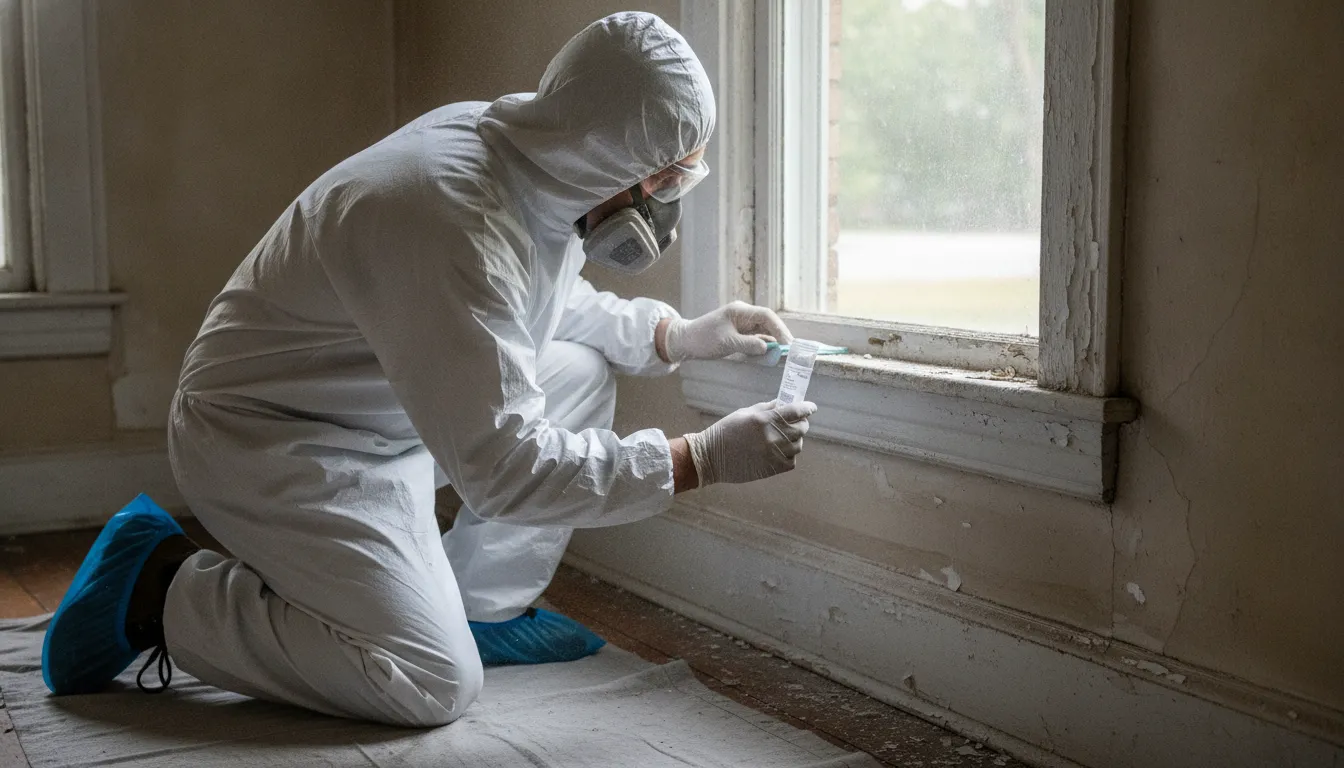
A lead risk assessment Raleigh NC owners request answers a different question than a paint inventory. It asks whether lead in an older home is already a hazard people can breathe or swallow. It does not only ask whether lead paint is somewhere in the building. That matters in pre-1978 houses around Oakwood, Boylan Heights, and other Triangle neighborhoods. Paint there can look fine until a window rubs, a door slams, or a renovation starts.
Remtech Environmental works with Raleigh homeowners, landlords, property managers, and buyers who need that distinction before they renovate, lease, or sell. Our EPA-accredited specialists start with what the property is doing now, then explain the options without a scare pitch. If you already know lead paint is present and want a map of every painted component, start with a Raleigh lead paint inspection. A risk assessment is the next step when dust, damaged paint, or young children are the concern.
Call (919) 554-2800 or get a free quote.
What a Lead Risk Assessment Raleigh NC Visit Looks For
EPA describes a lead risk assessment as a visit by a certified risk assessor. The visit looks for lead-based paint hazards in target housing and child-occupied facilities built before 1978. It is not a room-by-room catalog of every painted surface. The assessor is looking for conditions that can put lead into dust, onto hands, or into soil people use.
On a typical Raleigh visit, the work follows EPA's lead-based paint activity rules. The agency explains who may do a risk assessment, and how it differs from an inspection, in its guide to lead abatement, risk assessment, and inspection. Expect four kinds of evidence, not a single gadget reading.
- A visual check for deteriorated paint, plus notes on why it is failing. Friction from double-hung windows and impact from doors are common causes in older Triangle houses.
- Background on the building and how people use it. The assessor asks where children under 6 sleep, play, and crawl.
- Testing of deteriorated paint on friction and impact surfaces, and on other visibly damaged painted surfaces that have their own paint history.
- Dust samples from floors and interior window sills in living areas where young children are most likely to contact dust.
Paint that is intact and not on a rubbing or banging surface may not be the priority of this visit. The report is about current hazards. A later remodel can still turn intact paint into dust, which is a separate planning question.
Inspection, risk assessment, and renovation rules
People mix these up because all three show up around older paint. They are different jobs under EPA's lead rules.
| Question you have | What fits | What you get |
|---|---|---|
| Is there lead paint, and where? | Lead paint inspection | A surface-by-surface inventory, often with an XRF analyzer or paint-chip samples |
| Is lead already a hazard people can contact? | Lead risk assessment | A visual review, dust samples, and a written hazard finding with options |
| Will a contractor disturb paint during other work? | Lead-safe renovation practices | Containment and cleanup rules for disturbing paint in pre-1978 housing, not a hazard study |
EPA's lead program puts inspection and post-abatement testing with certified inspectors. Risk assessors may do those tasks and also a risk assessment or a lead hazard screen. Abatement, which is work designed to address a lead hazard, is a separate certification from renovation work. Remtech's Raleigh team can walk through which one matches the job in front of you.
When Raleigh Owners Should Ask for One
Age of the building is the first filter. Federal rules treat housing built before 1978 as the group where lead paint is most likely. A risk assessment is worth a call when one of these is also true.
- A child under 6 lives in the home, visits often, or will after a lease or sale.
- Paint is peeling, chalking, or cracking on windows, doors, stairs, porches, or trim.
- You are buying or leasing an older Raleigh property and want hazard findings, not only a paint inventory.
- A daycare, preschool, or other child-occupied space is in a pre-1978 building.
- Someone already found lead paint, and you need to know whether dust or damaged areas are the actual problem.
Landlords and property managers use this visit before a turnover when the unit has original windows or failing paint. Buyers use it when a contract gives time to check for lead hazards. Homeowners use it before they decide between leaving paint in place and planning removal.
You do not need a risk assessment for every pre-1978 house with sound paint and no children. You also should not treat a hardware-store swab as a substitute. Those kits read the top layer and miss buried paint and settled dust. If the question is hazard, not curiosity, use a certified risk assessor.
What this visit does not replace
A risk assessment does not write your seller disclosure, price an abatement, or clear a finished project. Disclosure rules for North Carolina sales and leases live in a different guide. Cost depends on access, occupancy, and which components are involved, so we do not publish a flat rate. Clearance testing after abatement is its own step, with dust limits that are not the same numbers used to decide whether a hazard exists today.
What to Gather Before the Visit
A useful visit starts with facts you already have. Remtech asks for these before we scope a Raleigh lead risk assessment, because missing history leads to vague reports.
- Year built, or the closest record from the deed, tax card, or listing. Note any post-1978 additions separately.
- Who occupies the property, including children under 6, and which rooms they use most.
- A simple list of failing paint: windows that stick, doors that chip, porch rails, stairs, and any recent water stain under paint.
- Prior testing, inspection reports, or renovation invoices. Bring the paper even if the result was "no lead."
- Plans for the next 12 months: a lease, a sale, a window replacement, or a full remodel.
- Access notes. Occupied rentals, locked rooms, and shared halls change where dust samples can be taken.
Photos of damaged trim help, but they do not replace the visual inspection. Do not scrape or sand a sample yourself before the visit. That spreads dust and can hide the condition the assessor needs to see.
If the building is a multiplex or a childcare space, say so early. EPA requires extra dust samples in common areas for those properties, not only inside one dwelling.
Plan a Raleigh Lead Paint Evaluation
How to Read the Risk Report
The report should separate three ideas. Look at where paint is deteriorated, where testing found lead, and where dust is high enough to treat as a hazard. A page that only says "lead present" is an inventory, not a risk assessment.
Ask the assessor to point at each finding and the choice that fits it. EPA's current dust rules, finalized in October 2024, changed the old floor and sill numbers. For risk assessments in pre-1978 homes and childcare facilities, dust is reportable at any level a National Lead Laboratory Accreditation Program lab can report. That replaced the older hazard levels of 10 micrograms per square foot on floors and 100 on window sills.
A different set of numbers decides when EPA recommends abatement and when abatement dust cleanup is done. Those dust-lead action levels are 5 micrograms per square foot on floors, 40 on window sills, and 100 on window troughs. If dust is reportable but still under those action levels, EPA does not recommend abatement from the dust result alone. It points to practical control instead: a HEPA vacuum on soft items, and damp cleaning of hard surfaces with a general cleaner.
That split is why the report matters. A finding can mean "clean and watch" or "plan abatement," and those are not the same project. Soil and paint condition still count. Chipping paint on a friction surface can justify more than a cleaning plan even when one dust wipe is low.
Options the findings usually support
Remtech explains the tradeoffs for the component in front of you. None of these is a default for every Raleigh house.
- Maintain and clean. Intact paint and low-concern dust can stay, with wet cleaning and a plan not to sand it.
- Stabilize. Loose paint is repaired and recoated when the substrate is sound and no one needs the paint gone.
- Encapsulate or enclose. A durable coating or a new layer covers the paint when removal would harm historic trim.
- Remove or replace. Windows, doors, or other components come out when friction, damage, or the project scope makes covering a poor fit.
Abatement is the set of measures designed to address a lead hazard. It can include removal, replacement, enclosure, or encapsulation. It is not the same as a painter disturbing paint while doing other work. If the report recommends abatement, the next conversation is scope, occupancy, and documentation, not a single method pushed for every room.
From the Report to a Raleigh Work Plan
Bring the report to the service conversation. Our Raleigh lead paint page is where evaluation turns into a project: what should be tested, what should be left, and how occupants stay out of dust. We serve homes and smaller commercial spaces across Raleigh and the surrounding Triangle, with the same education-first scope we use on asbestos and mold work.
A clear handoff includes the components named in the report, who will be in the building. And whether the goal is hazard control now or prep for a renovation. IICRC-certified technicians and EPA-accredited specialists are part of how Remtech staffs that work. We carry general liability, workers' compensation, and pollution liability coverage, and we price from the property rather than a posted rate card.
If you are still choosing a firm, read how a full lead paint abatement project is planned in North Carolina. Our lead paint abatement cost guide covers which conditions move a quote. Those pages cover method and budget. This one stops at the hazard finding.
Owners who want the company history before they book can read about Remtech. Bryan King started the company in the late 1990s after NC State engineering training, and the Raleigh team still leads with an explanation before a proposal. For properties outside the city but inside our day-to-day radius, the Raleigh service area page lists the communities we schedule from this office.
Have the year built, the occupancy, and any old test results ready. That is enough to tell whether a risk assessment, an inspection, or a work plan is the right first call.
Frequently Asked Questions
Is a lead risk assessment the same as a lead paint inspection?
No. An inspection maps where lead paint is, component by component. A risk assessment looks for hazards: deteriorated paint, the way people use the space, and dust on floors and window sills. You may need one, the other, or both.
Who is allowed to perform a lead risk assessment?
EPA rules say a risk assessment is done by a person certified as a risk assessor. An inspector certification covers inspection and post-abatement testing. It does not, by itself, cover a risk assessment. Ask for the certification before you book.
Do I need one if my Raleigh home was built after 1978?
Lead paint in housing is mainly a pre-1978 issue under the federal target-housing rules. Homes built later are a lower priority for this visit. If you have failing paint and a specific health concern, say so and we will tell you whether testing still makes sense.
Will the assessment tell me to remove all the paint?
Not usually. Many findings support cleaning, stabilization, or a coating when paint is intact. Removal or component replacement fits friction surfaces, badly damaged material, or a renovation that will disturb the paint anyway.
Can I stay in the house during the visit?
Yes for the assessment itself. Dust wipes and a visual review are not an abatement project. Keep children off the areas being sampled until the assessor is finished. Do not clean those sills the morning of the visit if you want a true reading.
Talk Through Your Raleigh Lead Findings
If a pre-1978 Raleigh property has damaged paint, young children, or a deal that needs hazard facts, start with a lead risk assessment. Do not guess from a paint color. Remtech will tell you whether you need a hazard study, a paint inventory, or a scoped work plan. We will also say what to bring to that call.
Send the year built, a few photos of failing trim, and who lives in the house. We will answer with the fitting next step and a project-specific quote. No phone tag required. Use the quote form and a specialist follows up.