
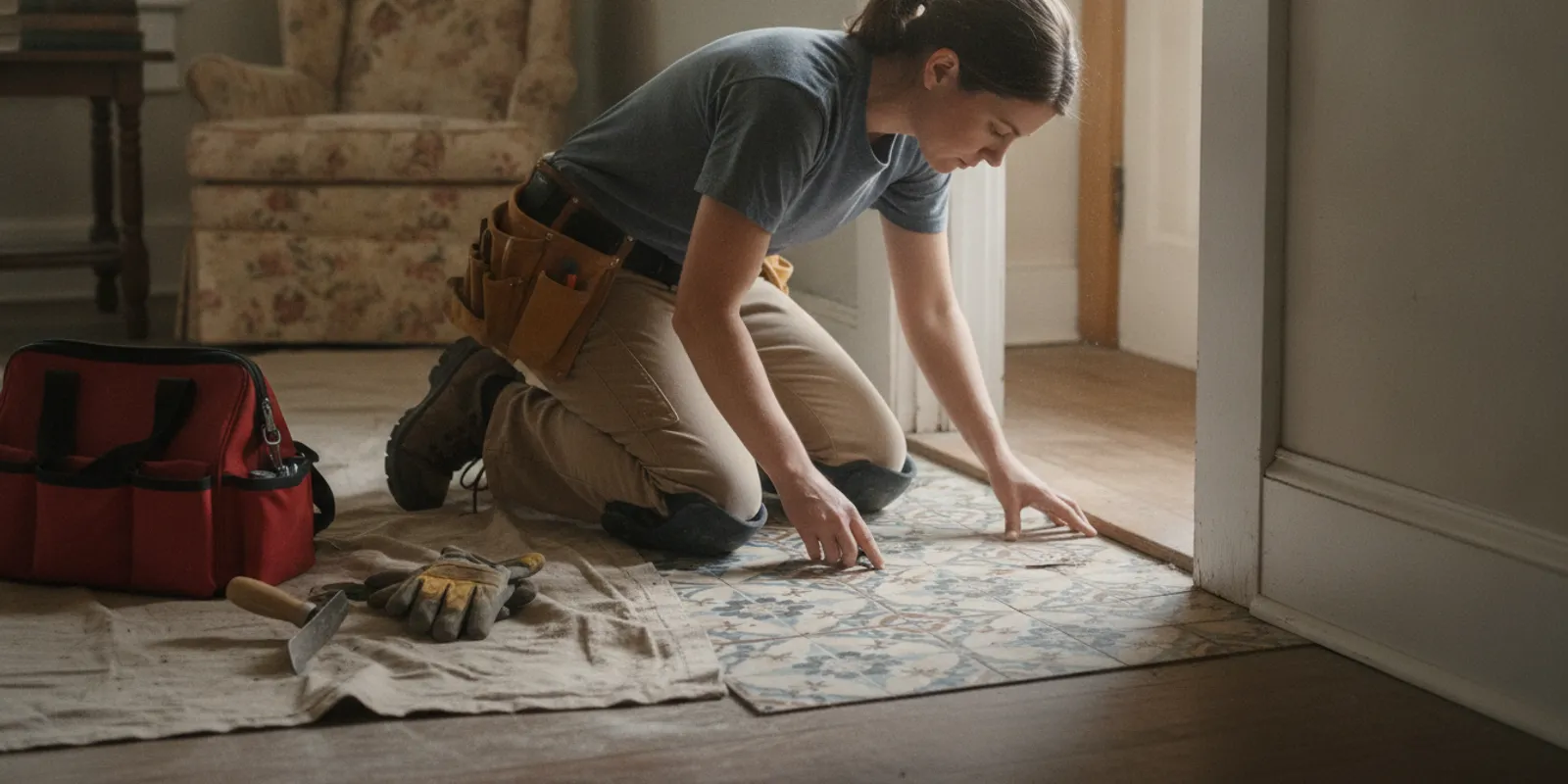
Asbestos tile can raise questions when you are planning a renovation or evaluating older flooring in a North Carolina property. Age and appearance cannot confirm whether a material contains asbestos, and intact flooring left undisturbed is a different situation from flooring that will be cut, scraped, drilled, or removed. A careful plan starts by identifying what is known and what still needs professional assessment.
Where might asbestos tile be found?
Asbestos-containing flooring may be present in older homes, offices, and other buildings. It can include resilient flooring often described as vinyl tile, as well as other tile-like products. The visible flooring is only part of the assembly. Adhesive or mastic beneath it, backing, underlayment, and older layers below a newer finish can also matter when a project will disturb the floor.
That does not mean every old floor contains asbestos. A color, pattern, size, or texture is not a reliable test. Buildings may have had several renovations, and the visible surface may not reveal the material underneath. Treat appearance as a reason to ask questions, not as a diagnosis. Remtech’s asbestos overview provides broader background.
Start by gathering existing information without lifting a tile or scraping adhesive. Look for renovation records, prior assessment reports, plans, or documents from a property sale. Note which rooms were renovated and whether the records identify specific materials and locations. A report about one room or one flooring layer may not describe a separate area or a later installation. Missing records do not prove a material is asbestos-free.
For a North Carolina property, the practical question is often not simply whether an old floor exists. It is whether planned work will affect it, whether its current condition calls for attention, and what evidence can guide the decision. Remtech’s Raleigh asbestos service information and service-area overview provide local context for property owners considering professional guidance.
Why does the condition of the flooring matter?
Condition and activity are important parts of the decision. Intact material that remains in place and is not being disturbed presents a different management question from cracked, crumbling, loose, or deteriorating flooring. A renovation can change the situation: cutting through flooring, grinding, sanding, drilling, scraping adhesive, or pulling tiles may disturb material that would otherwise remain undisturbed.
Do not test the material by breaking an edge or making a small opening. Avoid actions that could create or spread dust, such as scraping a loose piece, sweeping debris, or using a household vacuum on suspect material. Keep people and pets away from an area where flooring is deteriorating. Do not handle loose fragments or carry them to another room. If work has already started, stop the activity involving the suspect layer and seek qualified advice about the next steps.
These precautions are not a diagnosis or a claim that every older floor must be removed. The proper response depends on the material, its condition, the work being planned, and applicable requirements. A professional may discuss leaving material in place and preventing disturbance, or may explain why assessment or a different project approach is warranted. Ask for the reasons behind the recommendation rather than assuming one option fits every building.
For example, a property owner who wants to replace cabinets may find that the proposed work does not require touching the floor. The plan may be different from a full flooring replacement that requires scraping the adhesive. In either case, establish what the contractor intends to do before work begins. A clear description of the work helps determine whether suspect flooring needs to be assessed before the project proceeds.
Can you identify asbestos tile by sight?
No visual checklist can reliably confirm asbestos content. Age may help a professional decide what materials deserve investigation, but age alone is not proof. A product that resembles a flooring type associated with asbestos may not contain it, while an ordinary-looking floor does not rule it out. The same caution applies to adhesive, backing, and concealed layers.
When confirmation is needed, sampling and analysis should be planned and performed by appropriately qualified people. Do not take a sample yourself by breaking off a corner, scraping mastic, or lifting a section. A small sample can disturb material, and it may not represent all the layers or locations relevant to the project.
Before an assessment, describe the work you expect to do. Ask which materials and locations will be assessed, whether the floor assembly has multiple layers, and how the work area will be protected. If rooms have different flooring or renovation histories, ask whether the assessment scope covers each area of concern. A result should be interpreted in relation to the specific location and material sampled, rather than treated as a blanket conclusion about an entire building.
The University of Connecticut Environmental Health and Safety page on floor tile management addresses situations involving tile or mastic found to contain asbestos and points to qualified abatement considerations. It supports a practical principle: the floor and adhesive both matter, and management decisions should follow the circumstances rather than guesswork. Consult the applicable professionals for your specific property and project.
What should you do if you find suspect flooring?
- Pause work that could disturb it. Tell household members and contractors not to cut, drill, scrape, sand, or pull up the suspect layer until its status and the plan are clear.
- Limit access if material is damaged. Keep people away from the affected area and avoid cleanup, handling, or moving debris. Do not sweep or use a household vacuum.
- Record what you can observe safely. Note the room, visible condition, renovation history, and work you hoped to complete. Ordinary photographs from a safe distance may help explain the concern if they can be taken without touching or moving anything.
- Gather records. Collect available assessments, renovation documents, and project plans. Keep track of which room and flooring layer each record describes.
- Ask about professional assessment. Explain the intended work and ask whether assessment is appropriate before it proceeds. Request a scope that distinguishes known information from assumptions and unanswered questions.
- Wait for a clear work plan. Do not restart work on the affected flooring until the next step has been discussed with qualified professionals and the project team understands its responsibilities.
These steps help keep a property decision grounded in the actual condition and project. If a renovation crew has already disturbed material, avoid trying to clean it up yourself; stop work in that area and request site-specific guidance. A photograph or verbal description cannot substitute for an assessment, but accurate notes can help a professional understand what happened and where.
Property owners in the Triangle can review Remtech’s information on asbestos services in Cary, asbestos services in Durham, and Apex asbestos services. These pages provide local service information; a property-specific conversation is needed to determine what applies to an individual project.
How do assessment and removal differ?
An assessment helps answer what material is present, where it is located, and how it relates to the planned work. A removal or abatement scope describes how confirmed or presumed asbestos-containing material will be managed as part of a project. They are related but distinct decisions. Requesting an assessment does not automatically mean that removal is necessary.
Depending on the circumstances, a professional may discuss leaving material intact and managing it in place, isolating or covering it under an appropriate plan, or having it removed by qualified personnel. This article cannot determine which approach is right for a particular floor. Condition, future access, construction methods, and project-specific requirements all matter.
A useful proposal states which rooms, materials, and layers it covers; what work is planned; how the work area will be controlled; how debris will be handled; and what documentation will be provided. It should identify assumptions, exclusions, and the process for addressing unexpected layers. Remtech’s guides to how asbestos abatement works and abatement basics can help you prepare questions.
| Situation | What it may mean | Practical next step |
|---|---|---|
| Older flooring is intact and no work is planned | There may be no immediate reason to disturb it; appearance does not confirm its contents. | Keep it in good condition, avoid damaging it, and retain relevant records. |
| A renovation will affect the floor | Cutting, scraping, or removal could disturb tile or adhesive that has not been assessed. | Pause work on the suspect layer and ask whether assessment is needed first. |
| Tile or adhesive is damaged | The condition warrants attention, but visual inspection still cannot identify asbestos. | Keep people away, avoid handling or cleanup, and seek qualified advice. |
| Asbestos-containing material has been confirmed | The management choice depends on condition, planned work, and project requirements. | Review a documented plan for appropriate management or professional removal. |
What questions help clarify a recommendation?
A useful conversation should leave you understanding what is known, why a step is proposed, and what question it answers. Consider asking:
- What supports the conclusion about the tile, adhesive, and underlying layers?
- Is the recommendation based on laboratory results, property records, an assumption, or visual observation?
- Does the planned renovation require disturbing the material, or can the design avoid it?
- Which rooms, materials, and layers are included in the assessment or work scope?
- Who will perform any sampling or abatement, and what qualifications and procedures apply?
- How will the work area be managed, and how will debris and the site be handled?
- What records will I receive, and what do they establish or leave unresolved?
- What conditions could change the scope, and how will a change be explained before added work begins?
Answers should be specific to the building and project, not based on pressure or broad claims. If someone recommends immediate removal without explaining the basis, ask for the reasoning and scope in writing. If you receive multiple proposals, compare what each includes rather than comparing only the headline recommendation or price. Costs are project-specific; there is no single standard rate that applies to every tile floor.
Remtech describes its specialists as EPA-accredited and its technicians as IICRC-certified. Ask any provider which credentials and procedures apply to the work being proposed. The company background page offers additional information about Remtech. A provider should be able to explain the limits of an assessment and how its recommendations connect to the work you intend to do.
What should a removal proposal explain?
Read the proposal as a description of work, not merely as a final number. Check that it identifies the rooms and flooring layers involved. If the building has several rooms or multiple renovations, ask whether the proposal covers all areas you expect to change. If it does not, clarify what remains outside the scope and whether that affects the renovation schedule.
Look for a plain explanation of the work sequence. What preparation is included? How will access be controlled? What happens to the material and debris? What cleanup and completion documentation are included? If a proposal uses technical terms, ask for a direct explanation. You should be able to describe the main steps and understand what evidence you will receive when the work is complete.
Also ask how unexpected conditions will be handled. A hidden layer, a different adhesive, or a damaged section may alter the work plan. The proposal should explain how the provider will notify you, document the condition, and discuss changes before proceeding. Clarify who coordinates with flooring installers or other renovation trades and when they can return to the area.
For comparison, request the same details from each provider. One scope may cover assessment only, while another may include a defined removal area and closeout records. Those are not interchangeable offers. Compare the materials and rooms included, preparation, work-area controls, debris handling, documentation, assumptions, and exclusions. Remtech’s planning information may help organize questions before a scheduled project.
How can you compare contractors fairly?
Verify that a provider is qualified for the specific work being proposed and can explain how it will be performed. Ask about relevant credentials, procedures, work-area controls, debris arrangements, and records. Do not rely on a broad claim that a company is qualified without understanding who is doing which part of the work and what the proposal includes.
Use a simple comparison sheet. Put each provider’s scope in one column and list the same elements for each: area and material; assessment or removal tasks; preparation and access controls; debris handling; cleanup; documentation; schedule assumptions; exclusions; and steps for unexpected conditions. A blank or unclear item is a prompt for a follow-up question, not proof that a task is or is not included.
Consider an example: one proposal covers a kitchen floor but does not mention the adjacent pantry, while another describes both rooms but excludes a separate hallway layer. A lower total does not tell you which scope better matches your renovation. Ask each provider to explain the boundary and, if necessary, revise the written description so the comparison is like for like.
For Raleigh-area property owners, Remtech’s asbestos service information is a starting point for discussing a project. The company’s contact page provides a direct way to ask about a consultation. Any recommendation should make clear what is based on documented findings and what requires further evaluation.
What if you are planning a renovation?
Raise the flooring question before demolition or installation starts. Share existing records with the project team and identify whether the planned work will touch the old flooring, adhesive, or substrate. A new finish over an existing floor is not automatically suitable; its appropriateness depends on the assembly, condition, design, and project requirements. Do not use covering as a shortcut around evaluating damaged material or a planned disturbance.
Coordinate timing. If assessment is needed, schedule it early enough for the findings to inform the contractor’s scope. If professional abatement is part of the plan, establish which party is responsible for each task and how completion will be documented before the next trade begins. This reduces the chance that a renovation crew will unexpectedly encounter an unassessed layer.
Owners and managers of rental or commercial properties can keep assessment and project records with building documents. Record the areas reviewed, the materials described, the findings, and any stated limitations. When future work may affect the same areas, provide relevant records to the project team. Do not assume an older report covers a different room, a new layer, or a later alteration.
For projects across the region, Remtech’s Asheville asbestos service page and Durham asbestos service page offer local service context. The quote request page is another route for discussing project-specific needs.
Frequently Asked Questions
Does old tile always contain asbestos?
No. Age may be a reason to investigate, but it does not prove that a particular tile or adhesive contains asbestos. When confirmation is needed, ask qualified professionals about assessment of the specific materials and locations.
Can I remove one tile to see what is underneath?
Avoid breaking or lifting a suspect tile yourself. Doing so may disturb the tile, adhesive, or hidden layers. Pause work and seek qualified guidance about assessment and the project plan.
Is removal always necessary if asbestos is present?
Not necessarily. The appropriate approach depends on the material’s condition, whether planned work will disturb it, and project-specific requirements. Ask for an explanation of the basis for managing it in place or proposing removal.
Can a new floor covering go over old tile?
That depends on the existing floor’s condition, the proposed assembly, and applicable project requirements. Do not cover damaged material or proceed with installation until the floor and work plan have been considered as needed.
What if a renovation crew has already started pulling up tile?
Ask them to stop work on the suspect material, keep people away from the affected area, and avoid sweeping or vacuuming debris. Contact a qualified professional for site-specific guidance before cleanup or work resumes.
Plan the next step around the material and the work
Asbestos tile cannot be identified by appearance alone, and finding older flooring does not automatically mean removal is needed. Avoid disturbing suspect material, consider its condition alongside the renovation plan, and ask for a clear explanation of any assessment or proposed work. Remtech’s free quote request page is available if you would like to discuss a project-specific consultation.
A documented understanding of the material and a clearly defined scope can help you make a practical decision without relying on guesswork or pressure.