
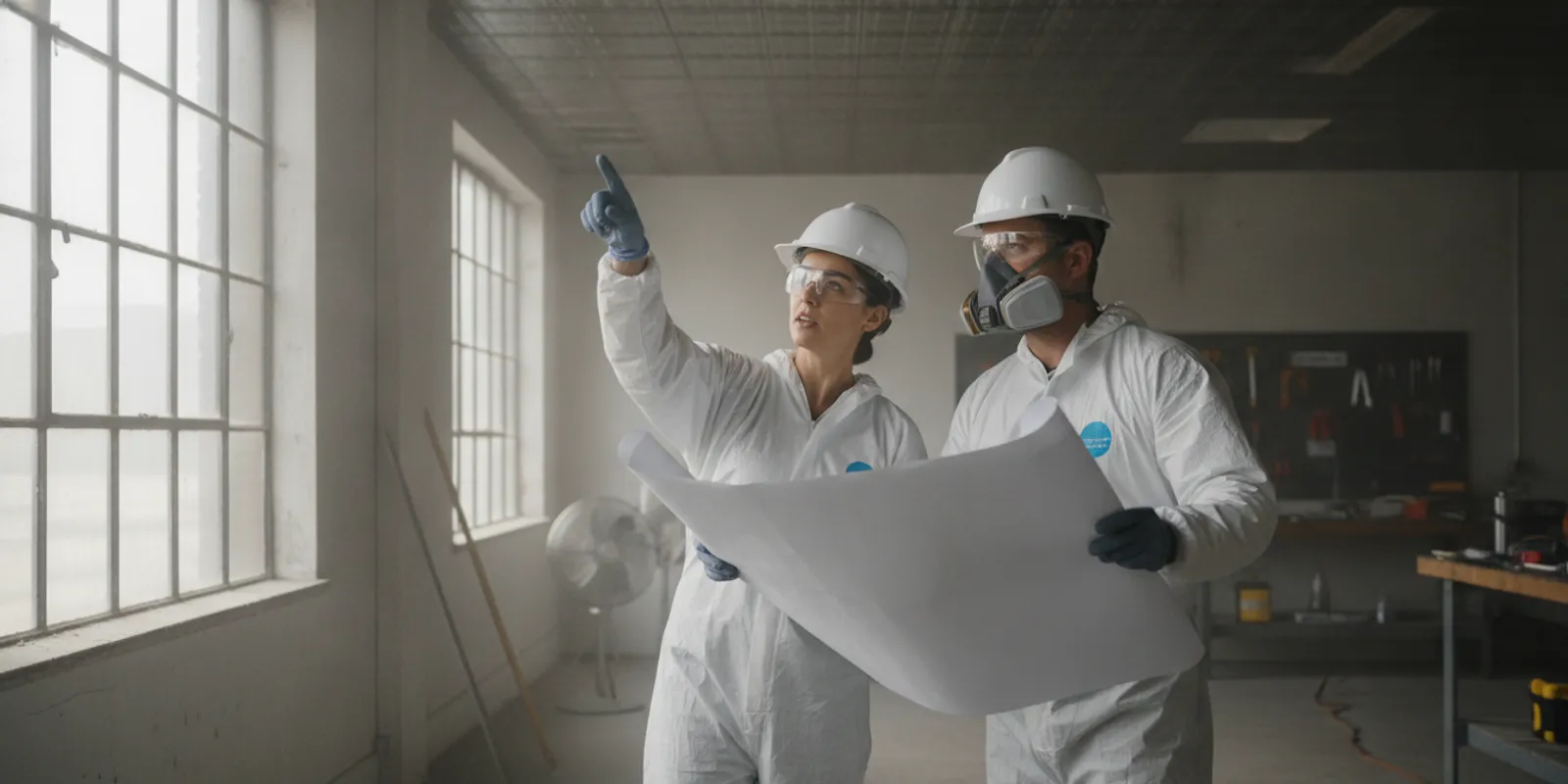
Commercial asbestos encapsulation may be considered when asbestos-containing material is in place, can be safely left undisturbed, and a qualified assessment finds that a suitable coating or covering can control exposure risks. It is not a universal substitute for removal: the material’s condition, location, planned building work, and ability to manage it over time all matter. For North Carolina property owners and managers, the decision should start with facts about the material and the building’s intended use, not alarm or assumptions.
What does commercial asbestos encapsulation mean?
Encapsulation is a method of controlling asbestos-containing material (ACM) by applying or installing a suitable barrier so fibers are less likely to be released. Depending on the material and project, a professional may use a coating that binds or seals the surface, or a durable covering that separates the ACM from the occupied space. The right system depends on what the material is, its condition, and the conditions it will face.
The goal is to control access to fibers while leaving the ACM in place. That distinguishes encapsulation from removal, where asbestos-containing material is taken out, and from enclosure, where it is isolated behind a separate barrier. These approaches are not interchangeable in every situation. A coating cannot reliably solve a problem if the underlying material is breaking down, if the coating will not adhere, or if future construction is likely to disturb it.
Encapsulation also does not make the material disappear. The ACM remains part of the building and may need to be identified, protected from damage, and considered when maintenance, renovation, or demolition is planned. A property team should retain the assessment and project information with building records so future decision-makers know what is present and what controls were installed.
For a broader introduction to asbestos and the reasons it can be a concern, see what property owners need to know about asbestos. For commercial properties, the key question is more specific: can the material be left in place and controlled under the actual conditions of this building?
When might encapsulation be considered for a commercial property?
Encapsulation may be worth evaluating when ACM is in a stable condition, is not scheduled for removal as part of planned work, and can be reached and treated without creating a greater disturbance. Examples might include certain intact materials in a limited-access area or a surface that can be protected from routine contact. Those examples are not a recommendation for any particular building: materials that look similar can differ in composition, condition, and suitability for a control method.
It may also be considered when a project needs to manage an identified material while keeping other building operations in view. A professional assessment should establish whether the proposed control is technically appropriate and how it would be maintained. The property owner, facility manager, and remediation professional should also consider whether the work can be scheduled in a way that controls access and protects occupants and workers.
There are important limits. Encapsulation may not be appropriate if the ACM is damaged, deteriorating, very soft, damp, or otherwise unable to support the proposed treatment. An Oregon State University student research paper discussing least-cost approaches notes that encapsulation is not recommended for very soft or poor-condition ACM because the added weight can cause further damage. That paper is not a substitute for a site-specific professional judgment, but it reinforces why condition matters. Review the paper, “Asbestos Abatement for Business Owners: Identifying a Least-Cost Approach”, as background rather than a project specification.
Encapsulation may also be a poor fit if walls, ceilings, mechanical systems, or other building components will soon be opened or modified. A barrier that is disturbed by later work may no longer control the material. Likewise, if maintenance staff cannot identify the treated area or prevent accidental damage, an in-place solution may be difficult to manage reliably. The answer depends on current conditions and the building’s plans, not just the apparent convenience of leaving the material in place.
How does encapsulation compare with removal or enclosure?
Property teams often frame the choice as “encapsulate or remove,” but an evaluation can include continued management, enclosure, or removal. A qualified professional should explain which options are feasible and what each means for the particular material. The table below is a planning aid, not a determination for a specific site.
| Approach | What it generally does | When it may be evaluated | Important planning point |
|---|---|---|---|
| Encapsulation | Applies a suitable coating or covering to control fiber release from ACM left in place. | When the material and surface are in a condition compatible with the proposed treatment. | ACM remains in the building; protect it and track it for future work and maintenance. |
| Enclosure | Places a separate barrier around or over ACM to limit contact or disturbance. | When the area can be isolated effectively and the barrier can remain intact. | Access, inspection, penetrations, and later renovation can affect the enclosure’s performance. |
| Removal | Takes ACM out of the affected area under an appropriate abatement plan. | When the project requires removal or an assessment concludes an in-place control is unsuitable. | Removal is a controlled project, not ordinary demolition; scope and work practices need professional planning. |
| Manage in place | Leaves stable ACM undisturbed with an appropriate identification and management approach. | When no disturbance is planned and the material’s condition supports this approach. | People responsible for maintenance and future work need to know the material is present. |
These options involve different scopes and site conditions, so there is no responsible universal price comparison. Cost depends on factors such as the material and its area, access, the condition of the ACM, occupied-building constraints, containment needs, waste handling, and the work required to restore affected spaces. An estimate should describe the proposed scope and assumptions rather than presenting a standardized rate.
Federal guidance on assessment and abatement describes different approaches, including dry removal, wet removal, and encapsulation of friable asbestos insulating materials. It can help readers understand that control methods are selected in relation to the material and work, rather than being one-size-fits-all. See the government publication Guidelines for Assessment and Abatement of Asbestos-Containing Materials.
What should a property team assess before choosing encapsulation?
Start by clarifying what is known and what is not. A visual impression alone cannot establish whether a material contains asbestos. Gather any existing survey, inspection, laboratory, renovation, and abatement records, and identify the source and date of each. If records do not answer the question, ask a qualified asbestos professional whether additional inspection or sampling is appropriate for the intended project. Avoid disturbing a suspect material just to find out what it is.
Then assess how the building is actually used. A material in a locked service space may face different contact and maintenance conditions than one in a frequently accessed corridor. Consider routine cleaning, repairs, equipment installation, tenant improvements, vibration, and the movement of people or stored items. Identify who could encounter the material, how the area is accessed, and which activities could disturb it.
Next, bring the work schedule into the decision. List planned renovations, repairs, equipment replacements, tenant changes, and demolition, even if those plans are preliminary. A control that makes sense for a building with no planned work may not make sense if the area will soon be opened. Coordinate the asbestos assessment with architects, contractors, facility staff, and owners early enough to avoid designing work around an unverified assumption.
Finally, consider whether the building can sustain the chosen control. Ask who will know the location and condition of the ACM, how the area will be protected, and how future maintenance teams will receive the information. A successful project is not only the application of a product or the completion of removal. It includes a clear handoff about what remains, what was done, and what future work must consider.
What does the assessment and project process typically involve?
Each property and scope differs, but an orderly process helps owners compare proposals and make informed decisions:
- Define the decision. Explain whether you are planning routine operations, a repair, a renovation, a change in use, or a larger redevelopment. The intended work influences what information is needed.
- Review records and affected areas. Share prior surveys and project documents with the professional. Identify the parts of the building that may be affected, rather than assuming that a single material or room represents the entire property.
- Evaluate condition and disturbance potential. The professional considers the material, its location, accessibility, current condition, and whether proposed work could disturb it. Ask what observations or testing support the conclusion.
- Compare feasible controls. Discuss encapsulation, enclosure, removal, or management in place where relevant. Ask why a proposed method fits the material and what conditions would make another approach necessary.
- Plan access and communication. Establish who needs to know about the work, how areas will be controlled, how building operations may be affected, and how questions from tenants or staff will be handled.
- Document the outcome. Request clear records of the work area, selected method, materials addressed, any material left in place, and recommendations for future access or work. Keep those records with facilities and renovation documentation.
For a closer look at the sequence involved in a removal project, Remtech explains how asbestos abatement works. That overview is useful context, but your project’s written scope should still be specific to the site and planned work.
How should encapsulation be planned in an occupied building?
Commercial properties may have employees, tenants, customers, residents, contractors, or visitors on site. Planning should account for the building’s occupancy and the work area, rather than assuming that one access plan works for every project. Ask the professional to describe how the scope will be separated from normal activity, what areas may be unavailable, and what instructions occupants or facility staff will receive.
Coordinate the schedule with building operations. A property manager can identify busy periods, sensitive operations, deliveries, cleaning, and maintenance tasks that might overlap with the work. Share those details before the proposal is finalized. Where a project affects tenant spaces or shared areas, establish who will communicate schedule updates and how access questions will be resolved.
Do not treat a coating or covering as permission for unplanned work nearby. If a contractor needs to drill, cut, attach equipment, or open a surface near known ACM, pause and check the project records and professional guidance first. Make sure work orders and renovation plans give relevant contractors a way to identify locations that need review before disturbance.
Federal asbestos guidance for public buildings emphasizes that asbestos-containing materials can warrant careful attention and management. The EPA study EPA Study of Asbestos-Containing Materials in Public Buildings provides useful background on the issue in commercial and public settings. For any specific property, rely on current applicable requirements and a qualified professional’s assessment, not a general report in place of project advice.
What should you ask an asbestos professional?
A proposal is easier to evaluate when the reasoning is clear. Ask the professional to explain the basis for the recommended option in plain language. Useful questions include:
- What records, observations, or test results support the identification and condition assessment?
- Which materials and exact areas are included in the proposed scope, and what is excluded?
- Why is encapsulation suitable for this material, if that is the recommendation? What findings would point toward enclosure, removal, or another approach?
- How could planned repairs or renovation affect the recommendation?
- What preparation, access controls, and occupant communications are expected for this project?
- What will the project documentation say about ACM that remains in place and future maintenance or construction?
- How is the project price developed, and what conditions could change the scope?
- Which qualified personnel will perform or oversee the work, and what relevant accreditation or certifications do they hold?
Compare proposals by scope and assumptions, not just the bottom-line figure. One estimate may cover assessment, preparation, controls, treatment, documentation, and restoration differently from another. Ask for any exclusions and allowances in writing. Remtech Environmental takes an education-first approach and provides project-specific consultations rather than standardized rates; learn more about the company’s experience and approach.
What should North Carolina owners keep in mind?
North Carolina commercial properties vary widely, from older offices and schools to retail, industrial, and multifamily buildings. Local building age or appearance alone does not establish whether a material contains asbestos. Existing documentation and a project-specific evaluation are more useful than relying on a building’s age as a diagnosis.
Requirements can depend on the project, material, building, and applicable state or federal rules. Do not assume that one notification, permit, work practice, or record requirement applies identically to every job. Ask the professional to identify which current requirements apply to the particular scope and who is responsible for each step. If the work is connected to a renovation or demolition, coordinate the asbestos review before the affected materials are disturbed.
Remtech serves residential and commercial properties across North Carolina, with offices serving the Triangle, Western North Carolina, and coastal and eastern markets. Property teams can review the company’s North Carolina service areas and its Raleigh-area environmental services to understand regional coverage. Remtech’s asbestos specialists are EPA-accredited; ask about project qualifications and scope as part of your consultation.
When should a property owner seek an assessment?
Seek professional guidance before planned work could disturb suspect material, when existing ACM appears damaged or has been affected by maintenance, or when building records are incomplete and a project depends on knowing what is present. A sudden concern does not automatically mean that removal is required. The practical first step is to limit unnecessary disturbance, communicate the concern to responsible property staff, and determine what assessment is appropriate.
For organizations managing several sites, a consistent record process can reduce confusion. Keep available surveys and project reports where facilities and renovation teams can find them. Note which areas were included and the limits of each report, since one assessment may not cover every material or future project. Update records after new inspection or abatement work, and share relevant information with contractors before work begins.
If you are weighing commercial asbestos encapsulation against other options, a consultation can help define what information is missing and which solutions merit comparison. Remtech’s asbestos services in Raleigh are one starting point for Triangle property owners; coverage and project suitability should be confirmed for your address and scope.
Get a Free Quote for Your Property
Frequently Asked Questions
Does encapsulation remove asbestos from a commercial building?
No. Encapsulation is intended to control asbestos-containing material while it remains in place. The material should still be identified in building records and considered before future maintenance, renovation, or demolition.
Is encapsulation always less expensive than removal?
Not necessarily. Project costs depend on the material, condition, area, access, occupancy, controls, disposal or treatment scope, and restoration needs. Request a site-specific proposal that explains its assumptions and compare the included work, not only the totals.
Can a building stay open during encapsulation work?
That depends on the location, scope, work methods, and the building’s operations. Ask the qualified professional to describe the controls, access restrictions, schedule, and occupant communications for the specific project before deciding how the property will operate.
What if the encapsulated material will be disturbed during future renovations?
Tell the asbestos professional about planned work before selecting a control. Future disturbance can change which approach is practical. Keep the location and project records accessible to facilities staff and contractors, and obtain appropriate professional guidance before disturbing the material.
Plan the next step around the material and the building
Commercial asbestos encapsulation can be a useful control in suitable conditions, but it is not a default answer for every building or every ACM. A sound decision accounts for material condition, exposure and disturbance potential, occupancy, scheduled work, and the ability to maintain clear records. If you are evaluating a property in North Carolina, gather available documentation and discuss your project plans with an experienced asbestos professional before work begins.
Clear information and a site-specific plan help property teams choose a practical path without relying on guesswork.