
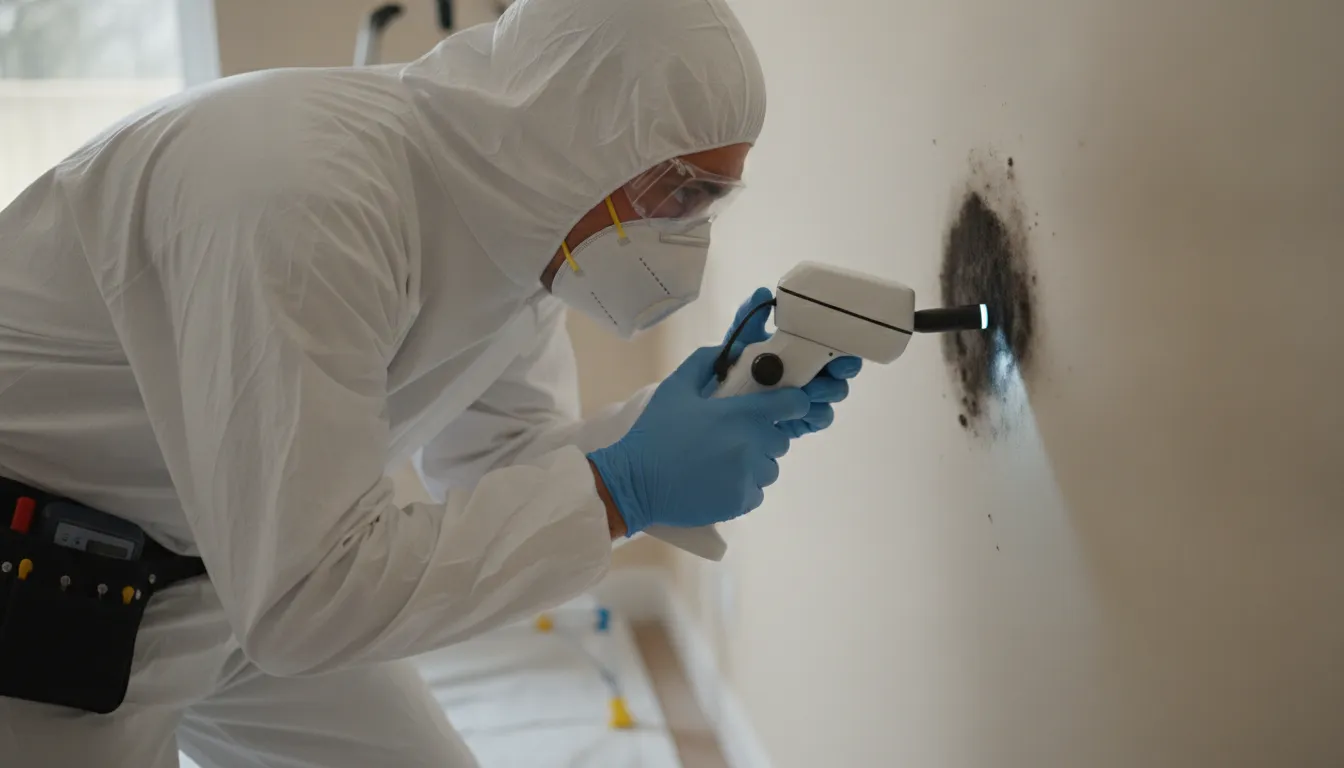
Dark patches on a wall can look alarming. But color alone cannot tell you what kind of mold you are seeing or how serious the health risk may be. Several common indoor molds can appear black, and any indoor growth deserves a measured response: identify the moisture source. Address the affected material, and avoid letting a label drive the decision.
Black mold vs regular mold is not a scientific comparison between one uniquely dangerous type and all other molds. "Black mold" is a common term for dark-looking growth, while Stachybotrys chartarum is one specific species. The CDC advises removing visible or smelled mold regardless of its color or species, because individual reactions vary. See the CDC's mold guidance for context.
To make a sound decision, start by separating the everyday label from the science behind it. That means looking more closely at what people mean by black mold, where it grows, and why appearance is an unreliable shortcut.
What Is Black Mold, and Is It a Real Species?
This is the question homeowners in Raleigh ask most often, and the honest answer may surprise you. There is no single scientific classification called "black mold." The term is a colloquial label, not a species. According to the CDC, mold can look like spots of many different colors. And that simple fact is the key to understanding what you are actually dealing with (cdc.gov/mold-health).
The mold people usually mean when they say "black mold" is a specific fungus called Stachybotrys chartarum. It is a greenish-black mold, and it is real. But it is only one strain among many, and it is not the only mold that appears dark in color. In fact, some of the most common household molds, including Cladosporium, Penicillium, and Aspergillus, can look black or very dark when they grow. Which is why so many homeowners assume every dark spot is the same thing (cdc.gov/mold-health).
What sets Stachybotrys chartarum apart is less its color and more where it grows. It tends to appear on high-cellulose materials such as gypsum board, fiberboard, and paper, and it needs constant moisture to survive. All mold, including this one, requires moisture to grow in both indoor and outdoor environments. Which is why the EPA points to moisture problems as the real root cause to address rather than any single color of mold (epa.gov/mold).
The reassuring takeaway is this: whether the growth is greenish-black Stachybotrys or one of the many other colors of common mold, the guidance is the same. Color alone does not tell you how dangerous it is. If you want to understand what you are looking at, start by learning to recognize the different types of common household mold so you can respond with facts instead of fear.
Health Symptoms of Black Mold vs Regular Mold
The most important thing to understand about the health impact of Black Mold vs Regular Mold is that the color of the mold does not change how your body reacts to it. According to the CDC, the health effects of mold exposure are not species-dependent. Meaning there is no meaningful medical difference between a dark-colored mold and a pale one when it comes to symptoms. What actually matters is how sensitive you are as an individual and how much mold you are exposed to.
For most people, exposure to mold in a home leads to mild, allergy-like reactions. These can include a stuffy nose, a sore throat, coughing, wheezing, burning eyes, or a skin rash. Some people feel nothing at all, while others who are sensitive to mold may react strongly to even a small amount. In other words, two people living in the same home can have very different responses to the same mold, regardless of what color it is.
The picture changes when the exposure happens in large quantities. The CDC notes that severe reactions, such as fever or shortness of breath. Occur mostly among workers exposed to large amounts of mold in occupational settings, such as farmers working around moldy hay. These are high-exposure scenarios, not the typical situation for a household mold problem. People with weakened immune systems or chronic lung disease should be more cautious, since they face a higher risk of lung infections from mold.
What this means for you and your family is reassuring: you do not need to panic based on the color of the growth you found. The CDC's guidance is that all molds should be treated the same way regardless of their health risk, and the same is true for removal. If you spot mold in your home, the practical response is not to determine whether it is "black" or "regular" but to address it promptly. Paying attention to the early signs of mold damage helps you act before a minor issue becomes a larger one.
Comparing Black Mold and Regular Mold Side by Side
When people talk about "black mold," they usually mean a specific species called Stachybotrys chartarum. But the reality is that many common household molds look black too, and distinguishing them by eye alone is difficult. To make the comparison clearer, here is a side-by-side look at how Stachybotrys chartarum stacks up against the everyday molds that grow in most homes.
| Attribute | Black Mold (Stachybotrys chartarum) | Common Household Mold |
|---|---|---|
| Typical appearance / color | Greenish-black in color, often described as slimy or sooty when it stays damp | Cladosporium, Penicillium, and Aspergillus are most common and can appear in many colors, including black and dark green |
| Where it grows | Prefers high-cellulose materials such as gypsum board, fiberboard, and paper | Grows on wood, paper, drywall, carpet, insulation, ceiling tiles, and even dust and fabric |
| Moisture requirement | Requires constant, sustained moisture over time to develop | Needs moisture to grow too, but can often appear after smaller or shorter damp conditions |
| Common species | Stachybotrys chartarum is the species people usually mean | Cladosporium, Penicillium, and Aspergillus are the most common indoor molds |
| Health considerations | Health effects are not tied to the species alone; sensitivities vary by individual and the CDC treats all mold the same | Can trigger allergy-type symptoms such as stuffy nose, coughing, or itchy eyes in sensitive people; not considered uniquely toxic |
| When professional help is needed | Call a professional whenever the growth is large, behind walls, or linked to an ongoing moisture problem, regardless of species | Small areas can often be cleaned by homeowners, but a professional is the right choice for large or recurring growth |
The key takeaway is straightforward: you do not need to identify the exact species to know it should be removed. According to the CDC and EPA, all mold should be treated the same way when it comes to cleanup, because no color or species is proven to be uniquely toxic. What matters most is not the label on the mold, but finding and fixing the moisture that allows it to grow in the first place.
Common Household Molds That Can Look Black
Many ordinary molds grow dark, so a black or nearly black appearance is far more common than people expect. According to the CDC, the most frequently found indoor molds are Cladosporium, Penicillium. And Aspergillus, and all three can show up in dark gray, brown, green, or black shades. That is the key idea behind this article: color alone does not tell you what species you are dealing with. And it certainly does not confirm the presence of the much rarer Stachybotrys.
What most homeowners call "black mold" is usually one of these common varieties. Under typical household conditions you are far more likely to be looking at Cladosporium on a bathroom wall than at the greenish-black Stachybotrys that needs constantly damp. High-cellulose material like gypsum board or paper to thrive. The CDC lists wood, paper, drywall, carpet, and insulation as common growth surfaces, along with dust, paint, wallpaper, fabric, and upholstery when enough moisture is present.
Because these molds are so widespread, they tend to appear in predictable spots. Shower tile and grout, window sills, and the cabinets under sinks are classic examples, especially bathrooms and kitchens where humidity stays high and small leaks go unnoticed. A dark patch in one of these damp, well-trafficked areas is almost always the same everyday mold you have seen before, not a rare or uniquely dangerous species.
The reassuring takeaway is that fixing the moisture problem is what matters, not memorizing species names. Both science and the CDC treat indoor mold the same way: if you see it, clean it up and correct the damp source. When the patch is small and on a hard surface, most homeowners can handle it. When it covers a large area or has grown into drywall or insulation, calling a professional keeps the job done safely and completely.
Want a clearer look at how the common molds compare with Stachybotrys in one place? Keep reading. Source: CDC, About Molds and Moisture.
The Biggest Myths About Black Mold Toxicity
"Toxic black mold" is one of the most overstated phrases in home maintenance. Scare headlines have built a myth around a single type of mold, and much of what people "know" does not hold up. Let us separate fact from fiction.
Myth: "Black mold" is a scientific classification
It is not. The term "black mold" is colloquial, not a scientific category. According to the CDC, no single classification of mold is called "black mold"; the name simply describes what many molds look like when they grow. Mold can appear as spots of many different colors, and several common indoor kinds, such as Cladosporium, Penicillium, and Aspergillus, can look dark or black.
Myth: Black mold is proven to cause severe illness in infants
This myth traces back to a widely publicized theory linking the mold Stachybotrys chartarum to a rare lung condition in infants. The CDC states that this link was never proven, and there is no documented evidence connecting Stachybotrys exposure to acute idiopathic pulmonary hemorrhage among infants.
Myth: A test can prove black mold is causing your symptoms
No test currently proves an association between a specific mold species and particular health symptoms. Sensitivities vary widely from person to person, and the same environment can affect two people very differently. This is why the CDC advises responding to any mold the same way regardless of color.
The bottom line: treat all mold the same
The CDC recommends treating all molds the same when it comes to health risks and removal. Severe reactions, such as fever or shortness of breath, are most often seen in occupational settings where workers face large exposures, not in typical home contact. If you notice early signs of mold damage and moisture trouble in your home, the right move is the same whether the growth is black. Green, or gray: address the moisture source and have the affected area handled properly.
For a closer look at how health effects compare across mold types, see our section on different types of common household mold. The evidence is clear: no panic needed, just a practical plan.
Testing for Mold: What It Can and Can't Tell You
When homeowners find a black-looking patch, one of the first questions is often, "Should I get it tested?" It is a fair question. And the honest answer is that mold testing can be useful in specific situations, but it is rarely the deciding factor in whether to address a problem.
Air sampling and surface sampling can help locate a hidden moisture or mold source. Such as inside a wall cavity or behind a cabinet where you cannot see the growth. After remediation, testing can also verify that cleaning was effective. These are legitimate uses when a professional uses the results to guide the work.
Where testing falls short is in answering "Is this mold dangerous?" The CDC is clear that no test proves an association between a specific mold species and particular health symptoms. When testing finds molds, you meet them everywhere: spores are naturally present in both indoor and outdoor air, and no indoor space is sterile. What a test tells you about the species name rarely changes the recommendation.
The reason is simple: the CDC and EPA treat indoor mold the same regardless of color or type. It is not necessary to determine the exact species before you fix the problem. And identifying the moisture source plus cleaning the growth matters more than the label on the mold. Testing sold mainly to hand you a dramatic species name, with no plan to find the leak or dry the material, is more snake oil than science.
So what should you do? If you see or smell mold, the priority is to stop the moisture and remove the growth, not to chase a test result. When you need help finding a hidden source or confirming a cleanup, a professional can use testing as one tool in a larger, practical process. Learn more about mold risks and cleanups from the CDC's mold facts and statistics page: https://www.cdc.gov/mold-health/data-research/facts-stats/index.html.
When to Call a Professional for Mold Remediation
Many homeowners can handle a small patch of surface mold with soap and water. But the job quickly becomes a professional one once the growth grows beyond a modest cleanup. General guidance from the U.S. Environmental Protection Agency is to address mold growth larger than about 10 square feet with proper containment during the mold cleanup process, because disturbing a larger colony can release spores throughout the home.
Call Remtech for certified professional mold remediation services when any of these red flags apply:
- Mold covers more than about 10 square feet, or is spread across several rooms.
- Growth has moved inside drywall, wall cavities, or insulation, where it is hard to reach and remove.
- A moisture problem keeps returning, which means the underlying leak or humidity source still needs to be found and fixed.
- The heating, ventilation, or air conditioning system may be affected and could be circulating spores through the house.
- Structural wood or insulation has become contaminated and needs careful removal and replacement.
- An infant, an older adult, someone with asthma, or anyone with a weakened immune system occupies the home.
- You need proper containment and air filtration to keep spores from spreading to other rooms.
Any of these situations means the focus shifts from a quick wipe-down to a careful, contained removal. Remtech approaches this work with a strong set of credentials. Its specialists follow the IICRC S520 mold remediation standard, its team is EPA-accredited, and the company has served North Carolina for more than 25 years. An important note for homeowners: mold remediation in North Carolina is not regulated by a state license. So Remtech voluntarily exceeds what is required by applying rigorous professional standards and thorough containment to every project.
If a mold problem feels too large to contain on your own, or it keeps coming back after cleanup, that is a clear signal to bring in help. Remtech can investigate the source, contain the work area, and remove the growth properly while protecting your family. Get a free quote by visiting the free quote page, or learn more about black mold removal.
How to Keep Mold From Returning
Mold usually returns because the conditions that let it grow are still there. The most effective way to prevent it is to control moisture, since every type of mold needs moisture to survive. Here is a practical, step-by-step plan to keep mold from coming back.
- Find and fix the water or moisture source. Look for the leak or dampness feeding the mold, whether it is a pipe, a roof, a window, or condensation. Cleaning visible growth without fixing the moisture source means the mold will simply return.
- Dry water-damaged areas and items within 24 to 48 hours. The EPA advises drying water-damaged areas and materials quickly to prevent mold growth. Carpets, drywall, and wood that stay damp too long become prime ground for mold.
- Reduce indoor humidity and improve ventilation. Keep humidity low, especially in the bathroom, kitchen, and laundry. Use exhaust fans, open windows when you can, and run the fan during and after showers.
- Clean visible growth on hard surfaces with the right products and gear. For small patches on non-porous surfaces, use a detergent solution or a product made for mold and follow the label. Wear gloves, goggles, and a mask, and work in a ventilated area. If growth covers a large area or has soaked into drywall, cleaning is not enough.
- Inspect high-risk areas regularly. Check bathrooms, window sills, under sinks, and crawl spaces for early signs of moisture or growth. Catching a small issue early is easier than waiting until it spreads.
- Know when a recurring problem signals a deeper issue. If mold keeps returning in the same spot, it often points to a hidden moisture source, such as a slow pipe leak or poor drainage. That is a good time to call a professional for a closer look.
Moisture control matters more than the color of the mold you see. If you keep dealing with the same problem, professional mold remediation can find and fix the underlying issue for good. For more on prevention, the EPA offers a useful guide to mold, moisture, and your home.
Frequently Asked Questions About Black Mold vs Regular Mold
What is the difference between black mold and regular mold?
"Black mold" is not a specific scientific classification. It is a colloquial term for any mold that appears dark, and most common household molds fall into a few species. The CDC notes that all molds, regardless of color, should be treated the same when it comes to health and removal. In practical terms, there is little meaningful difference for how you should respond.
Is all black mold considered toxic?
No. There is no test that links a specific mold species to particular symptoms, and color alone does not tell you how risky a mold might be. The CDC and EPA advise treating all molds the same, since any mold can trigger sensitivities and should be removed promptly. Education-first, the takeaway is to clean up any growth rather than worrying about its color.
How can I tell the difference between black mold and regular mold in my house?
You cannot reliably tell species apart by eye. Many common molds, such as Cladosporium, Penicillium, and Aspergillus, can appear black or dark even though they are not Stachybotrys. Since color is not a reliable guide. The practical step is to treat any visible or musty growth the same way and address the moisture source that allowed it.
Can I remove black mold myself like regular mold?
Small patches on hard surfaces, like tile, can often be cleaned with soap and water. Larger areas or growth hidden behind walls should be handled by a professional, since cleanup must also fix the moisture source to keep the mold from returning. The CDC recommends identifying the moisture problem and cleaning up the mold safely, which is more involved than a simple surface wipes.
Is it safe to live in a house with black mold?
Any mold growth indoors should be addressed, because damp environments can cause health effects and damage building materials over time. Severe reactions are mostly linked to large occupational exposures, not incidental home contact. While it is not cause for panic, it is wise to remove the mold and fix the moisture issue rather than leave it untreated.
Take the Next Step With a Trusted North Carolina Mold Team
Understanding what is growing in your home is the first step, but knowing what to do about it matters just as much. Whether you are dealing with a small patch of everyday mold you would like to confirm or a larger area that has spread behind walls and into insulation. Remtech Environmental can help you respond safely and confidently.
For more than 25 years, Remtech has served homes and businesses across North Carolina with a calm, education-first approach. Our EPA-accredited specialists and IICRC-certified technicians take the time to explain what we find and why. Doing the right work the right way without scare tactics or pushy sales. Every mold situation is different, and pricing is always customized to your specific project after an on-site inspection.
If you would like a straightforward assessment of the mold in your home and a clear plan to address it, reach out today.