
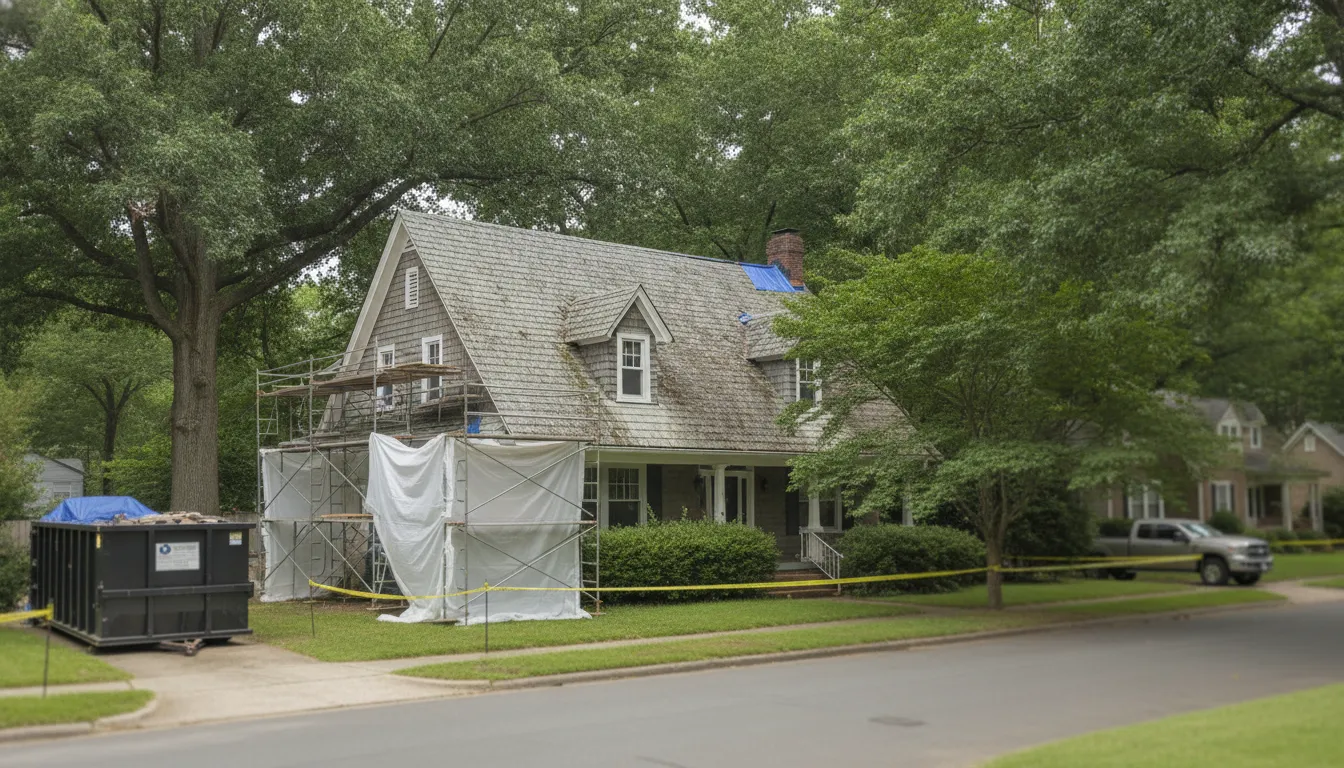
If you own an older home in Raleigh, learning about asbestos in roofing materials can help you avoid an unsafe surprise during repairs, replacement, or solar work. Asbestos may be present in cement shingles, built-up roofing, roofing felt, base flashing, coatings, and other older products. You cannot confirm it by appearance alone, so pause before cutting, drilling, scraping, or removing a suspect roof component.
Where can asbestos be found in roofing materials?
Asbestos in roofing materials is most often associated with older asbestos-cement shingles or panels, built-up roofing components, asphalt or bituminous products, underlayment felts, and some base flashing. A product's age and appearance can raise a question, but only appropriate professional sampling and laboratory analysis can confirm whether a specific material contains asbestos.
The U.S. Environmental Protection Agency's roofing guidance discusses asbestos-containing roof membranes and flashing, including asbestos-cement shingles, asbestos-asphalt shingles, reinforced asbestos felt, and asbestos-containing base flashing. The EPA overview of asbestos regulations for roofing materials is a useful starting point, but it is not a substitute for a project-specific assessment.
| Roofing material | Where it may appear | Why it matters | Safe next step |
|---|---|---|---|
| Asbestos-cement shingles or panels | Exterior roof surfaces, especially on older residential or outbuilding roofs | Often nonfriable while intact, but cutting, breaking, or deteriorating the material can change the risk | Do not drill or break a panel. Arrange professional evaluation before repair or removal. |
| Built-up roofing and roofing felt | Layered low-slope roof systems, membranes, underlayment, and repair layers | Multiple layers can hide suspect material, and removal methods affect fiber-release controls | Have the full roof assembly evaluated before tear-off or power-tool work. |
| Base flashing and bituminous flashing | Roof edges, walls, drains, expansion joints, and other membrane transitions | Older asbestos-reinforced flashing existed, while some visible counterflashing is ordinary metal | Do not assume metal-looking or tar-like flashing is safe or hazardous based on appearance. |
| Asphalt shingles, coatings, and mastics | Older shingles, roof coatings, sealants, and adhesive products | Different products and layers can have different compositions and work-practice requirements | Identify the product and have a qualified professional determine whether sampling is appropriate. |
Not every old roof contains asbestos, and not every asbestos-containing roof must be removed immediately. The practical distinction is between leaving an intact material undisturbed and planning work that will disturb it. Before a roofing contractor starts, make sure the scope explains which layers and details will be inspected, sampled, repaired, removed, or left in place.
What are asbestos-cement shingles, roofing felt, and flashing?
Asbestos-cement shingles are rigid panels made with cement and reinforcing fibers. Roofing felt and built-up roofing are layered products that may use asphalt or other binders. Base flashing seals roof membrane edges and can include reinforced felt or other bituminous materials. These categories are not interchangeable, and a roof may contain more than one product.
Asbestos-cement shingles and panels
Asbestos-cement roofing can look like ordinary gray or weathered shingles. It may remain relatively stable when intact, but age, impact, freeze-thaw cycles, improper repairs, or aggressive cleaning can damage the surface. Avoid drilling, nailing, cutting, grinding, or breaking a panel to make a repair easier. A professional can determine whether testing or a controlled removal plan is appropriate.
Roofing felt and built-up roof layers
Older built-up roofs can contain several membranes, felts, coatings, and adhesives. The visible top layer does not necessarily represent every layer below it. A roof replacement plan that assumes a single ordinary membrane may miss an asbestos-containing underlayment or base flashing. That is why the scope should address the complete roof assembly, not only the surface a worker can see.
Flashing and roof-edge materials
Flashing deserves a careful distinction. Some counterflashing is made from metals such as aluminum, copper, or galvanized steel, while older base flashing and bituminous materials may have used asbestos reinforcement. The EPA roofing guidance notes that asbestos flashing was not manufactured in the United States after about the early 1980s, but an older installation can remain in place. Age is a reason to investigate, not proof of asbestos.
Get a Free Consultation for Suspect Roofing Materials
How can Raleigh homeowners identify asbestos in a roof?
Homeowners cannot reliably identify asbestos in a roof by color, texture, brand, or age. The dependable path is to stop planned disturbance, document the area from a safe location, and arrange an assessment by a qualified asbestos professional. If sampling is warranted, the professional should control the sampling activity and use an appropriately accredited laboratory.
- Start with the building history: Note the home's approximate construction date, previous roof replacements, additions, repairs, and any available invoices or product records.
- Observe without disturbing: From the ground or another safe location, record visible roof areas, damage, exposed layers, and the planned work. Do not climb onto a suspect roof to collect a piece.
- Tell every contractor what you know: Share the age of the home and any concern about original roofing, felt, flashing, coatings, or shingles before anyone begins demolition or repair.
- Use professional sampling when appropriate: A qualified inspector can decide which materials require sampling and coordinate laboratory analysis. A visual guess is not a clearance result.
- Wait for a written scope: Before work starts, ask what will happen to each suspect material, how the work area will be controlled, and how waste and closeout documentation will be handled.
Remtech's Raleigh asbestos testing guide explains why material identification should come before renovation decisions. Testing is especially important when a project will involve tear-off, penetrations for equipment, repairs around roof edges, or any method that can break or abrade an older product.
What happens if roofing asbestos is disturbed?
Disturbing an asbestos-containing roof can release microscopic fibers into the air, where they may be inhaled. The risk depends on the material's condition, the activity, the tools and methods used, the work area, and the controls in place. Avoiding disturbance is the safest immediate response when a suspect material has not been evaluated.
Asbestos exposure is associated with serious diseases, including asbestosis, lung cancer, and mesothelioma. A single visual inspection cannot measure exposure, and a homeowner should not try to sweep, vacuum, scrape, or clean suspected roofing debris. Keep people and pets away from the work area and ask a qualified professional how to proceed.
Damage does not automatically mean that a roof must be removed. An assessment can distinguish between an intact material that can remain in place and a material that needs repair, enclosure, or controlled removal. The correct recommendation depends on the condition, the planned work, and the applicable requirements.
What should Raleigh homeowners know about North Carolina roofing rules?
North Carolina requirements for asbestos roofing work can depend on the material, its condition, the amount involved, the building, and the removal method. The North Carolina Department of Health and Human Services roofing FAQ describes permit and notification requirements for specific types and quantities of roofing work.
For example, the state FAQ identifies circumstances involving more than 160 square feet of friable asbestos-containing material, more than 5,580 square feet of nonfriable built-up roofing removed with a rotating blade cutter, or nonfriable material removed in a way that makes it friable. It also explains that an applicable permit application and notification may be due at least 10 working days before work begins, with waste-shipment documentation after completion.
Those figures are not a universal instruction for every Raleigh home. Exemptions and requirements can depend on the exact project, material, building type, and method. Ask the contractor to confirm the current rules with the North Carolina Health Hazards Control Unit and to identify who is responsible for permits, notifications, air monitoring, waste shipment records, and final documentation.
A qualified professional should also separate the stages of work. Inspection and sampling identify a material. Abatement or removal addresses the material under a written plan. Clearance or post-work verification documents the result when applicable. Disposal and transportation involve their own controls. Make sure your written proposal states which party performs each stage.
How does professional asbestos roof abatement work?
Professional asbestos roof abatement begins with a defined scope rather than an immediate tear-off. The team evaluates the roof system, confirms suspect materials as needed, determines applicable controls and notifications, and explains whether the material should remain, be repaired, enclosed, or removed. Work then proceeds with trained personnel, controlled methods, contained waste, and project documentation.
- Assess the roof system: Review the building history, visible materials, planned construction, and likely disturbance points.
- Confirm the material: Coordinate sampling and laboratory analysis when the results will affect the work plan.
- Plan the controls: Define the work area, access limits, protective measures, wet methods where appropriate, equipment, notifications, and responsibilities.
- Perform controlled work: Use appropriately trained and accredited personnel and methods selected for the material and project conditions.
- Manage waste and records: Package, label, transport, and document asbestos waste according to applicable requirements.
- Complete closeout: Provide the agreed documentation, inspection or clearance records when applicable, and a clear explanation of any remaining material.
Remtech Environmental's Raleigh asbestos removal service is a resource for homeowners who need help evaluating suspect materials or planning professional abatement. The company emphasizes education first, EPA-accredited specialists, and a written understanding of the work before a project proceeds.
What should you ask an asbestos roofing contractor?
Choose a contractor who can explain the roof-specific scope in plain language and show how applicable credentials can be verified. A low price or a confident visual opinion is not enough. Ask for written answers so you can compare proposals based on safety, documentation, and the actual materials involved.
- Which roofing materials and layers are included in the assessment or work scope?
- Who will inspect, sample, analyze, remove, transport, and dispose of the material?
- What current North Carolina credentials or accreditations apply to the personnel and work?
- How will the work area, roof access, tools, debris, and adjacent property be controlled?
- Which permits, notifications, air monitoring, waste shipment records, or closeout records may apply?
- What happens if additional felt, flashing, coating, or adhesive is found beneath the visible roof?
- What work is excluded, and how will changes be approved before they affect the price or schedule?
- What documentation will you receive when the project is complete?
Ask for project-specific pricing rather than relying on a standardized rate. Roof size, access, layers, material condition, testing, controls, disposal, and repair responsibilities can all affect the scope. A professional consultation can clarify those variables without asking you to make a hazardous material decision from a photograph.
Request a Free Quote for Raleigh Asbestos Roofing Help
Frequently Asked Questions
Can you tell whether a roof contains asbestos by looking at it?
No. Color, texture, age, and roof style can suggest that a material deserves evaluation, but they cannot confirm asbestos. A qualified professional should determine whether controlled sampling and laboratory analysis are appropriate before repair, replacement, or other disturbance.
Are asbestos-cement roof shingles always dangerous?
An intact, undisturbed asbestos-cement shingle may present less immediate risk than a broken or actively disturbed one, but it should still be treated as suspect until evaluated. Do not drill, cut, grind, pressure wash, or break the shingles yourself.
Can older roofing felt contain asbestos?
Yes, some older built-up roofing systems and asphalt or bituminous felts may contain asbestos. A visible roof surface may hide several layers, so a replacement plan should address membranes, underlayment, coatings, and flashing rather than assuming that only the top layer matters.
Does every Raleigh roof need asbestos testing?
No. Testing decisions depend on the roof's age, materials, condition, history, and planned work. Testing or professional evaluation is especially important before cutting, drilling, scraping, tear-off, or other activity that could disturb suspect roofing products.
Can a general roofing contractor remove asbestos roofing?
Do not assume that an ordinary roof replacement crew is prepared for asbestos work. Ask who will perform the assessment and abatement, how applicable North Carolina credentials will be verified, and how permits, controls, disposal, and closeout documentation will be handled.
What should I do if a roof worker already disturbed suspect material?
Stop the work and keep people away from the area. Do not sweep, vacuum, scrape, or collect debris yourself. Contact a qualified asbestos professional promptly and explain what material was disturbed, what tools were used, and where debris may have traveled so the next step can be evaluated safely.