
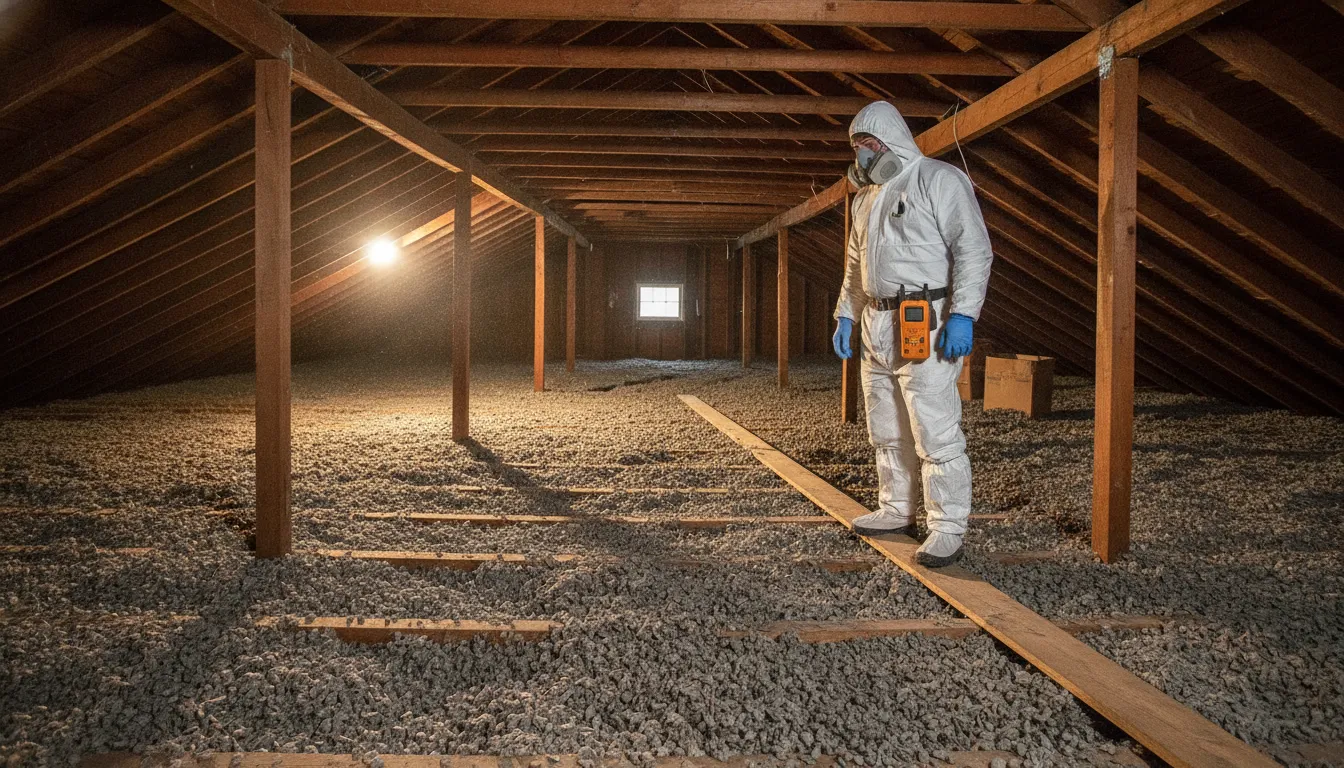
Loose, pebble-like insulation in an older North Carolina attic can look harmless. If it is vermiculite, however, its appearance cannot tell you whether asbestos is present. The safest response is to leave the material undisturbed and get qualified guidance before an attic repair, insulation project, electrical upgrade, or renovation.
Vermiculite insulation asbestos concerns deserve careful handling because some insulation associated with the former Libby, Montana mine may be contaminated. Do not rake, vacuum, scoop, or move it. A qualified asbestos professional can assess the project, explain sampling limits, and recommend management or abatement based on the material and planned work.
This guide explains what vermiculite insulation may look like, why Zonolite is a warning sign. What disturbance can do, and how North Carolina homeowners can plan the next step without relying on guesswork.
What Does Vermiculite Insulation Look Like in an Attic?
Vermiculite insulation usually appears as loose, lightweight granules or flakes between attic joists. It may be gray, tan, silver, gold, or brown, with a layered or shiny appearance. Those visual traits can suggest vermiculite, but they cannot identify asbestos or confirm where the material originated.
Vermiculite is a naturally occurring mineral that expands when heated. That process produces lightweight particles that can be used as loose-fill insulation. In an attic, the material may sit between ceiling joists, around an attic access opening, or beneath another layer of insulation. It can also collect near wiring, vents, recessed fixtures, and other building components.
Homeowners commonly describe the material as small pebbles, coarse flakes, or gray-brown granules. Some pieces have a reflective, accordion-like texture. Lighting, dust, age, and surrounding insulation can change the way it appears, so photographs and color comparisons are not reliable identification tools.
Age can provide context, but it is not proof. Vermiculite was used in many homes built or renovated before 1990. A Raleigh-area home with older attic insulation may contain vermiculite even if the product label is missing. A newer renovation may also have left older material in place beneath or beside newer insulation.
Do not disturb the material to get a closer look. Raking it aside, lifting a sample, walking through it, or using an ordinary vacuum can create dust and spread material. If you suspect vermiculite, close the attic access if practical, keep children and pets away, and tell anyone planning work that the insulation may need professional evaluation.
Vermiculite is only one possible asbestos-containing material in an older home. Other products may be present in flooring, pipe insulation, roofing materials, or heating-system components, depending on the building's age and construction history. Remtech's guide to common places to find asbestos in a home offers broader context for planning an inspection.
Why Is Zonolite Vermiculite Associated With Asbestos?
Zonolite is a brand name associated with loose-fill vermiculite insulation, not a visual asbestos test. The concern is the source of the ore used in some products. The former Libby, Montana mine supplied much of the vermiculite sold in the United States, and its ore was contaminated with asbestos.
Zonolite insulation became widely known because of its connection to vermiculite mined near Libby. The U.S. Environmental Protection Agency reports that the Libby mine supplied more than 70 percent of the vermiculite sold in the United States from 1919 to 1990. Asbestos contamination in that ore created a potential pathway for asbestos to enter insulation products made from it.
That history does not mean every product labeled Zonolite contains asbestos, and it does not mean every vermiculite product came from Libby. It does mean the product name, installation date, and location are useful information to share with an asbestos professional. The EPA advises homeowners to assume that vermiculite insulation may contain asbestos and to avoid disturbing it.
A brand label can disappear during remodeling, attic cleanup, or insulation replacement. A missing label does not make the material safe. Likewise, a label or a familiar appearance cannot establish the mine source. Only a qualified assessment and appropriate laboratory process can help determine how the material should be handled for a specific project.
For Raleigh homeowners, this distinction matters when buying a home or planning work in an older attic. A contractor who sees loose-fill insulation may need to pause before installing lighting, running cables, replacing ductwork, or adding insulation. Tell the contractor about the suspected material before anyone enters the work area or moves it.
The goal is not to create alarm. The useful fact is simple: the history of Libby-associated vermiculite makes caution appropriate, even when the insulation looks clean and intact. Careful planning prevents an avoidable disturbance and gives you a clearer basis for deciding whether the material should remain in place or be removed.
How Can Vermiculite Insulation Asbestos Exposure Occur?
Exposure can occur when suspected vermiculite insulation is moved, crushed, swept, blown, or vacuumed and contaminated dust becomes airborne. Asbestos fibers are too small to identify by sight. Leaving the insulation alone and controlling access are safer than trying to clean or investigate it yourself.
Vermiculite insulation can remain relatively low risk when it is intact and left undisturbed. Risk can change when attic activity breaks, compresses, or disperses the loose-fill material. Dust may move through gaps around attic hatches, light fixtures, wiring penetrations, or ductwork, depending on the building's construction.
Asbestos is a known human carcinogen. The CDC and Agency for Toxic Substances and Disease Registry describe health effects associated with inhaling asbestos fibers, including asbestosis, lung cancer, and mesothelioma. Health outcomes depend on factors such as the amount and duration of exposure, the type of fibers, and individual circumstances. A suspected material should therefore be managed with prevention in mind, not with a home experiment.
The CDC and ATSDR overview of asbestos exposure explains why fibers can be a concern when asbestos-containing materials are disturbed. An ordinary household vacuum is not a substitute for professional containment or HEPA-controlled work. Sweeping or blowing dust can move particles instead of removing the source.
What should homeowners avoid?
- Do not rake, shovel, scoop, or spread the insulation.
- Do not take a bulk sample without qualified direction.
- Do not vacuum it with household equipment.
- Do not walk through it to reach wiring or storage.
- Do not blow it away with compressed air.
- Do not ask an unqualified contractor to work through it.
If the insulation has already been disturbed, do not continue cleaning it. Keep people out of the area and explain what happened to the professional you contact. The right response depends on the extent of disturbance, the condition of the attic, and the planned work. One brief contact with a qualified professional can prevent a small repair from becoming a larger cleanup problem.
How Is Vermiculite Insulation Asbestos Tested?
Testing starts with a qualified professional evaluating the material and the planned work. Visual inspection alone cannot confirm asbestos. If sampling is appropriate, a trained professional should collect representative material using controlled procedures and send it to a qualified laboratory. Homeowners should not collect or mail a sample themselves.
Testing is not always as simple as sending a handful of attic granules to a laboratory. Vermiculite may be unevenly distributed, and a single small sample may not represent the entire insulation layer. Sampling can also disturb the material. The professional should consider whether sampling will change the risk and whether the project can be planned by treating the insulation as potentially contaminated.
The EPA explains that bulk samples of vermiculite insulation can be difficult to analyze with standard polarized light microscopy because of the material's characteristics. Its guidance on analyzing vermiculite insulation samples is one reason homeowners should rely on qualified professionals and appropriate laboratory methods rather than a do-it-yourself kit.
What information helps an assessment?
- The home's approximate construction and renovation dates.
- Photos of the attic taken from a safe location, without moving the material.
- Any visible product packaging or labels already present.
- The locations of planned electrical, HVAC, roofing, or insulation work.
- Whether the material has already been moved, vacuumed, or walked through.
- Any records from prior inspections, renovations, or home purchases.
A professional can use this information to explain whether the immediate priority is access control, sampling, a work plan, management in place, or removal. The answer may differ between an attic that will remain undisturbed and one that must be entered for a renovation.
Do not interpret a negative result from one limited sample as permission to disturb all attic insulation. Ask what area the sample represents, what method was used, and how the result affects the planned scope. A clear explanation is part of a responsible assessment.
Should Vermiculite Insulation Stay in Place or Be Removed?
Vermiculite insulation may be managed in place when it is intact, access can be controlled, and no work will disturb it. Removal may be considered when renovation, damage, access needs, or other conditions make disturbance likely. A qualified professional should determine the safest option for the property.
Homeowners often assume removal is automatically the best answer. In some situations, leaving undisturbed material in place with appropriate controls may reduce unnecessary handling. In other situations, renovation or building conditions may make professional removal the more practical choice. The decision should be based on the material, the space, the future work, and the controls that can be maintained.
| Management in place | Professional removal |
|---|---|
| May fit an intact attic that will not be disturbed. | May fit a project that requires access or relocation of the insulation. |
| Requires keeping people away and documenting the material for future work. | Requires a written scope, containment, work practices, and compliant disposal. |
| Can avoid unnecessary disturbance when conditions allow. | Can address material that is damaged, scattered, or in the way of planned work. |
| Does not mean the material is confirmed asbestos-free. | Should be performed by a qualified asbestos abatement contractor, not a homeowner. |
Management in place may include securing or labeling an attic access point, informing future contractors, avoiding storage in the insulation, and maintaining a record of the concern. It is not a casual decision to ignore the material. The control plan must match how the attic will be used.
Professional removal involves more than carrying insulation out of an attic. The contractor must plan access, protect adjacent areas, control dust, use appropriate equipment and work practices, package waste, and follow applicable disposal and notification requirements. The EPA's guidance for homeowners with vermiculite insulation explains why professional help is recommended when removal is necessary.
Do not compare options by price alone. Ask what each proposal includes, who will perform the work, how the work area will be controlled, how waste will be handled, and what documentation you will receive. Project scope is specific to the property, so a responsible contractor should explain the assumptions behind the recommendation rather than promise a standard package.
What Do North Carolina Homeowners Need to Know Before Renovating?
Before renovation or demolition in North Carolina, homeowners should determine whether asbestos-containing materials may be affected and use appropriately accredited professionals. Regulated asbestos projects can involve state notification, permits, work-practice, and disposal requirements. Confirm the current requirements for your project before work begins.
North Carolina homeowners should not assume that a small attic project is exempt from asbestos planning. The requirements depend on the type of work, the material, the quantity, the building, and the agency rules that apply. Renovation, demolition, insulation replacement, electrical work, and HVAC work can all create different questions.
The North Carolina Department of Health and Human Services provides current asbestos rules and program information. Its North Carolina asbestos rules page is a better starting point than an old checklist or an assumption based on a neighbor's project.
Questions to resolve before work starts
- Will anyone need to enter or move through the attic?
- Will the work disturb, remove, or cover the insulation?
- Does the building type or project scope require an accredited inspection?
- Are state notification or permit requirements triggered?
- Who is responsible for containment, cleanup, packaging, and disposal?
- What documentation will be provided after the work?
For covered renovation or demolition activities, North Carolina guidance may require advance notification and other project controls. A professional can help identify the applicable process and sequence the work so that the renovation contractor does not begin before the environmental questions are resolved.
Rules and agency guidance can change. Use the state's current materials and ask the contractor to identify which requirements apply. Avoid relying on a generic statement that a project is too small to matter. The safest plan is based on the actual building and scope.
How Should Raleigh Homeowners Handle Vermiculite Insulation Asbestos Concerns?
Raleigh homeowners should leave suspected vermiculite insulation alone, restrict unnecessary attic access, gather property and renovation details, and request an assessment from a qualified asbestos professional. The professional can explain whether testing, management in place, or abatement is appropriate for the home's condition and planned work.
The next step does not have to be dramatic. Start by stopping activity around the insulation. Tell family members, contractors, inspectors, and anyone scheduling attic work that the material is suspected vermiculite and should not be disturbed until evaluated.
Choose a contractor who can explain the assessment and work process in plain language. Ask about asbestos credentials, project experience, containment, worker protection, disposal, notifications, and closeout documentation. A trustworthy professional should be willing to explain what is known, what is uncertain, and why a recommendation fits the property.
Remtech Environmental takes an education-first approach to environmental remediation in North Carolina. The company supports homeowners, property managers, and commercial clients with professional guidance for asbestos concerns. Its team includes EPA-accredited specialists and IICRC-certified technicians, with an emphasis on doing the right work the right way.
If you are preparing to renovate an older Raleigh-area home, do not wait until the contractor is standing in the attic. Early planning gives you time to understand the material, coordinate the project, and avoid unnecessary disturbance. You can also review Remtech's asbestos services in Raleigh for additional information about professional support.
- Stop disturbing the insulation and limit attic access.
- Record the home's age, planned work, and any known disturbance.
- Ask a qualified asbestos professional whether assessment or sampling is appropriate.
- Review management and professional-abatement options for the actual project.
- Confirm North Carolina requirements before renovation or demolition begins.
Frequently Asked Questions
Does all vermiculite insulation contain asbestos?
No. Not all vermiculite contains asbestos, but some vermiculite associated with the former Libby, Montana mine may be contaminated. Because appearance cannot establish the source or content, the EPA advises homeowners to avoid disturbing vermiculite insulation and seek qualified guidance before attic work.
Can I remove vermiculite insulation myself?
Homeowners should not remove suspected vermiculite insulation themselves. Raking, scooping, vacuuming, or carrying the material can create dust and spread contamination. A qualified asbestos professional can evaluate the space, plan controls, and determine whether management in place or professional abatement is appropriate.
Is Zonolite proof that asbestos is present?
No. Zonolite is a brand associated with loose-fill vermiculite, but a product name alone is not an asbestos test. Its connection to Libby, Montana is an important reason for caution. Share any label or installation information with a qualified professional and do not disturb the insulation to investigate it.
Should vermiculite insulation be tested before a renovation?
A qualified professional should determine whether sampling is appropriate and what assessment the renovation requires. Vermiculite can be difficult to analyze, and a limited sample may not represent the whole attic. Planning should account for the material and project scope before anyone moves or works through the insulation.
What should I do if vermiculite insulation was already disturbed?
Stop the activity and keep people out of the area until a qualified professional provides direction. Do not sweep or use a household vacuum. Tell the professional what happened, where the material was moved, and whether dust or debris entered other areas. The response depends on the extent of disturbance and the property.
Get Professional Guidance Before Attic Work
Suspected vermiculite insulation is a reason to pause, not panic. Leave it undisturbed, document what you know, and get a professional assessment before renovation or attic maintenance. Remtech Environmental can explain the questions to ask and the options available for your Raleigh-area property.