
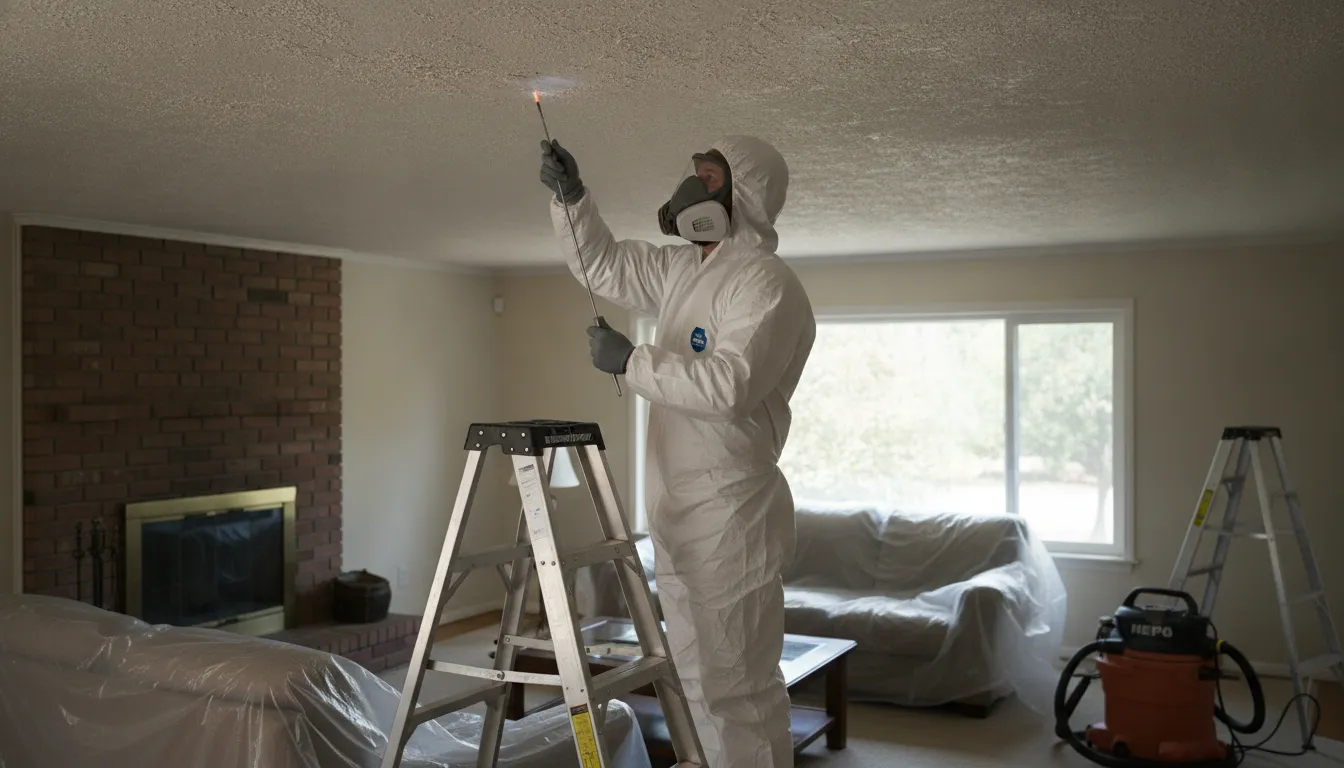
Popcorn ceilings can look like a dated design detail, but older spray-applied textures deserve care before you scrape, drill, sand, or renovate. In North Carolina homes, age can raise a reasonable question, yet appearance alone cannot confirm whether ceiling texture contains asbestos.
For asbestos popcorn ceilings Raleigh NC homeowners should not rely on a visual inspection or a DIY test. An accredited professional can collect a bulk sample for qualified laboratory analysis, then explain whether leaving the material in place. Encapsulating it, or arranging licensed removal fits the ceiling's condition and your renovation plans.
A ceiling that is intact and undisturbed may present little day-to-day concern, while scraping or sanding can release fibers into the air. Understanding when these textures were common and what signs matter helps you make a measured decision before work begins.
Schedule a free asbestos popcorn ceiling consultation in Raleigh NC
What Are Asbestos Popcorn Ceilings and When Were They Common?
Popcorn ceilings, also called acoustical or textured ceilings, have a rough, cottage-cheese-like finish. Contractors commonly applied this texture by spraying it onto drywall or plaster. The material helped hide minor imperfections and could soften sound, which made it a familiar feature in many homes.
Some popcorn ceiling products contained asbestos, a naturally occurring mineral once used in building materials for its strength and heat resistance. The texture was widely spray-applied from the 1950s through the 1980s. As a result, homes built or finished before 1980 deserve particular care when a renovation may disturb the ceiling. Age is a useful reason to investigate, but it is not proof that asbestos is present.
You cannot reliably identify asbestos by looking at a ceiling. Color, texture, age, and visible condition do not provide a definitive answer. Confirmation requires a bulk sample collected by an accredited professional and analyzed by a qualified laboratory. If you are researching other possible sources in an older home, review this guide to where asbestos is found in homes.
Condition also matters. Asbestos is hazardous when fibers become airborne. An intact, undisturbed popcorn ceiling generally presents low day-to-day risk, so homeowners do not need to panic when they discover textured ceilings. The greater concern is activity that breaks up the material, such as scraping, sanding, drilling, cutting, or removing fixtures through it.
If the ceiling is peeling, crumbling, water-damaged, or scheduled for renovation, avoid disturbing it until it has been assessed. A professional can help determine whether testing is appropriate and explain the next step based on the results. That may involve leaving an intact ceiling alone, managing it in place, or planning licensed abatement before remodeling.
How Do I Know if My Popcorn Ceiling Contains Asbestos in Raleigh NC?
You cannot reliably identify asbestos in a popcorn ceiling by looking at its color, texture, age, or pattern. Asbestos-containing and asbestos-free ceiling materials can look alike. The only dependable answer comes from having a qualified professional collect a bulk sample and send it to a qualified laboratory for analysis. If you are researching asbestos popcorn ceilings Raleigh NC homeowners may encounter, treat visual inspection as a reason to ask questions, not as a test result.
Why the age of the home matters
Popcorn and other acoustical ceiling textures were widely spray-applied from the 1950s through the 1980s. A home built or finished before 1980 deserves particular care before a ceiling is scraped, sanded, drilled, or otherwise disturbed. Age does not prove that asbestos is present, and a newer-looking renovation does not prove that it is absent. Materials may have been installed during a remodel, so the construction and finishing history can help determine whether testing is appropriate.
Test before renovation work begins
Renovation is the point at which an undisturbed ceiling can become a concern. Scraping, sanding, drilling, cutting, or removing the texture can release asbestos fibers into the air if the material contains asbestos. The EPA recommends sampling materials before renovation when the work could disturb them. Testing the ceiling material itself is more useful for this decision than general air sampling. Bulk material sampling, followed by laboratory analysis, determines whether asbestos is present.
That does not mean every intact popcorn ceiling creates an immediate household emergency. Asbestos fibers become a hazard when they become airborne, and a ceiling in good condition that remains undisturbed generally presents low day-to-day risk. Avoid probing or collecting a do-it-yourself sample, especially if the surface is damaged, crumbling, or already shedding material. A professional can help determine the safest next step. For more preparation guidance, read our how to test for asbestos safely article.
The next section explains what professional sampling involves, including how a sample is collected and what happens while you wait for the laboratory results.
How Asbestos Popcorn Ceiling Testing Works
Testing should happen before scraping, sanding, drilling, painting, or other work that could disturb a popcorn ceiling. Because asbestos-containing material cannot be identified reliably by appearance. The dependable approach is to collect a small piece of the ceiling texture and have it analyzed by a qualified laboratory. The U.S. Environmental Protection Agency recommends sampling materials before renovation when the work could disturb them. Learn more about EPA guidance for asbestos and home remodeling.
1. An accredited professional assesses the ceiling
An accredited asbestos inspector first considers the ceiling's condition, the planned renovation, and areas where the texture may differ. The inspector uses controlled methods to limit debris and collects a representative bulk sample. This is not a do-it-yourself test. Cutting into the texture without proper precautions can create the very disturbance testing is intended to prevent.
2. The laboratory analyzes the bulk sample
A qualified laboratory examines the material using polarized light microscopy, commonly called PLM. This bulk-material analysis is designed to determine whether asbestos is present in the ceiling texture. The report may identify the material as asbestos-containing or not asbestos-containing, along with the laboratory's findings. Your inspector can explain what the result means for the specific project you are planning.
3. Air monitoring is a different type of test
Air monitoring can assess occupational exposure during certain work activities, but it is not the test for deciding whether a popcorn ceiling contains asbestos. A room's air sample may not capture asbestos in an intact ceiling. For that question, bulk sampling of the ceiling material is the appropriate starting point.
4. Wait for the results before disturbing the texture
Keep the ceiling undisturbed until the laboratory report is available. If asbestos is detected, the next step depends on the material's condition and your plans. An intact ceiling may be managed in place, while damaged material or a renovation that will disturb it may require professional abatement. Testing first gives you a clear basis for choosing the safest, most practical path.
Asbestos Popcorn Ceiling Encapsulation vs. Removal: Which Is Right for You?
Once testing confirms asbestos in a popcorn ceiling, the safest choice depends on the ceiling's condition and your plans for the room. Encapsulation manages intact material in place. Removal, also called abatement, takes the material out under controlled conditions. Neither option should be selected by appearance alone or treated as a do-it-yourself project.
| Consideration | Encapsulation | Removal or abatement |
|---|---|---|
| Materials suited | Intact, firmly bonded popcorn that is not being disturbed. | Damaged, friable, loose, or deteriorating material, or material that must be disturbed. |
| Main cost driver | Surface preparation, sealant selection, ceiling condition, and project size. | Containment, labor, disposal, clearance requirements, ceiling condition, and project size. |
| Risk management | Seals the surface and limits disturbance when installed correctly by qualified professionals. | Removes the source, but requires careful containment, worker protection, cleanup, and disposal. |
| When to choose | When the ceiling is stable and you plan to leave the texture in place. | Before scraping, sanding, drilling, major renovation, or when the texture is damaged or friable. |
| Future renovation | May make later wet-removal harder because sealed popcorn will not absorb water. | Creates a clean starting point for planned ceiling work after the abatement process is complete. |
Encapsulation typically uses a latex primer, sealant, or specialty encapsulant. It can be a practical management strategy when the ceiling is in good condition and there is no near-term renovation plan. However, painting over the texture is not a substitute for testing, and it can complicate future removal. Guidance from Puget Sound Clean Air Agency notes that sealed popcorn may not absorb water during later wet-removal.
Removal is generally the better path when a remodel will disturb the ceiling, or when damage has made the material friable. In Raleigh and throughout North Carolina, use properly licensed asbestos abatement professionals for this work. A consultation can account for the test results, ceiling condition, renovation schedule, and project requirements without relying on a fixed price.
What You Should Know About NC Compliance and Asbestos Disposal
Safe asbestos work involves more than removing textured material from a ceiling. In North Carolina, licensing, worker training, project controls, and disposal requirements help protect occupants, workers, and future property owners. These safeguards matter whenever popcorn ceiling material may be disturbed during renovation.
North Carolina licensing and worker protections
North Carolina administers asbestos licensing through the North Carolina Department of Health and Human Services (NCDHHS). Abatement firms and workers must have the appropriate accreditation and training, including requirements based on the EPA's AHERA and TSCA programs. Hiring a properly licensed team gives a homeowner a clearer way to verify that the work is being planned and performed by qualified professionals.
Worker protection also follows OSHA requirements. Depending on the work, this includes respiratory protection under 29 CFR 1910.134, HAZWOPER provisions under 29 CFR 1910.120, and the asbestos construction standard under 29 CFR 1926.1101. The asbestos permissible exposure limit is 0.1 fibers per cubic centimeter of air. These rules address containment, protective equipment, exposure control, and safe work practices rather than relying on ordinary dust-control methods.
Notifications and approved disposal
Larger renovation or demolition projects may require advance notification, including a 10-day notice, before work begins. Asbestos waste must also be packaged, handled, transported, and disposed of through an approved licensed landfill. It should never be placed in household trash, left on-site, or taken to an ordinary construction dumpster.
Compliance protects more than the immediate work area. Incomplete records, improper waste handling, or unlicensed removal can create safety concerns and liability for a homeowner, contractor, or property manager. For a clearer explanation of the options and responsibilities involved, read our guide to asbestos abatement vs. removal. A qualified professional can review the ceiling's condition, the planned renovation, and the property's requirements before recommending the appropriate path.
Choosing Certified Asbestos Popcorn Ceiling Abatement in the Raleigh Area
Once testing confirms asbestos in a popcorn ceiling, the next decision is choosing a provider that can explain your options and manage the work responsibly. Look for a company with the right credentials, relevant experience, and a process that fits the condition of your ceiling and your renovation plans. The lowest quote is not necessarily the best value if it leaves questions about containment, worker protection, disposal, or documentation.
Verify training, licensing, and insurance
Ask whether the company and workers are properly trained and accredited for asbestos work in North Carolina. A qualified provider should be able to explain how it follows applicable North Carolina requirements, EPA-based training standards, and OSHA protections. It should also carry comprehensive insurance appropriate for environmental work, including general liability, workers' compensation, and environmental pollution liability.
Remtech Environmental has served North Carolina for more than 25 years. Its team includes EPA-accredited specialists and IICRC-certified technicians, with procedures aligned with OSHA requirements. That experience matters because popcorn ceiling abatement involves more than removing visible texture. The work should account for preparation, controlled disturbance, cleanup, waste handling, and communication throughout the project.
Choose clear guidance over pressure
A trustworthy provider will not assume removal is necessary without considering the ceiling's condition and your plans. If the material is intact and will remain undisturbed, encapsulation may be a reasonable management option. If you plan to scrape, drill, remodel, or address damaged material, professional abatement may be more appropriate. Your provider should explain these distinctions in plain language, identify what is known and what still needs confirmation, and describe project-specific pricing rather than promise a standard rate.
For specialized help, review Remtech's asbestos popcorn ceiling removal services in Raleigh. You can also learn more about asbestos removal and abatement in Raleigh. The goal is not to create alarm. It is to make an informed decision and do the right work the right way.
Get a free quote for asbestos popcorn ceiling testing and abatement in Raleigh NC
Frequently Asked Questions
Can I tell whether a popcorn ceiling contains asbestos by looking at it?
No. The texture, color, and age of a ceiling cannot confirm its contents. An accredited inspector should collect a bulk sample, and a qualified laboratory should analyze it before renovation or disturbance.
Should I test the ceiling before painting or remodeling?
Yes. Drilling, scraping, sanding, or otherwise disturbing a textured ceiling can release asbestos fibers if the material contains asbestos. Testing first gives you information to plan the work safely and decide whether the ceiling should remain intact, be encapsulated, or be professionally removed.
Is encapsulation better than removal for an asbestos popcorn ceiling?
It depends on the ceiling's condition and your project plans. Intact material may be a candidate for encapsulation with a compatible sealant. Damaged material, planned ceiling work, or a renovation that requires disturbance may call for professional abatement instead. Painting can also make later wet removal more difficult, so discuss the sequence before applying coatings.
How much does asbestos popcorn ceiling testing or removal cost in Raleigh?
There is no responsible one-size-fits-all price. The estimate depends on factors such as the area involved, ceiling height, site conditions, test results, and the selected approach. A project-specific consultation is the best way to understand the scope and expected cost before work begins.
Ready to Plan Your Next Step
If you are considering renovation or want clearer answers about a popcorn ceiling, book a consultation to review testing and abatement options for your Raleigh home. Remtech Environmental can explain the process without pressure and help you decide what comes next.
Get a free quote for professional asbestos popcorn ceiling testing and abatement