
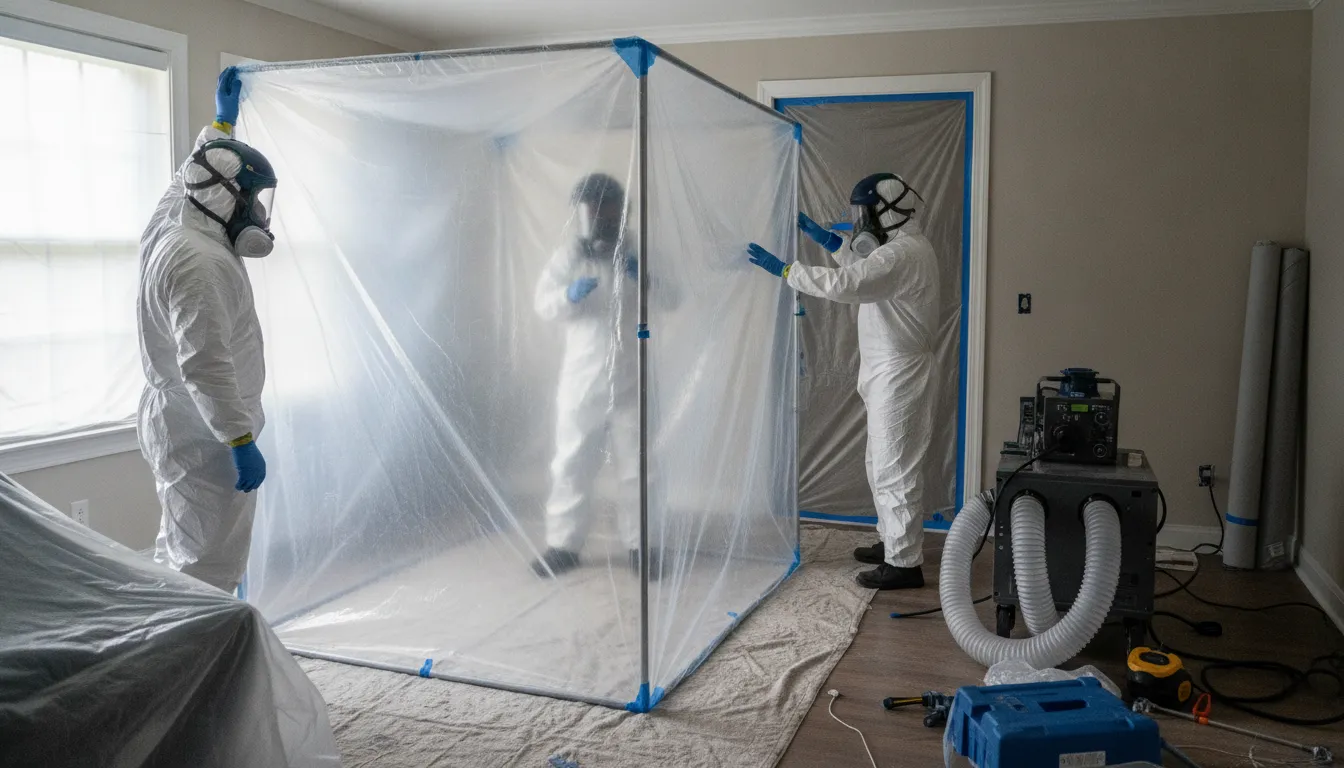
Asbestos work in an occupied home, office, or shared building requires more than covering furniture and closing a door. The work area, building systems, schedule, and occupant movement all need to be considered before materials are disturbed. A well-planned approach helps limit the chance that fibers move beyond the work zone while allowing property owners and managers to make informed decisions about access and timing.
Asbestos containment procedures are the project-specific controls used to isolate work, manage access, protect building systems, and reduce the potential spread of asbestos fibers. EPA recommends job-site controls for work that could disturb asbestos-containing material, with the nature and extent of those controls reflecting the likelihood of disturbance and fiber release: EPA job-site controls guidance.
The right setup depends on the material, the planned task, the property layout, and the people who need to remain nearby. Here is how professionals evaluate those factors and build a containment plan for North Carolina properties.
What Are Asbestos Containment Procedures?
Asbestos containment procedures are the planned controls used to keep asbestos-containing material and potential dust within a defined work area while the work is performed. The goal is not simply to cover a surface. A qualified team evaluates the material, the planned activity, the surrounding building, and the people who may be nearby, then selects controls that fit the project.
For an occupied home, office, school, or commercial property, containment can help separate the work from normal activities and reduce the chance that fibers move into adjoining spaces. The setup may involve physical barriers, controlled entry, protection of floors and surfaces, ventilation decisions, cleaning methods, and a defined sequence for removing waste. The specific combination depends on the likelihood of disturbance and fiber release, as the EPA's safe-work guidance explains.
Containment is a control system, not a single plastic barrier
Plastic sheeting may be visible, but it is only one part of a coordinated system. Depending on the scope, a project may use a full enclosure, a smaller mini-enclosure, or other localized controls. Workers may also limit access, adjust scheduling, protect openings, and assess whether heating, ventilation, and air-conditioning systems need to be isolated or modified. These decisions should be made from the work plan and site conditions rather than copied from another project.
EPA guidance describes job-site controls as part of an operations and maintenance approach for work that could disturb asbestos-containing material. In practical terms, that means planning how the material will be handled. The plan should also explain how occupants will be kept out of the work zone and how the area will be cleaned and evaluated afterward. The controls should be proportionate to the task, not presented as one universal checklist for every property.
Readers who want the broader sequence can review how asbestos abatement works. This article focuses more narrowly on how containment decisions support occupied-property protection. For North Carolina projects, trained professionals can also help interpret the applicable requirements and explain which controls are appropriate for the material and scope.
How Is an Occupied Property Assessed Before Work?
Before work begins, the assessment should connect the planned task with the materials, spaces, and people that could be affected. The goal is not to apply the same asbestos containment procedures to every project. Controls should reflect the work scope, the condition and location of suspected asbestos-containing material (ACM), the likelihood of disturbance, and the possibility of fiber release.
A practical review starts with available written records, building plans and specifications, and prior ACM inspection reports. These documents can help identify whether ACM is present near the planned work. Records may not answer every question, especially in older or altered buildings. The assessment should also consider what the crew will open, remove, drill, cut, or otherwise disturb.
What should the planning conversation cover?
For organized maintenance programs, the EPA describes a work-request process that records the location, timing, and type of work, along with available information about nearby ACM. It also identifies the contractor or other person authorized to perform the work. A building owner may use forms or a work permit system to create a clear record. The exact paperwork is a planning practice, not automatically a universal legal requirement for every property or task.
If ACM is present but is not expected to be disturbed, the plan should note its location and clearly instruct workers not to disturb it. If ACM is present and likely to be disturbed, EPA guidance calls for a qualified supervisor, someone qualified by training or experience, to visit the site and determine work practices intended to minimize fiber release. That determination should be documented in an authorization record before work proceeds.
The assessment should also define the work area, nearby occupied spaces, access boundaries, scheduling needs, and any coordination required with the property owner or occupants. For a project in Raleigh, Durham, or elsewhere in North Carolina, the applicable requirements can vary by project and jurisdiction. A qualified professional should confirm the current rules rather than treating a general checklist as a complete compliance determination. EPA's job-site control guidance explains the records, authorization, and supervision concepts behind this planning process.
How Do Professionals Separate the Work Area From Occupants?
Professional containment creates a planned boundary between asbestos-related work and the people who live, work, or move through the property. The setup is not identical for every project. It depends on the material, the task, the condition of the area, and how likely the work is to disturb asbestos-containing material.
What changes in a home, business, or shared building?
For a limited task with possible accidental disturbance, the controls may include drop cloths or a mini-enclosure around the immediate work area. For work where disturbance is intended or likely, EPA guidance describes area containment as a more deliberate control. That may involve enclosing the work zone, limiting openings, and establishing a clear separation from adjacent rooms. These measures are selected for the scope rather than applied as a universal checklist. EPA's safe-work-practice summary describes how controls change with the type of activity.
Access control is part of that separation. Doors, signs, barriers, or a designated entry route can help keep occupants and unprotected workers out of the work area. Depending on the task, special scheduling may be appropriate so work occurs when fewer people are present. In a home, that might mean coordinating around family routines. In a business or shared building, the plan may need to account for employees, customers, residents, deliveries, and emergency paths.
HVAC decisions also require project-specific judgment. EPA's summary indicates that an HVAC system may need modification for possible accidental disturbance and shutdown for intended or likely disturbance. The appropriate choice depends on the work area and the building's layout. A contractor should assess whether air movement could connect the work zone to occupied spaces, then document the control plan before work begins.
Good containment also includes communication. Occupants should know which areas are restricted, when access will change, and whom to contact with questions. A clear plan reduces accidental entry and helps the crew maintain the boundary throughout the project. For a visual overview of the broader workflow, see these asbestos removal process steps, while keeping in mind that occupied-property controls are tailored to each site.
| Project consideration | Example controls |
|---|---|
| Work scope and disturbance | Localized controls, a mini-enclosure, or a larger contained area. |
| People and traffic | Restricted access, designated routes, and special scheduling. |
| Building air systems | HVAC modification or isolation when appropriate. |
| Property layout | Barriers, protected surfaces, openings, and communication. |
What Controls Limit Fiber Movement During Removal?
Containment works best when several controls operate together. The exact setup depends on the material, the work area, the removal method, and the requirements that apply to the project. For relevant Class I work, OSHA Appendix F lists wet methods, HEPA vacuums, and immediate bagging of waste among its general provisions. These are regulatory provisions for the work covered by that standard, not a universal checklist for every asbestos project.
Wet methods help keep material damp during disturbance, reducing the chance that fibers become airborne. HEPA vacuums are used to collect fine particles without simply redistributing them through the area. Crews may also install critical barriers over openings and isolate HVAC systems when those controls apply to the scope. Impermeable dropcloths protect floors and surfaces, while objects inside the regulated area may need to be covered. OSHA identifies these measures among the listed provisions for relevant Class I work.
Why cleanup is part of containment
Containment does not end when the material is removed. Waste should be packaged and bagged promptly within the controlled work process, rather than carried uncovered through occupied portions of a property. Workers also follow a planned exit sequence, which can include decontamination steps and cleaning tools, protective equipment, and surfaces before leaving the work area. Remtech describes area preparation, worker protection and decontamination, wet removal methods, and contained waste handling as parts of its asbestos operations. The specific steps still depend on the project.
Sequencing matters because each stage supports the next. A typical planning sequence may include:
- Prepare and isolate the work area before disturbance.
- Keep materials controlled during removal and package waste within the planned work process.
- Clean as work progresses and complete the agreed inspection or clearance steps.
- Document the result before dismantling controls and returning the area to ordinary use.
This approach helps prevent clean areas, walkways, and vehicles from becoming part of the work path. Final inspection or air-clearance testing may also be appropriate when required by the project, client, or applicable rules. Those checks should be explained in advance instead of assumed to be identical for every property.
For a Raleigh home, business, or managed facility, a qualified supervisor should match these controls to the work and document the plan. That is more reliable than treating one barrier, one vacuum, or one cleanup step as sufficient on its own.
How Does Negative Pressure Work in a Containment Enclosure?
Negative pressure means the air pressure inside a containment enclosure is kept slightly lower than the pressure outside it. With that pressure difference, air should move into the enclosure rather than carrying dust or fibers outward through small gaps. A properly configured system typically uses filtered exhaust equipment to maintain airflow in the intended direction while workers perform the controlled task.
The exact setup depends on the work, enclosure, building, and applicable requirements. OSHA Appendix F describes criteria and procedures for negative-pressure enclosures when they are used as an allowable control method for relevant Class I asbestos work. It does not make one enclosure design or one pressure reading universal for every asbestos project. The appendix also distinguishes mandatory criteria from additional guidance, so the project team must evaluate which provisions apply to the specific scope. Read OSHA Appendix F.
What does a pressure reading tell the crew?
A pressure reading gives the crew evidence about whether the enclosure is maintaining the intended pressure difference. For relevant Class I work using this control method, OSHA Appendix F lists maintaining -0.02 inches water gauge within the enclosure and using manometric measurements. That figure should be understood as an OSHA Appendix F provision for the applicable work, not as a blanket requirement for every containment enclosure.
Monitoring pressure is only one part of the check. The same OSHA provisions address air movement away from employees performing removal work. Crew members can also use smoke testing, or an equivalent method, to look for leaks and confirm the direction of air movement. If smoke reveals air escaping through a seam, opening, or other weak point, the enclosure and equipment need attention before work continues.
Negative pressure works alongside other controls rather than replacing them. Depending on the scope, the plan may also address critical barriers over openings, HVAC isolation, impermeable dropcloths, wet methods, HEPA vacuuming, and immediate waste bagging. A qualified team documents the controls that fit the project and checks them as conditions change.
How Do Projects Stay Safe While Occupants Remain on Site?
Occupants may be able to remain in part of a property during asbestos work, but that decision is project-specific. The material involved, the work area, the expected disturbance, the building layout, and the controls that can be maintained all matter. A clear plan should explain which spaces are available, which areas are restricted, when work will occur, and how changes will be communicated.
Can occupants stay during asbestos work?
Sometimes, but staying on site is not automatically appropriate. EPA guidance indicates that work beyond maintenance or small-scale, short-duration activities should be performed by specially trained and accredited asbestos professionals. The level of supervision and control should reflect the likelihood that asbestos-containing material will be disturbed and fibers released.
Scheduling is one practical way to reduce contact between occupants and the work. A crew may coordinate disruptive activities for times when fewer people are present, while property managers provide advance notice about restricted entrances, noise, access changes, and expected work periods. In a home, this may mean keeping residents away from a room or floor. In a business or shared building, it may require coordination with tenants, staff, visitors, and building operations.
Physical boundaries should be treated as meaningful no-entry areas, not suggestions. Doors, barriers, signs, and designated paths can help separate occupants from the regulated work space. Depending on the task, the plan may also address nearby air-handling systems and whether they need modification or shutdown. EPA's summary associates possible accidental disturbance with special scheduling or access control, initial supervision, and controls selected for the specific activity.
Supervision continues after setup. EPA recommends that a qualified supervisor visit when work begins if contact with asbestos-containing material is likely. For lengthy jobs where disturbance is intended or likely, periodic inspections are recommended for the duration of the project. These checks help confirm that the work practices, boundaries, and communication plan remain appropriate as conditions change.
Temporary relocation may be the better choice when work affects essential living or operating areas, safe separation cannot be maintained, or the project scope makes occupant traffic difficult to control. That decision should be explained before work starts, rather than left to occupants to judge on their own. Remtech provides professional asbestos removal in Raleigh for residential and commercial properties, with project-specific planning and trained specialists.
What Happens After Containment Is Removed?
Removing the enclosure is not the same as declaring the project finished. The closeout work should reflect the material, work area, removal method, and applicable project requirements. A professional team typically completes a careful cleanup, checks the area, and explains what has been verified before normal use resumes.
Cleanup may include removing remaining debris, wiping surfaces, and using appropriate HEPA-equipped equipment where the scope calls for it. Final air-clearance testing is not a universal requirement for every asbestos job. The project plan should identify whether visual inspection, air testing, or another form of verification applies.
Until the agreed inspection or clearance process is complete, occupants should continue to respect the work-area boundaries. Reoccupancy decisions depend on the findings and the project's requirements, not simply on whether plastic barriers and equipment have been taken down. If additional cleaning or corrective work is identified, that work should be completed before the area is returned to ordinary use.
What should the closeout conversation include?
Ask the project representative to explain what work was completed, what areas were inspected, whether clearance or testing was performed, and what the results mean. Owners should also understand any remaining restrictions, materials that were left in place, and recommendations for future maintenance or renovation. These questions are especially useful when several parties, such as a homeowner, property manager, contractor, or tenant, will rely on the records.
Documentation is part of responsible closeout. EPA recommends placing the request and authorization forms in a permanent file, and filing the completed evaluation of work affecting asbestos-containing materials in the building's permanent asbestos file: EPA job-site control guidance. Keep project records with the property documents so future work can be planned with better information. For property owners arranging professional work, Raleigh asbestos abatement services can include project-specific planning and closeout discussions.
Frequently Asked Questions
How long do asbestos containment procedures take?
There is no universal timeline. Duration depends on the material, work area, containment design, amount of preparation, required removal, cleanup, inspections, and any applicable clearance process. A professional assessment should account for the property's layout and whether occupants or nearby operations must be accommodated. Ask for a project-specific schedule rather than relying on a standard number of days.
Can occupants stay in the property during asbestos work?
Sometimes, but only when the work plan supports it. Professionals may use restricted access, special scheduling, barriers, or HVAC changes based on the task and its likelihood of disturbing asbestos-containing material. EPA guidance identifies access control and scheduling as possible measures for work that could disturb these materials: EPA safe work practices. The crew should define no-entry areas and explain when temporary relocation is more appropriate.
What does negative pressure do in a containment enclosure?
Negative pressure helps direct airflow into the enclosure instead of allowing air to move outward. When a negative-pressure enclosure is an allowable control method for relevant Class I work, OSHA Appendix F describes monitoring, airflow, and leak-detection provisions, including smoke testing or an equivalent method: OSHA Appendix F. The exact controls depend on the project and applicable requirements.
Is air-clearance testing required after every asbestos project?
Not necessarily. Whether clearance testing applies depends on the project scope, materials, work practices, and applicable requirements. Your contractor should explain the closeout inspection, documentation, and reoccupancy criteria before work begins.
Talk With a Professional About Asbestos Containment
Every asbestos project has its own materials, layout, schedule, and occupancy concerns. A conversation with a qualified professional can help you understand what assessment and containment controls fit the property before work begins.